Chair of King Charles execution judge to be sold

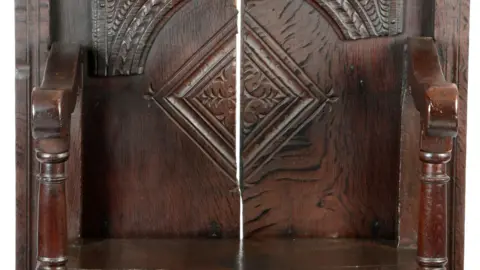 Woolley & Wallis
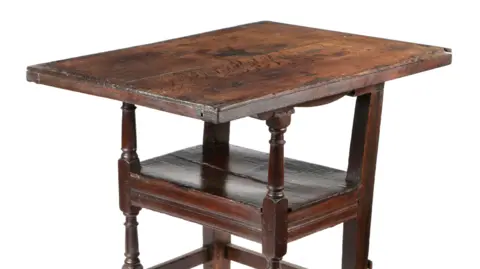
A rare oak chair that once belonged to the man who sentenced King Charles I to death is to be sold at auction.
Charles was found guilty of treason by judge John Bradshaw, who sentenced the monarch to death at a trial at Westminster Hall in January 1649, at the end of the English Civil War.
In finding the King guilty, Bradshaw changed the course of British constitutional history, as it was the first time the monarch had been held to account by a court acting in the name of Parliament.
The chair is up for auction at Woolley & Wallis in Salisbury, Wiltshire, on Tuesday, and is expected to be sold for between £1,500 and £2,500.
The inscription on the underside reads: "This chair belonged to John Bradshawe of Bradshawe Hall Derby SH presiding judge of the trial of King Charles I."
 Woolley & Wallis
Bradshaw died in October 1659, but it was the Royalists who had the final say.
Following the restoration of King Charles II in 1660, Bradshaw was declared a regicide and had his body dug up alongside fellow regicides Oliver Cromwell and Henry Ireton.
His body was then hung from gallows, beheaded and his head placed on a spike before reburial.
Furniture specialist Mark Yuan Richards commented: "This is a powerful survival from one of the most turbulent moments in British history. Table chairs are rare in themselves, but one with a direct and explicit association to John Bradshaw is exceptional.
"Objects like this bring history off the page and into the room."
Follow BBC Wiltshire on Facebook, X and Instagram. Send your story ideas to us on email or via WhatsApp on 0800 313 4630.
