Everything you need to know about wassailing

 Barley Wood Cider
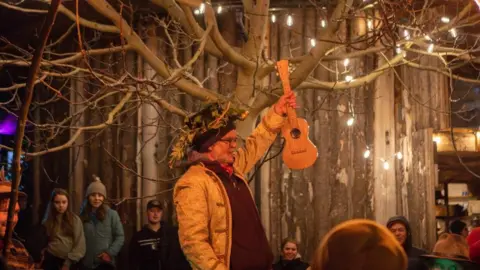
As we leave Christmas behind, some people are celebrating the folk tradition of wassailing.
Rooted in paganism, the festivity sees groups gathering at farms and orchards with the aim of encouraging a good harvest.
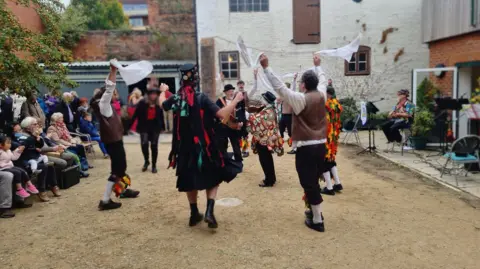
Involving cider, toast, fire and dancing - it is a unique celebration which can be quite the spectacle.
So what does it all mean - and where can you celebrate it? Here is everything you need to know about wassailing.
What is wassailing?
Wassailing is a collection of folk traditions to bring communities together and encourage a good harvest.
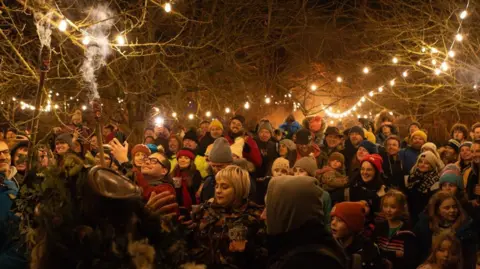
Ceremonies typically see cider poured onto the roots of apple trees and toast placed in branches as offerings.
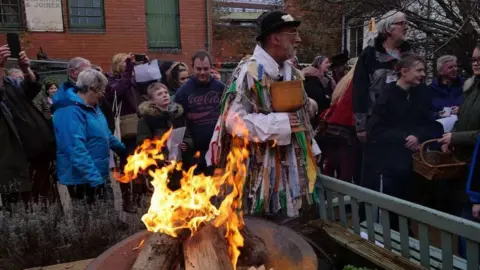
A fire is lit to represent the return of the sun after winter.
Barley Wood Cider owner and director, Joel Jenkins, said he thought the tradition worked as he saw a "bumper crop this year" following the wassail in 2025.
"We've had an unbelievable amount of fruit, too much," he added.
The meaning of wassailing
 Barley Wood Cider
The word wassail is derived from the Anglo-Saxon "wes hal" meaning "be whole", or "good health".
The words were used to drink to the health or success of someone and to make a toast.
When is wassailing celebrated?
 The Folk of Gloucester
Wassailing traditionally took place on the Twelfth Night after Christmas but dates for the celebration are now more flexible, with ceremonies taking place throughout January.
Jenkins said wassailing came at a valuable time of year to help people connect in "the dark of winter".
"Keeping up a tradition that's incredibly old - we feel very responsible as the stewards of doing this," he added.
The history of wassailing
 The Folk of Gloucester
The tradition's roots date back to the 8th Century, according to the National Association of Cider Makers.
At this time, rural communities had little knowledge of weather systems or climate patterns.
Instead, their approach to ensuring a bountiful autumn harvest was to appeal to the apple gods and goddesses.
They hoped to ward off evil spirits from the orchards and attract benevolent insects and birds to the trees.
Wassail 2026 events near you
Bristol
- Barley Wood, 23-24 January
- Horfield Organic Community Orchard, 17 January
- Magpie Bottom Nature Reserve, 17 January
- Got Greens Farm, 24 January
Gloucestershire
- The Folk of Gloucester, 17 January
- Got Greens Farm, 24 January
- Oakbrook Community Farm, 25 January
Somerset
- Tyntesfield, 18 January
- Sheppy's Cider, 23 January
- Midsomer Norton Town, 31 January
- The Community Farm, 31 January
Wiltshire
- TWIGS Community Gardens, 10 January
Follow BBC West social channels in Bristol, Gloucestershire, Somerset and Wiltshire. Send your story ideas to us on email or via WhatsApp on 0800 313 4630.
