Port Talbot to become offshore wind hub for Celtic Sea

 Reuters
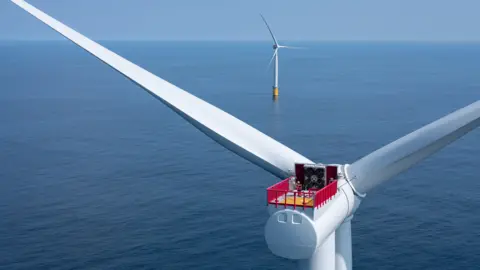
Port Talbot will become the first dedicated hub for floating offshore wind in the Celtic Sea.
Associated British Ports (ABP) will begin detailed design and engineering work on new port infrastructure after securing grant funding of up to £64m from the UK government.
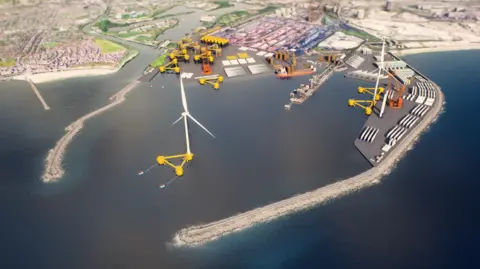
The project will support the assembly and deployment of floating turbines that will operate in deeper waters off the Welsh coast. ABP said the development could support thousands of jobs and attract hundreds of millions of pounds in further investment.
The UK government said the new port would help deliver clean, homegrown electricity, protect households from volatile fossil fuel markets and create up to 5,000 new jobs.
Redeveloping the port to handle the assembly of wind turbines could position Port Talbot at the centre of a fast-growing clean energy sector.
Offshore wind is expected to play a major role in meeting future electricity demand and will further reduce the UK's reliance on volatile global oil and gas markets.
Floating offshore wind technology allows turbines to be installed far further from the shore than traditional fixed bottom structures - opening up areas of the Celtic Sea that are regarded as having some of the best wind resources in Europe.
The design work in Port Talbot is the first stage in creating the infrastructure needed to handle, assemble and launch giant floating turbine platforms.
 Associated British Ports
ABP's chief executive, Henrik Pedersen, said: "This development would drive industrial regeneration, support thousands of skilled jobs and ensure Wales and the UK captures the full economic benefit of this emerging sector."
The new facilities in Port Talbot will help unlock at least 4.5 GW of new generating capacity - enough to power about 6.5 million homes - and follows last year's seabed leasing round in the Celtic Sea.
ABP expects the project to support thousands of direct and indirect jobs once construction begins, with the company estimating it could unlock more than £500m in associated investment.
It said business groups had previously argued that securing a major offshore wind port would be central to attracting new industries and supply chain companies to the area.
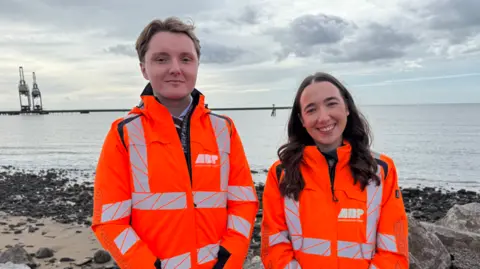
Lewis Smith, 23. from Neath, said it was a "huge investment in south Wales" and "extremely good news for an area that needs it now more than ever".
He works at ABP in the business development team and said: "Being a local it's a chance to stay at home and work on a major project.
"It should provide thousands of jobs for the local area and for the wider economy," he said.
Abbey Smith, 24, from Cardiff, is a commercial graduate at ABP, and said she thinks the investment is "going to help put Port Talbot on the map".
"I think it will bring people to the area but also help retain people who are from the area and make them want to stay here."
She also said she hoped it would encourage people to challenge themselves and pursue "something that they think they might want to do".
The move comes amid wider economic changes in Port Talbot, including the town's designation as part of the Celtic Freeport and a major restructuring at Tata Steel, as it shifts towards electric arc furnace production of steel.
A UK government transition programme has also been set up to support workers, businesses and the wider community affected by changes at the steelworks.
 Reuters
"Port Talbot will be the forefront of a pioneering, new, clean energy industry," said a UK government spokesperson.
Labour Welsh secretary, Jo Stevens, said it was a "significant moment for Port Talbot and a major step forward for the growing clean energy industry in Wales".
"This investment will further cement Port Talbot as a hub of the industries of the future and heralds the next chapter of jobs and investment to the area."
She added that clean steel-making, the development of the Celtic Freeport, and the expansion of floating offshore wind, meant Port Talbot was firmly at the heart of south Wales's growing clean energy economy, supporting thousands of new jobs and helping deliver Britain's clean power mission.
Grant arrangements for the port development have been agreed between the UK government and ABP, with the release of funding still subject to regulatory checks and final approval.
Welsh Liberal Democrat Westminster spokesperson David Chadwick said: "Any job creation is a positive step for Port Talbot, but Labour need to be honest about what this actually contains.
"These turbines are set to be built using imported steel and only assembled locally, not manufactured. This means much of the real economic value will still go elsewhere," adding that such projects should be used to back Welsh industry.
