Dentist's 'unique work' could unlock mystery of murdered man dumped in woods 22 years ago

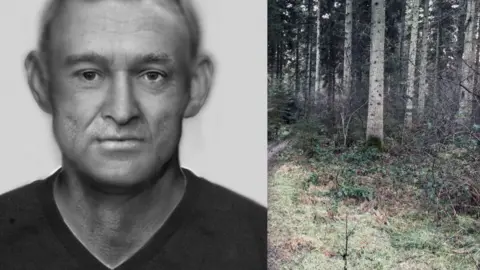 Crimestoppers/BBC
Detectives say a dentist who recognises their own work could be key to identifying a man who was murdered and dumped in a forest more than a decade ago.
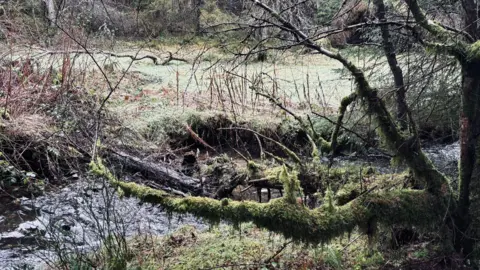
Two campers found part of the man's skull in Clocaenog Forest, Conwy county, in 2015, leading to the discovery of his skeleton by police.
But despite extensive tests, and a £20,000 Crimestoppers reward for information leading to the arrest of those responsible, the man has never been identified.
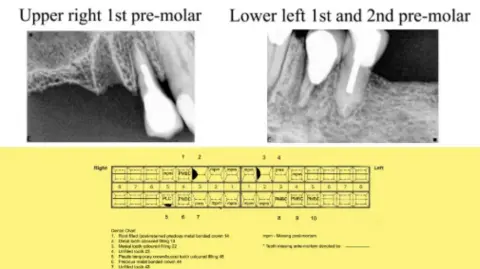
North Wales Police, which has issued a renewed appeal for information, said that the man's teeth - which were described as having "unique" work including fillings, crowns and root canals - could help them to finally identify him.
"We firmly believe that if you were the dentist you would recognise your work - it's quite unique," Det Supt Chris Bell from North Wales Police told BBC's Crimewatch Live.
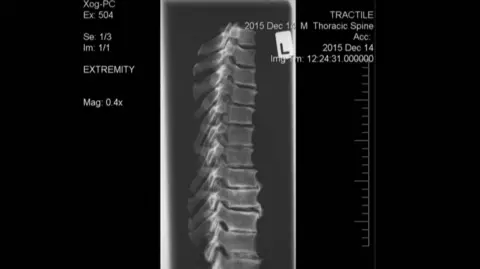
He said X-rays of the man's spine also showed that he had arthritis which would have caused him back pain.
"That back pain may not have been disclosed to family and friends or loved ones," he added.
 North Wales Police
The man's body was discovered on 14 November 2015 by two brothers who were camping in the forest ahead of the Wales Rally GB, an international motor competition.
"One of the brothers went off to look for firewood, and in doing so discovered what they believed to be a human skeleton," said Det Supt Bell.
He said the discovery sparked a huge and "challenging" forensic search in an area of "dense undergrowth".
"An experienced pathologist looked at the skull and was able to say that there was inflicted trauma to the head, which left us clear that this was a murder investigation," he added.
But more than 10 years since the discovery, police said they were "no closer" to identifying the victim.
"We firmly believe that that male would have been left at that location between 2004 and 2011," said Det Supt Bell.
"Because of the delay in the time that we believe that the body was left, and the time that we got notified, we don't have the benefits of a traditional crime scene."
Det Supt Bell said extensive tests showed that the man "must have been born before 1950".
"We believe that the male was of heavy build [and] we believe he was between 5ft 8in and 5ft 10.5in tall," he added.
"From examining the spine, we know that this male had arthritis [and] he would have suffered with back pain."
He said the man's teeth were also "particularly important" to the investigation.
Det Supt Bell said: "We are told that if you are that dentist performing that procedure you are likely to recognise your own work, which would hopefully enable us to identify who this person is."
 North Wales Police
Forensic odontologist Dr John Rosie told Crimewatch in 2016: "His pre-molar teeth have got some very extensive crown work, root canal work and filling work, which is of a high quality.
"Now, the style of the dentistry is typical of dentistry that was done in the 90s, 2000s, possibly late 80s."
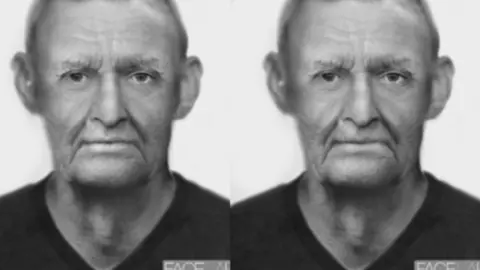
Detectives have previously released mock-up facial images showing how the man might have looked aged in his 50s, 60s and 70s.
Det Supt Bell said while these were a "useful guide", they were just a "depiction of what that person might look like, it's only a guide".
 Crimestoppers
"I'd like to stress that if the other things that I've mentioned - his height, his age - if they resonate with people and they think they may know who is it, but he doesn't necessarily look like [the facial reconstruction], please don't use that as a reason not to contact us," he added.
"We want to hear from everybody, if they think that somebody's gone missing between 2004 and 2011, anybody's friends, anybody's loved ones."
North Wales Police said it had also established that the man had been wearing a Pringle jumper which was last manufactured in 2004.
"We also found some underwear, that was Marks & Spencer's underwear, and from the label we are able to say that it was a large size," said Det Supt Bell.
"It's vitally important that we identify who that person is, who does this loved one belong to, and from then we can start other lines of inquiry to identify how he's come about his demise and who was responsible."
