From peelings to power: Where does our food waste go?

 BBC
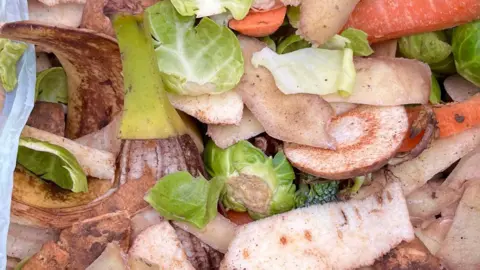
BBCAs households across England gear up for weekly food waste bin collections, you might be wondering what will happen to the leftovers in your plastic kitchen caddy.
The UK produces about 6.4 million tonnes of food waste annually, according to the environmental action body Wrap.
Most of that currently gets scraped into people's black bins along with general rubbish, meaning it is burned or sent to landfill - creating unwanted greenhouse gases.
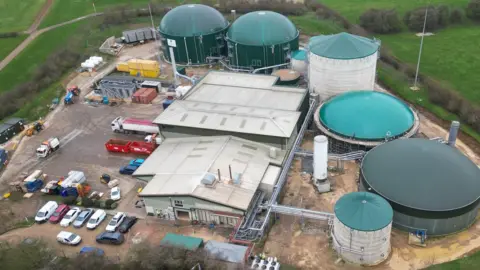
Ahead of a change in legislation, specialist anaerobic digestion plants like Fernbrook in Northamptonshire have expanded so they are ready for an influx of peelings and leftovers.
The BBC took a look behind the scenes to find out how they work and why it is better for the environment.
 Steve Hubbard/BBC
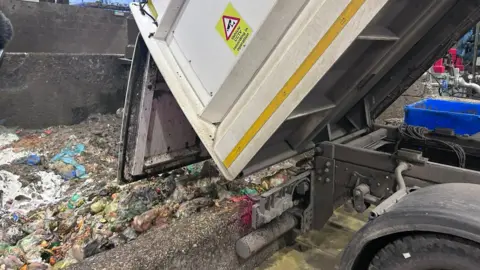
Every day, local councils deliver five loads of food waste to Fernbrook, just off the A14 near Kettering.
As a private firm, it takes in waste from a variety of local authorities and private firms.
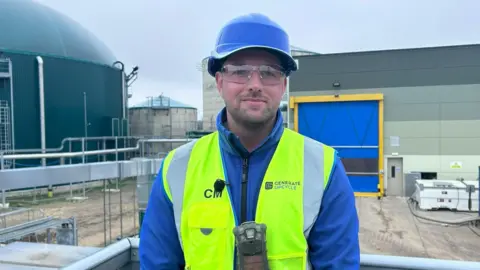
"On average we take around 1,000 tonnes of solid food waste a week, and 500 tonnes of liquid," said Chris Mallia, head of commercial UK at Generate Upcycle, which runs Fernbrook.
"We tip it into a pit at our facility and process it through a machine, then separate the plastics from the organics.
"That basically creates what we call an anaerobic digestion soup."
The "soup" is heated to a high temperature – up to 70C (160F) – to kill bacteria, then put into digester tanks.
 Kate Bradbrook/BBC
"It is an oxygen-free environment where the bacteria will eat away the organic material and create a biogas, which is held at the top of the gas dome," he explained.
That biogas is piped to two different areas of the plant, with some of it burned to produce 1.5 megawatts of electricity. The surplus heat is also harnessed.
"On the other side of the plant, which was part of our expansion, it's upgraded to biomethane and that's injected directly to the grid," Mallia added.
A further by-product is a "nutrient-rich" fertiliser that can be spread on agricultural land - almost closing the loop back to food production.
 Kate Bradbrook/BBC
Mallia said the anaerobic digestion (AD) was "obviously a better place for food waste to go to rather than landfill".
Wrap's senior recycling specialist Adam Herriott agrees, although he pointed out that only 5% of food waste currently goes to landfill, with most being burned at incinerators or energy-from-waste plants.
"AD is a positive thing. It's a good way of dealing with food waste compared to the alternatives, which is in the black bin and on to incineration or landfill. Then you have a lot of methane gas going into the atmosphere," he said.
"Whereas in AD, the gas is captured and turned into fertiliser and energy."
Herriott said the ideal would be "to avoid the food waste in the first place".
"We are in a cost of living crisis and two-thirds of food waste is avoidable and can be used," he said.
 WRAP
WRAPAnother benefit of anaerobic digestion is the cost of disposing of food waste.
Herriott said councils generally pay a "gate fee" to whichever company processes the rubbish.
"The AD fee is significantly less than paying for energy-from-waste, which is complex," he said.
"It is done on a tonnage basis and food waste is inherently heavy."
He said councils would typically pay about £140 per tonne for energy-from-waste processing and £80-100 for landfill, compared to about £30-40 for AD.
North Northamptonshire Council, which began food waste collections in 2021, collects about 2,700 tonnes every year and sends it all to Fernbrook.
Some of the district councils that West Northamptonshire Council replaced in 2021 had begun collecting food waste in 2012.
They used to use Fernbrook, but since 2018 they started sending to waste sites near Oxford and Birmingham.
A West Northants spokesperson said: "In recent months, as more councils collect food waste, we are aware that the treatment capacity is in demand, which may push the reprocessing prices up in the future."
West Northants said it collected about 187 tonnes of food waste a week — which equates to about 19,700 tonnes a year.
That council said that for the nine-month period 1 April-31 December 2025 the average household was throwing out 39kg (six stone) of food.
'The smell!'
 Reuters
Not everyone is pleased about Fernbrook's expansion.
In 2023, Rothwell Town Council objected to the idea, quoting one resident who complained of an "absolutely disgusting stench [that] ruined much of our spring and summer".
Since then, Fernbrook has "invested quite heavily in the odour abatement system, which neutralises the smell outside," Mallia said.
The BBC spoke to a number of residents in February 2026, who said the smell could still be "really bad" on a hot summer's day.
However it did not particularly bother them.
"It's only every so often, so it's not a problem," one woman said.
Fernbrook employee Tracey Giddings admitted that when they leave work, everyone can tell where they've come from.
"You never get used to [the smell]," she said.
"After being here for a couple of hours you do sort of get used to it, but when I leave site you can't just go to the shops."
Follow Northamptonshire news on BBC Sounds, Facebook, Instagram and X.
