Summary

  1. 'It's a 60-minute round trip to the tip'published at 11:59 GMT

    Kaleigh Watterson
    Cheshire political reporter

    A woman in an orange coat stands in a cafe. Chairs and tables can be seen behind her
    Image caption,

    Liz Clarke has lived in Bollington for more than 30 years

    Long round trips to recycle waste are also common for residents in parts of Cheshire.

    Cheshire East Council closed three household waste and recycling centres last year as part of cost‑saving measures.

    It means residents in the north of the borough now face a 30-minute drive to reach the nearest facility in Macclesfield.

    “If you go the wrong time of day, you'll just be stuck in traffic," says Liz Clarke from Bollington.

    "They're often queues down the road."

    The council said it was working to improve the booking system to manage peak-time demand and reduce traffic problems.

  2. Top tips for recycling right from 'binfluencer' The No1 Binmanpublished at 11:40 GMT

    Alix Hattenstone
    Journalist, BBC Local

    A man in a beanie hat and orange jacket smiles. He is standing in front of some controls.Image source, The No1 Binman
    Image caption,

    Ashley has worked in the "bindustry" for 13 years

    Ashley, also known as viral sensation The No1 Binman, has 13 years’ experience in the "bindustry" so we know his tips won’t be… rubbish.

    • Don’t bother with plastic bags -"Waste of time!” says Ashley. “Black bags cost a fortune as well. Everything in recycling bins should be loose apart from food waste. Save your money and rinse your containers."

    • Stop food recycling getting sticky -“If you leave waste for a couple of days, it sticks to the bottom, then you're the one having to scoop out,” Ashley explains. “Most councils allow you to use newspaper at the bottom of your food recycling.”

    • Check what you can recycle -Ashley’s bugbears include people who leave food recycling in the packaging - or put polystyrene in the paper bin. If he finds a recycling bin with more than 5-10% of non-recyclable items, he is told to leave the whole thing.

    Read the rest of Ashley's recycling tips here.

  3. Residents face a 22-mile round trip to recycle wastepublished at 11:30 GMT

    Julia Bryson
    BBC Yorkshire

    A recycling centre in Ilkley, West Yorkshire, showing a digger and some metal shipping containers within the site's wooden gates.

    For the residents of Ilkley, West Yorkshire, the closure of their local tip means they now have a 22-mile (35km) round trip to their nearest site.

    Not the most environmentally-friendly of moves, the local MP Robbie Moore argues.

    The Conservative started a petition against the closure of the household recycling centre and more than 10,000 people signed it – but Bradford Council went ahead and closed the site, along with two others, in March 2024.

    Moore, and local litter-picking volunteers, have noted an increase in fly-tipping on the region’s famous hills – but the council claim this is not the case.

    A spokesperson said closing the Ilkley tip and two others in the district had saved £900,000 a year – and said those who fly-tip are likely to do it regardless of whether there is a tip nearby.

  4. 'I am not going to change my ways'published at 11:20 GMT

    Nicky Campbell
    BBC Radio 5 Live presenter

    Nicky Campbell's BBC Radio 5 Live programme has been taking calls from the public about the food waste systems in their area.

    Peter, from Brighton, says his food waste has been collected on time after his local council began introducing collections in September.

    "I was expecting it to be a disaster," he said. "Before food collection it was quite an issue, very close to 50% of food was missed, but it seems to have got better somewhat since."

    But another caller - Steve from Stafford - says this is a "load of nonsense".

    "For me it's hard enough to take out the rubbish to the wheelie bin, but I respect people who do," he adds.

    "I'm not going to change my ways."

  5. Can London finally clean up its act?published at 11:11 GMT

    Tom Edwards
    Transport Correspondent, BBC London

    Oliver Peat, a man in a recycling facility wearing an orange hi-vis vest, protective glasses and a red hard hat

    At a recycling facility in Southwark, cans, bags and cardboard whizz around us on conveyor belts.

    About 100,000 tonnes of rubbish from five different boroughs are sorted here each year, but with London's recycling rate stalling at 33% for more than a decade, clearly more needs to be done.

    Oliver Peat, one of the bosses at the facility run by Veolia, says there is no silver bullet to increasing recycling in London, but it's up to everyone to play their part.

    "If you can separate out food waste as best as possible, that is the best way to live sustainably and really boost recycling rates in London," he explains.

    He says recycling bins contaminated with items that can't be recycled are a regular issue for the team.

    "We do come across problems of people who want to do the best they can, and they think that anything that they put in their recycling bin can be recycled - which unfortunately just isn't the case in London.

    "What we want to see is people just putting the correct items into their recycling bin."

  6. Are you ready for the Trash Cam?published at 10:57 GMT

    Sarah Farmer
    BBC South

    Not long now before someone hits the big ‘Go’ button here at Padworth Recycling Centre in Berkshire, and we’ll start our Trash Cam live stream.

    In front of me is a mountain of plastics waiting to be sorted - milk bottles, fizzy drink bottles, detergent tubs, the lot.

    You’ll soon be able to watch it all tumble past on a conveyor belt as it’s filtered, scanned and picked through by workers.

    Just click on the 'Watch Live' button at the top of this page to see the action!

  7. A 'nightmare' in borough with England's lowest recycling ratepublished at 10:52 GMT

    A woman with black hair in a long black coat puts a bin bag into a pink bin.
    Image caption,

    Hirra Khan Adeogun described herself as a "diligent recycler"

    Just 15.8% of waste in the London borough of Tower Hamlets is recycled, according to the most recent figures, externalfrom the Department for Environment, Food and Rural Affairs.

    That makes it the worst local authority at recycling in England.

    Residents living on estates in Bow have been telling the BBC about the problems they face when they attempt to recycle.

    Jackie Warner has lived on her estate for 26 years.

    She calls the waste management a "nightmare" as recyclables have to be placed in special bags, which are "extremely thin".

    "You can only put so much in there, and you can only put certain things in, but no one seems to adhere to that," Warner says.

    She adds that general waste and food waste also are sent down the same chute and not split up.

    "In the summer it can be quite foul," Warner said about the communal bin's smell.

    On another estate, Hirra Khan Adeogun has to take her waste outside to two small futuristic-looking waste disposal units with bins supposed to be emptied on separate days.

    "I am a diligent recycler, I really try. But we've noticed that actually they seem to bung it all in the same van," she says.

    Tower Hamlets Council says the low recycling rate is largely down to the borough being one of the "most densely populated in England, with 88% of homes as flats, meaning most residents rely on communal recycling facilities rather than individual bins".

    "High-rise living and rapid housing growth make recycling structurally challenging," it added.

    It says it is piloting new systems such as introducing food waste to some tower blocks which has led to improved rates.

  8. How good is your local authority at recycling?published at 10:45 GMT

    BBC News England

    There is a wide gap between the highest and lowest recycling rates across England.

    London and the North East consistently have the lowest rate, recycling just over 30% of household waste each in 2023-24.

    Tower Hamlets has the lowest rate of recycling of any English local authority, recycling only 15.8% of household waste.

    At the other end of the scale, South Oxfordshire District Council has the highest rate at 63% for 2023-24.

    Some household waste is rejected from recycling sites.

    This can be for several reasons, including contamination by water, dirt or paint, and inclusion of the wrong materials.

    Defra estimates that 6% of household waste sent for recycling was rejected in 2023-24.

    This Flourish post cannot be displayed in your browser. Please enable Javascript or try a different browser.

    .

  9. Your stories on waste - what we've learnt so farpublished at 10:37 GMT

    A person putting an apple core into a food recycling binImage source, Getty Images

    Today we're looking at stories from around England focusing on how we recycle our waste.

    So far this morning, we've heard from a chef who set up a community kitchen to help stop people wasting food - something he says is a "heinous crime".

    Ever wondered how compost is made? Have a look at this fascinating guide to the journey your food waste takes.

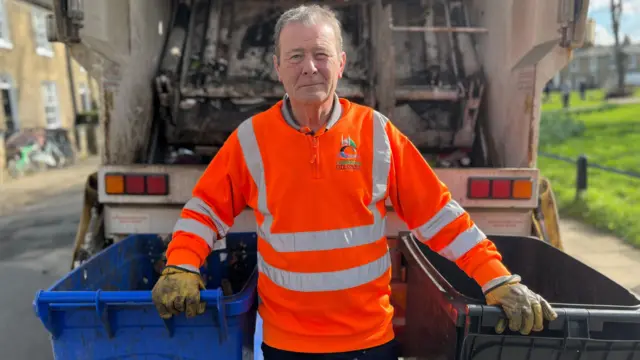
    And BBC reporter Hayley Coyle spent a cold February day with the bin loading team in Doncaster, and found out what they like - and don't like - about the job.

  10. BBC reporter joins bin collection roundpublished at 10:26 GMT

    Josh Sandiford
    BBC News, West Midlands

    Three men in bright orange visibility jackets stand in front of a bin lorry.
    Image caption,

    Matt Tilley, Liam Taylor and Mark Cox help keep Lichfield and Tamworth tidy

    "I’ve been out on a bin collection round in Edingale this morning. Here are crew members Matt Tilley, Liam Taylor and Mark Cox, who collect for the joint Lichfield and Tamworth waste service.

    "It comes as big changes are on the way for residents across both council areas. The government is requiring every council in England to introduce separate weekly food waste collections by March next year, meaning new trucks, kitchen caddies and outdoor caddies will be rolled out to homes in early 2026.

    "The council says food waste currently ends up in black bins and is incinerated - but separate collections will allow it to be turned into renewable energy and fertiliser instead. The government is funding the new vehicles and has provided additional money to help run the service.

    "A waste and recycling roadshow is taking place in Lichfield city centre later today, where residents can find out more and ask questions about the changes ahead."

  11. Waste site powers 27,000 homespublished at 10:18 GMT

    Jessica Lane
    BBC Look North

    A large indoor waste facility where piles of household rubbish sit on the floor, with cranes above ready to grab rubbish lift material into an incinerator.

    Lincolnshire’s Energy from Waste plant in North Hykeham is continuing to turn household rubbish into electricity - processing more than two million tonnes since opening in 2014.

    The county council says the site now prevents almost all general waste from going to landfill, generating enough power for about 27,000 homes.

    Environmental groups argue incineration produces high emissions, but both campaigners and the council agree on one point: households need to create less rubbish in the first place.

    With food waste collections now rolling out across the county, new material streams - such as soft plastics - are expected to follow.

    The council says food waste will be taken to an anaerobic digestion plant to become green fuel and fertiliser.

    Read the full story here.

  12. Growing fruit and veg from landfill gasespublished at 10:10 GMT

    A large white inflated dome made from tent-like material. It is rounded, tall and in an oblong shape with an entryway. The word Sustain is printed on it in yellow. It sits on a muddy field under a grey sky.Image source, Sustain Wiltshire

    People are coming up with innovative ways to use waste sustainably.

    In Royal Wootton Bassett, Wiltshire, a company is generating electricity from methane produced by a landfill site.

    Now, the landfill owners Crapper and Sons have installed a giant dome to grow fruit and vegetables from the sites gases as well.

    The dome's warm air allows fruit and vegetables to be grown out of season – including avocados, which do not normally grow in the UK.

    The owners’ community interest company, Sustain Wiltshire, is planning to build more than 100 such domes if planning permission is granted.

    Nick Ash, the project director, said that the domes could supply 80% of the fruit and vegetable needs of Royal Wootton Bassett, Purton and Brinkworth.

    Read the full story here

  13. A day in the life of a bin loaderpublished at 09:56 GMT

    Hayley Coyle
    BBC Yorkshire

    A bin lorry on a street with three bin-loaders and reporter Hayley, all in orange hi-visImage source, Hayley Coyle/BBC

    Did you know the bin loaders in Doncaster walk the equivalent of a half-marathon on every shift?

    Starting the day at 5am and helping to empty the region's 17,000 bins, refuse workers are the frontline of waste disposal.

    I spent the day with them to see for myself what they like - and don't like about the job.

    The bin teams enjoy fresh air and camaraderie but have to put up with unpleasant smells and, sometimes, bad-tempered residents.

  14. How have landfill and recycling rates changed over the years?published at 09:31 GMT

    If we look back to the start of the century, local authorities in England sent 22 million tonnes of waste to landfill in 2000-01.

    There’s been a 94% drop since then, with the figure for 2023-24 standing at 1.4 million tonnes.

    The amount of household waste recycled shot up over that period, at least initially. In 2000-01, just 11% of household waste was recycled.

    That figure had reached 42% by 2010-11.

    But things have levelled off since then.

    From 2010-11, Defra switched from calculating ‘household waste’ to ‘waste from households’ - a very similar name, but the two figures aren’t directly comparable.

    That new recycling metric was also at 42% in 2010-11.

    In 2023-24, the most recent year available, the figure was at 44%.

    Defra’s target is to reach 65% in 2035.

    This Flourish post cannot be displayed in your browser. Please enable Javascript or try a different browser.

    .

  15. Compost made from food waste supports community growingpublished at 09:16 GMT

    A man with long hair picks an apple from a tree. It is a sunny day
    Image caption,

    Martin King is the manager of Rooted in Hull

    As part of a government scheme, all local authorities must collect household food waste on a weekly basis.

    It will then be turned into compost, which will go to support agriculture or community groups.

    In Hull, which is set to introduce the new food waste system at the end of March, a not-for-profit organisation says it has already received free council compost to grow fruit and vegetables on the banks of the River Hull in St Peter's Street.

    "We're growing the food, but we're also cooking the food," says Rooted in Hull's manager Martin King.

    "We're learning about making healthy meals and that has a knock-on effect for our mental health.

    "Pretty much everyone that comes here thinks it is a brilliant idea and they think that we should be doing a lot more of this stuff in our city."

    Read the full story here.

  16. How is compost made?published at 09:01 GMT

    Ever wondered how your food waste becomes compost?

    It is a surprising multi-stage process, which can take just six weeks to complete.

    Read more here.

    This Flourish post cannot be displayed in your browser. Please enable Javascript or try a different browser.

    .

  17. Food waste is a heinous crime, says chefpublished at 08:50 GMT

    A man poses in a cafe, looking into the camera with his arms folded. He is wearing a turtle-neck black jumper and a dark jacket

    Taz Khan is a London-based cordon bleu chef turned social entrepreneur.

    Angered by the amount of food waste which ends up in landfill sites he set up a "zero waste, zero hunger" charitable organisation that aims to stop food being thrown away and instead be distributed to those in need.

    He started London's Community Kitchen 15 years ago.

    "I saw children in my area going to school without food and that sparked a thought that nobody in our country should go without food, especially at school," Khan said.

    The organisation now supports about 25,000 individuals by intercepting some 75 metric tonnes of food and distributing it among community cafes in places like Barnet, Brent and Enfield, as well as at a cookery school.

    Taz considers all food waste to be the result of "someone with a lack of a imagination and creativity".

    "Food waste is a heinous crime because it takes from the planet... and it ends up in landfill and damages our environment," he adds.

    "We all need to do better."

  18. Fly-tippers have 'no shame' - landownerpublished at 08:30 GMT

    Kirk England
    BBC South West environment and tourism correspondent

    A man in a grey fleece in standing in front of a hedegrow in rural Devon. There is fly-tipped material in the background including a black bin bag
    Image caption,

    Landowners like Ralph Rayner are responsible for clearing material fly-tipped on their property

    A landowner has said he fears fly-tipping is getting worse.

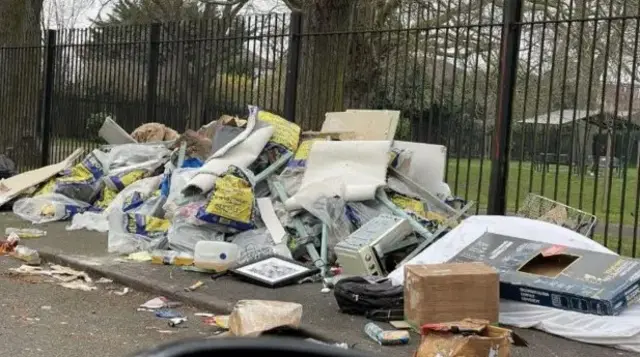
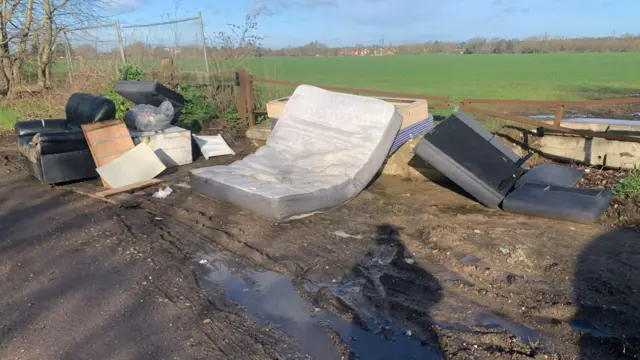
    Ralph Rayner, of Ashcombe Estate, near Dawlish in Devon, has seen everything from old sofas and mattresses, to the "entire contents" of a garden shed dumped on farmland, woods and moorland he owns.

    Fly-tippers have "no shame", he said.

    Teignbridge District Council said it is "committed to tackling fly-tipping," while in Cornwall the council is using cameras at hot spots to catch offenders.

    Sarah-Jane Brown, group leader of community protection and parking enforcement at Cornwall Council, said that by using covert surveillance operations “we're catching more and more people”.

    "We've recently prosecuted a man who was caught fly-tipping six or seven times," she added.

    The government said it was "giving authorities the tools they need to fight back" against "waste criminals".

    • Stay with us as we'll bring you details of new figures on the levels of fly-tipping from 09:30.
  19. 'I love my job'published at 08:14 GMT

    Emily Hudson
    Hampshire & Isle of Wight political reporter

    A man wearing a high vis jacket and protective glasses smiles at the camera, behind him is a skip full of food waste bags piled up and some large silver tanks.

    Antonio Rodrigues oversees the arrival of 80-100 tonnes of food waste a day at this anaerobic digestion plant near Piddlehinton in west Dorset.

    He works for Eco Sustainable Solutions which is opening a second site next month to meet rising demand from councils across the south of England.

    The new £16m facility, north of Christchurch, will take a further 70,000 tonnes a year collected from kerbsides and will cut the distance waste has to travel for processing.

    Councils from across Dorset and as far away as the Isle of Wight and Portsmouth have been sending their food waste to the Piddlehinton site for years.

    Antonio, who's the plant manager, admitted the smell could be overwhelming but he had got used to it after 20 years.

    "I love my job, it's incredibly clever, the technology behind it and to be able to give back to the environment and community is fascinating," he said.

    Read the full story here.

  20. Food waste's power potentialpublished at 08:00 GMT

    Wondering what all the fuss is about? Sustainability charity Wrap has some fascinating facts on why food waste collection has become such a focus.

    This Flourish post cannot be displayed in your browser. Please enable Javascript or try a different browser.