Summary

  1. Fly-tippers to be 'named and shamed' under new guidancepublished at 14:04 GMT
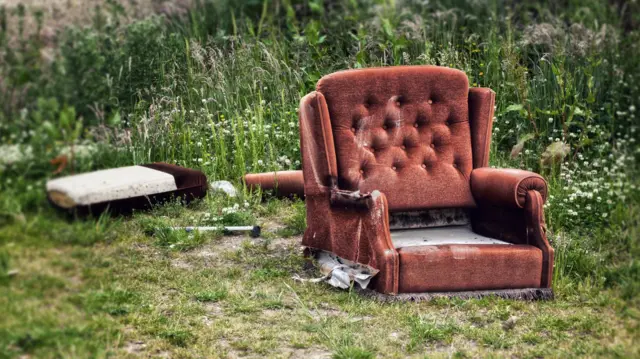
    A old sofa has been dumped on a patch of grass. There are white wild flowers in the background.Image source, Getty Images
    Image caption,

    The government said it shares the public's "fury" over fly-tipping

    The government has issued new guidance today to local authorities that recommends "naming and shaming" people convicted of fly-tipping on social media.

    Officials also outlined how councils can search, seize and destroy offenders' vehicles in a bid to boost deterrence.

    The guidance also recommended sharing images and videos of their cars being crushed online, as well as advice on taking cases to court and securing convictions against vehicle owners.

    "We are empowering local authorities to clamp down on waste cowboys and restore pride in our local areas," says circular economy minister, Mary Creagh.

    "I share the public’s fury at seeing our streets, parks and fields used as dumping grounds," she continued.

    "Fly-tippers should know – if you use your van to trash our countryside, don’t be surprised when it ends up on the scrapheap."

  2. Watch live as recycling journeys from bin to beyondpublished at 13:55 GMT

    Sarah Farmer
    Reporter, BBC South

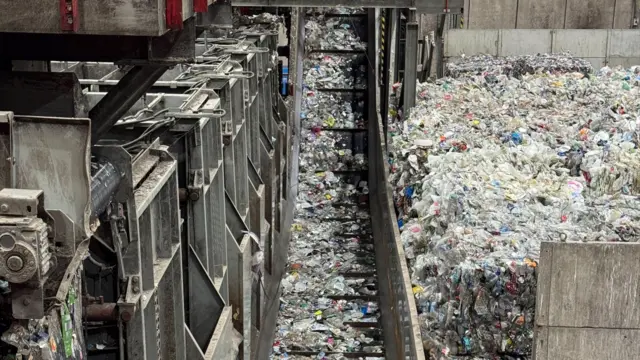
    A industrial waste‑processing facility filled with large amounts of mixed rubbish, primarily plastic. In the centre of the scene, a long conveyor belt runs vertically through the frame, carrying scattered plastic debris along its surface. To the left, there is a heavy metal structure made up of panels, machinery components, and support beams
    Image caption,

    After dry mixed recycling is tipped off collection vehicles, it is loaded onto conveyor belts

    Did you catch our Trash Cam earlier?

    Well, it won’t be long before the conveyor belt whirs back into action here at Padworth Recycling Centre in Reading.

    Right in front of me is a huge mound of mixed plastics collected from homes across West Berkshire - all about to be sorted through live by the team here.

    Keep an eye out for a bit of wishcycling as well - that’s when people pop things into the bin hoping they're recyclable… but sadly, they’re not!

    Soon you'll be able to tap the Watch Live button at the top of this page to see the whole process unfold live.

  3. 'There's only so much we can take'published at 13:50 GMT

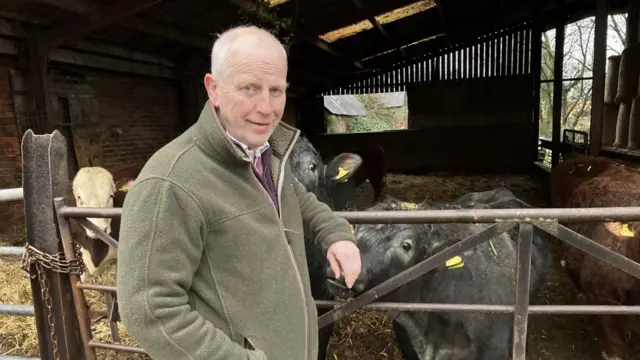
    A man has very short white hair and is wearing a dark green zip jumper. He is leaning on a metal fence into a barn. Beyond the fence there are some curious black and brown cows near him, one is sniffing his hand. There is hay on the ground of the barn and a window in the back corner showing greenery and a farm building.

    Richard Yates, a livestock farmer in Shropshire, says he has seen repeated cases of fly-tipping on his land that seem to be getting worse.

    He has found everything from general rubbish to builders’ waste, garden waste, tyres, and chemicals dumped on his farm in Bridgnorth.

    "Often it's off the back roads and they pull in, get away pretty quickly, dump their stuff," he says.

    "It's pretty annoying because it's my responsibility now to tidy it up."

    He adds that farmers were implementing their own measures to try and deter people by doing things like putting large tree trunks in front of gates, and the threat of the issue made farmers hyper-vigilant.

    "We note numbers, I made one citizen’s arrest. I wouldn't advocate that as a line of action, but I felt I needed to do it at the time, there's only so much we can take."

  4. Farmers call for new scheme to deal with fly-tippingpublished at 13:37 GMT

    Malcolm Prior
    Environment correspondent

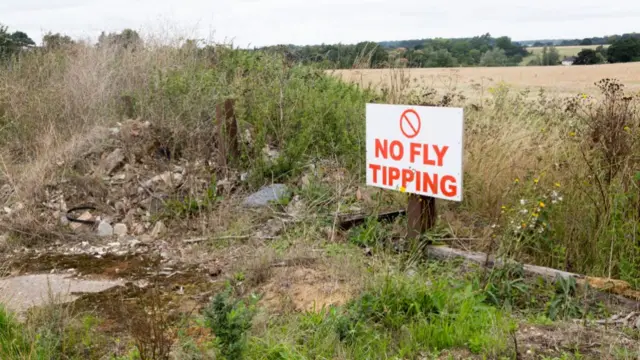
    A sign by a field saying no fly tipping.Image source, Getty Images
    Image caption,

    The government says responsibility for clearing private land rests with landowners

    Farmers and landowners are calling for a new scheme to allow them to get rid of fly-tipped rubbish that has been illegally dumped on their land free of charge.

    The Country Land and Business Association (CLA), which represents thousands of rural businesses and landowners, said farmers “have had enough” of seeing their land buried under piles of waste.

    The CLA has called for a permit scheme to allow landowners, who did not cause or knowingly allow waste to be fly-tipped on their land, to dispose of it at landfill sites without paying the usual fees and taxes.

    Colin Rayner, whose family farm in Berkshire, Buckinghamshire and Surrey, said it was "out of control".

    “We just clear up the fly-tipping waste and bear the high disposal costs at the registered landfill site, which significantly impact our farm's finances," he said.

    "My team must litter pick the footpaths weekly, adding to our ongoing expenses.”

    The government says responsibility for clearing private land rests with landowners but, on conviction, fly-tippers can be made to pay their costs.

  5. Check your waste removal provider's licence, council warnspublished at 13:28 GMT

    Gemma Dillon
    Political Reporter, BBC Yorkshire

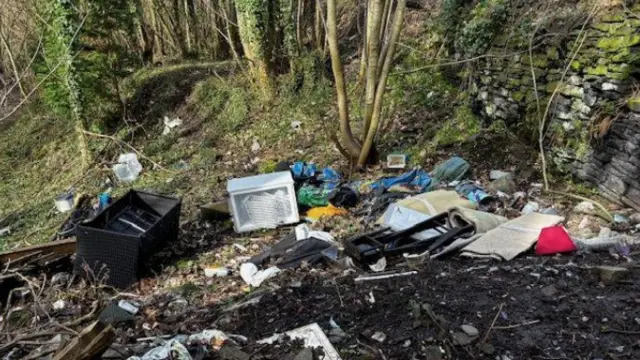
    Fly-tipped rubbish in woodland in Calderdale

    If you pay a waste removal company to take your rubbish and they fly-tip it, you could be liable to pay the fine, a council in West Yorkshire has said.

    Calderdale Council say it is because of a technicality which says residents must show a duty of care when disposing of household waste.

    Senior highway enforcement officer Sam Pearson said if people are paying businesses to remove things like fridges and sofas, they should check they hold an upper tier waste carrier licence.

    This can be checked on the Environment Agency website,, external he said.

  6. New figures show all fly-tipping incidents risingpublished at 13:20 GMT

    Ema Sabljak
    England Data Unit

    Fly-tipping incidents across England have risen, according to the latest Defra data.

    Local authorities dealt with 1,257,863 incidents in 2024-25, up by 9% year on year.

    Almost two thirds of those involved waste from households.

    Household waste, which included abandoned black bags of rubbish, was up 13% from 2023-24.

    Unidentified waste made up for the second highest number of the total incidents, but this dropped slightly year on year.

    Incidents involving construction waste were the third biggest category. These rose by 12% year on year but accounted for just about one in 20 of the total fly-tipping reports in the most recent figures.

    Chemical drums, oil or fuel incidents rose by 32% - the biggest rise across the different waste types - but it makes up a relatively small proportion of total incidents.

    This Flourish post cannot be displayed in your browser. Please enable Javascript or try a different browser.

    .

  7. 'Fly-tipping is dead easy round here'published at 13:10 GMT

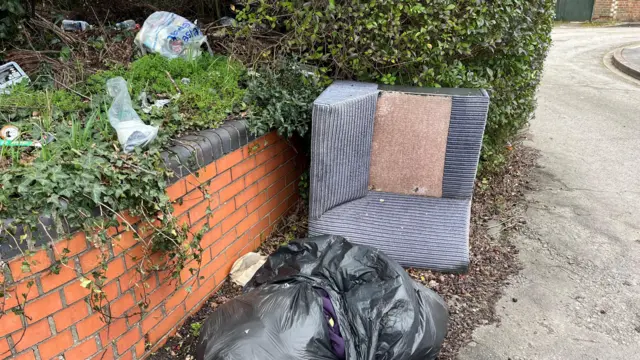
    An upturned armchair and two full black bin bags are on the ground, next to a small brick wall on a residential back road. Plastic bags, empty cans and plastic bottles are littered on grass above the wall.
    Image caption,

    Sofas, mattresses, tyres and chairs are among the items fly-tipped in Blackbird Leys

    A resident living in one of Oxfordshire's largest housing estates says fly-tipping around the area has become a regular occurrence.

    Andy Beal, who lives in Blackbird Leys, says a lot of the waste is left in alleyways, behind garages and people's gardens.

    "It's dead easy to come round here at night and dump stuff, even in the day," he says.

    "I've seen people driving vans and they have dumped all their stuff out."

    As well as waste collection fees, Beal blames a new advanced booking system at Oxfordshire's recycling centres for the increase in fly-tipping.

    In a statement Oxfordshire County Council said there was no evidence to suggest the booking system changes would lead to an increase in fly-tipping.

  8. Increase in large-scale fly-tippingpublished at 12:54 GMT

    Paul Lynch
    BBC Shared Data Unit

    A huge pile of wasteImage source, PA Media
    Image caption,

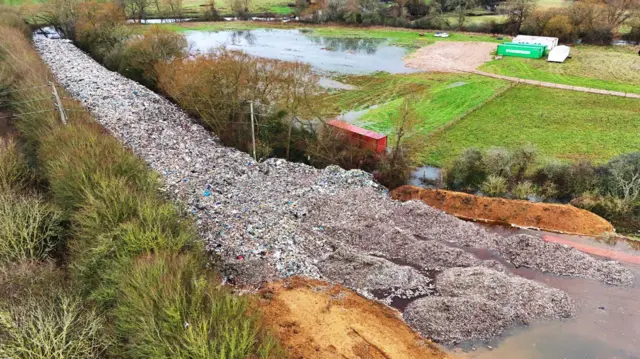
    A huge pile of fly-tipped waste was dumped in a field in Oxfordshire last year

    For years, the number of fly‑tipping incidents reported in England hovered around one million annually.

    But in 2020, the BBC’s Shared Data Unit identified a worrying trend: large‑scale incidents the size of a “tipper lorry” or bigger had been rising steadily.

    Campaign groups pointed to organised crime as the driving force. Fake waste‑clearance firms, posing as legitimate operators, were dumping commercial waste in fields, barns and parks.

    High‑profile cases, like the 150m‑long waste mound beside the A43 in Oxfordshire, may draw headlines, but thousands more a year are still substantial in scale and are continuing to increase in frequency.

    In 2019‑20, councils logged around 31,000 incidents at least a tipper lorry in size; last year that had risen to nearly 52,000. The cost of clearing them, more than £19m.

    Yet, those campaigners still argue punishment remains too low when it comes to the bigger offences. Only 663 fines more than £1,000 have been issued to fly-tippers since 2019.

  9. Watch live as rubbish gets new lease of lifepublished at 12:49 GMT

    Inside a large waste‑processing facility, a rubbish truck is tipping a load of mixed recyclable materials onto a massive pile. The truck is surrounded by heaps of plastic, paper, and other waste, with concrete walls and industrial equipment visible around the sorting area.
    Image caption,

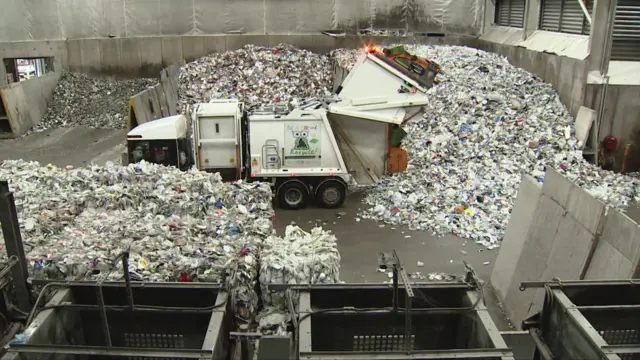
    The site in Padworth handles the processing of household dry mixed recycling, including paper, card, plastic bottles, pots and cans

    You have rinsed the jars, flattened the cardboard and dutifully lined everything up on the kerb - but what happens to your recycling once that bin lorry pulls away?

    We had a look behind the scenes at the Materials Recovery Facility in Padworth, Berkshire, and watched as plastics, paper and tin cans began a carefully choreographed journey through a wonderland of machinery and magnets.

    Curious to see for yourself? Tune in at 14:00 GMT for the next live stream by clicking on the 'Watch Live' button at the top of this page.

  10. Fly-tipping reports up in Birminghampublished at 12:40 GMT

    Jonathan Fagg
    BBC England Data Unit

    A Birmingham City Council report published last year found the city saw a rise in fly-tipping reports in the early months of the strike.

    "The overall numbers of cases of fly-tipping have increased significantly as an impact of the industrial action in waste management," a report for the city council's licensing and public protection committee agenda said in June.

    "This work is currently taking nearly all the available resource of the Waste Enforcement Unit.”

    The report shows the number of fly-tipping cases recorded by the city council in eight months in 2024 was 53.

    From the start of the strikes in January, the report shows an average 96 per month from January to March - with 118 cases in March alone.

  11. What's happening with Birmingham's bin strike?published at 12:29 GMT

    Kath Stanczyszyn
    BBC West Midlands

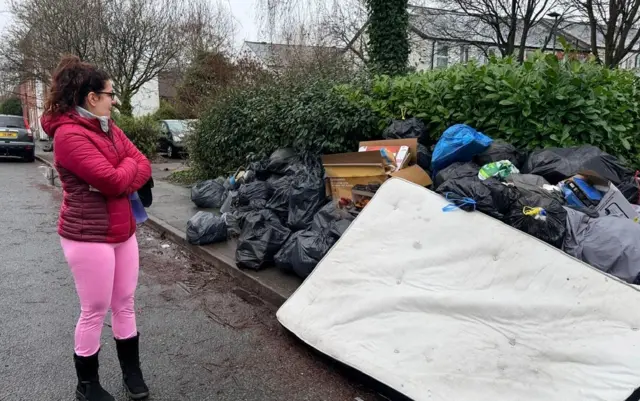
    A Brookfield Road resident looks at the pile of rubbish gathering on her roadImage source, Gabriel Bononi

    This is a strike rapidly heading for the record books.

    There is still no sign of a deal between two sides that seem completely entrenched.

    The council remains adamant about making modernising changes that will not bring about further equal pay claims. Unite says the idea of members’ pay and treatment being collateral damage for this is an unimpeachable red line.

    It is hard to see how it ends, but the ramifications are huge. The ongoing cost to the council is in the tens of millions and rising. The ongoing cost to workers is more than just financial.

    Residents in the second city have had more than enough. There have been zero recycling collections for more than 12 months and small pockets of the city are struggling to look acceptable.

    With local elections on the horizon, it would usual to assume both the Labour administration - who will likely be punished at the polls - and Unite - who so not know what will be on the cards from May - would be pushing behind the scenes for a resolution. But it seems there is no wriggle room.

    And of course, in industrial disputes there never is - until there is. Watch this space.

  12. 'Why don't they make fox-proof bins?'published at 12:13 GMT

    Nicky Campbell
    BBC Radio 5 Live presenter

    A fox stands on a garden fence. It is bushy and crimson coloured.Image source, Getty Images
    Image caption,

    Simon from London says foxes used to eat out of his bins

    Nicky Campbell's BBC Radio 5 Live programme has been taking calls from the public about the food waste systems in their area.

    Simon told the show that ten years ago he had brown bins at his home in Barnet, London, but had problems with foxes.

    "My wife and I did it and the foxes ate it all," he adds.

    "It was disgusting and we stopped doing it because the foxes kept on eating it.

    "Why don't they make fox-proof bins?," he asked.

  13. 'It's a 60-minute round trip to the tip'published at 11:59 GMT

    Kaleigh Watterson
    Cheshire political reporter

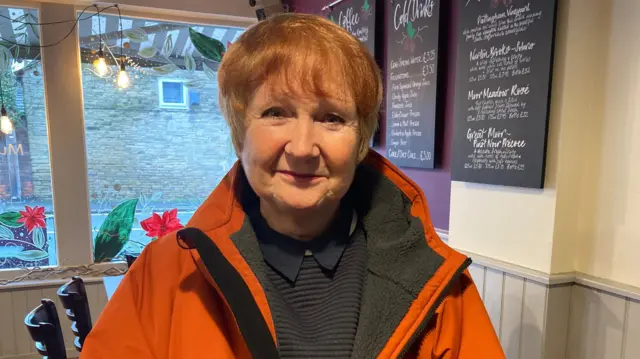
    A woman in an orange coat stands in a cafe. Chairs and tables can be seen behind her
    Image caption,

    Liz Clarke has lived in Bollington for more than 30 years

    Long round trips to recycle waste are also common for residents in parts of Cheshire.

    Cheshire East Council closed three household waste and recycling centres last year as part of cost‑saving measures.

    It means residents in the north of the borough now face a 30-minute drive to reach the nearest facility in Macclesfield.

    “If you go the wrong time of day, you'll just be stuck in traffic," says Liz Clarke from Bollington.

    "They're often queues down the road."

    The council said it was working to improve the booking system to manage peak-time demand and reduce traffic problems.

  14. Top tips for recycling right from 'binfluencer' The No1 Binmanpublished at 11:40 GMT

    Alix Hattenstone
    Journalist, BBC Local

    A man in a beanie hat and orange jacket smiles. He is standing in front of some controls.Image source, The No1 Binman
    Image caption,

    Ashley has worked in the "bindustry" for 13 years

    Ashley, also known as viral sensation The No1 Binman, has 13 years’ experience in the "bindustry" so we know his tips won’t be… rubbish.

    • Don’t bother with plastic bags -"Waste of time!” says Ashley. “Black bags cost a fortune as well. Everything in recycling bins should be loose apart from food waste. Save your money and rinse your containers."

    • Stop food recycling getting sticky -“If you leave waste for a couple of days, it sticks to the bottom, then you're the one having to scoop out,” Ashley explains. “Most councils allow you to use newspaper at the bottom of your food recycling.”

    • Check what you can recycle -Ashley’s bugbears include people who leave food recycling in the packaging - or put polystyrene in the paper bin. If he finds a recycling bin with more than 5-10% of non-recyclable items, he is told to leave the whole thing.

    Read the rest of Ashley's recycling tips here.

  15. Residents face a 22-mile round trip to recycle wastepublished at 11:30 GMT

    Julia Bryson
    BBC Yorkshire

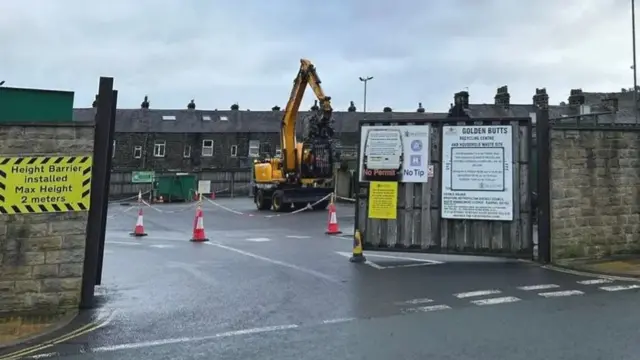
    A recycling centre in Ilkley, West Yorkshire, showing a digger and some metal shipping containers within the site's wooden gates.

    For the residents of Ilkley, West Yorkshire, the closure of their local tip means they now have a 22-mile (35km) round trip to their nearest site.

    Not the most environmentally-friendly of moves, the local MP Robbie Moore argues.

    The Conservative started a petition against the closure of the household recycling centre and more than 10,000 people signed it – but Bradford Council went ahead and closed the site, along with two others, in March 2024.

    Moore, and local litter-picking volunteers, have noted an increase in fly-tipping on the region’s famous hills – but the council claim this is not the case.

    A spokesperson said closing the Ilkley tip and two others in the district had saved £900,000 a year – and said those who fly-tip are likely to do it regardless of whether there is a tip nearby.

  16. 'I am not going to change my ways'published at 11:20 GMT

    Nicky Campbell
    BBC Radio 5 Live presenter

    Nicky Campbell's BBC Radio 5 Live programme has been taking calls from the public about the food waste systems in their area.

    Peter, from Brighton, says his food waste has been collected on time after his local council began introducing collections in September.

    "I was expecting it to be a disaster," he said. "Before food collection it was quite an issue, very close to 50% of food was missed, but it seems to have got better somewhat since."

    But another caller - Steve from Stafford - says this is a "load of nonsense".

    "For me it's hard enough to take out the rubbish to the wheelie bin, but I respect people who do," he adds.

    "I'm not going to change my ways."

  17. Can London finally clean up its act?published at 11:11 GMT

    Tom Edwards
    Transport Correspondent, BBC London

    Oliver Peat, a man in a recycling facility wearing an orange hi-vis vest, protective glasses and a red hard hat

    At a recycling facility in Southwark, cans, bags and cardboard whizz around us on conveyor belts.

    About 100,000 tonnes of rubbish from five different boroughs are sorted here each year, but with London's recycling rate stalling at 33% for more than a decade, clearly more needs to be done.

    Oliver Peat, one of the bosses at the facility run by Veolia, says there is no silver bullet to increasing recycling in London, but it's up to everyone to play their part.

    "If you can separate out food waste as best as possible, that is the best way to live sustainably and really boost recycling rates in London," he explains.

    He says recycling bins contaminated with items that can't be recycled are a regular issue for the team.

    "We do come across problems of people who want to do the best they can, and they think that anything that they put in their recycling bin can be recycled - which unfortunately just isn't the case in London.

    "What we want to see is people just putting the correct items into their recycling bin."

  18. Are you ready for the Trash Cam?published at 10:57 GMT

    Sarah Farmer
    BBC South

    Not long now before someone hits the big ‘Go’ button here at Padworth Recycling Centre in Berkshire, and we’ll start our Trash Cam live stream.

    In front of me is a mountain of plastics waiting to be sorted - milk bottles, fizzy drink bottles, detergent tubs, the lot.

    You’ll soon be able to watch it all tumble past on a conveyor belt as it’s filtered, scanned and picked through by workers.

    Just click on the 'Watch Live' button at the top of this page to see the action!

  19. A 'nightmare' in borough with England's lowest recycling ratepublished at 10:52 GMT

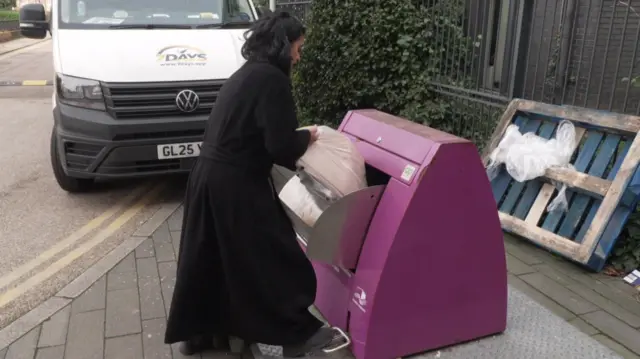
    A woman with black hair in a long black coat puts a bin bag into a pink bin.
    Image caption,

    Hirra Khan Adeogun described herself as a "diligent recycler"

    Just 15.8% of waste in the London borough of Tower Hamlets is recycled, according to the most recent figures, externalfrom the Department for Environment, Food and Rural Affairs.

    That makes it the worst local authority at recycling in England.

    Residents living on estates in Bow have been telling the BBC about the problems they face when they attempt to recycle.

    Jackie Warner has lived on her estate for 26 years.

    She calls the waste management a "nightmare" as recyclables have to be placed in special bags, which are "extremely thin".

    "You can only put so much in there, and you can only put certain things in, but no one seems to adhere to that," Warner says.

    She adds that general waste and food waste also are sent down the same chute and not split up.

    "In the summer it can be quite foul," Warner said about the communal bin's smell.

    On another estate, Hirra Khan Adeogun has to take her waste outside to two small futuristic-looking waste disposal units with bins supposed to be emptied on separate days.

    "I am a diligent recycler, I really try. But we've noticed that actually they seem to bung it all in the same van," she says.

    Tower Hamlets Council says the low recycling rate is largely down to the borough being one of the "most densely populated in England, with 88% of homes as flats, meaning most residents rely on communal recycling facilities rather than individual bins".

    "High-rise living and rapid housing growth make recycling structurally challenging," it added.

    It says it is piloting new systems such as introducing food waste to some tower blocks which has led to improved rates.

  20. How good is your local authority at recycling?published at 10:45 GMT

    BBC News England

    There is a wide gap between the highest and lowest recycling rates across England.

    London and the North East consistently have the lowest rate, recycling just over 30% of household waste each in 2023-24.

    Tower Hamlets has the lowest rate of recycling of any English local authority, recycling only 15.8% of household waste.

    At the other end of the scale, South Oxfordshire District Council has the highest rate at 63% for 2023-24.

    Some household waste is rejected from recycling sites.

    This can be for several reasons, including contamination by water, dirt or paint, and inclusion of the wrong materials.

    Defra estimates that 6% of household waste sent for recycling was rejected in 2023-24.

    This Flourish post cannot be displayed in your browser. Please enable Javascript or try a different browser.

    .