Summary

  1. 'Fed up of rubbish in Newcastle's West End'published at 15:44 GMT
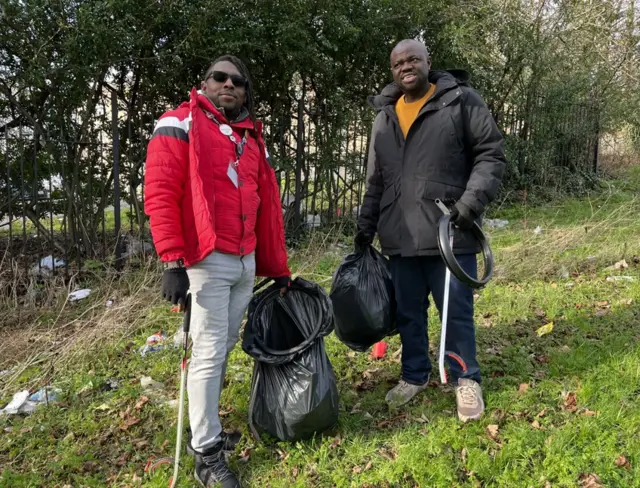
    Volunteers from Newcastle’s West End Refugee Service are among those doing their bit to clean up the city.

    People here in Newcastle’s West End say they are fed up of the amount of rubbish that is often strewn across the back lanes that run behind terraced streets.

    There are overflowing bins, old mattresses, take-away containers and cardboard boxes which are stuffed with… you guessed it, yet more rubbish.

    Residents are angry and disappointed, though many also acknowledge the city council is trying to fix it.

    Newcastle City Council says steps have been taken to improve cleanliness, but stress that communities need to play their part too.

    Some are doing just that. One local refugee charity has been organising weekly litter picks to try and restore a bit of order.

    Those taking part say the act of cleaning up improves their sense of belonging.
  2. London has the highest fly-tipping ratepublished at 15:33 GMT

    Lauren Woodhead
    England Data Unit

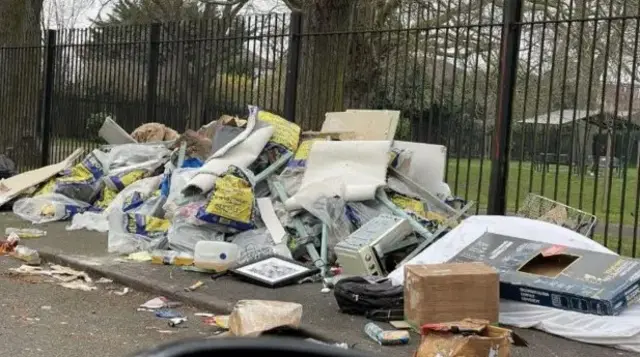
    A large amount of fly-tipped rubbish on a street next to a metal fence with a park in the backgroundImage source, Jay Rajput

    Of the 10 local authorities with the highest rate of fly-tipping incidents per 1,000 people in 2024-25, eight are in London.

    Recording practices do vary over time and between local authorities.

    But even taking this into account, London councils have dominated the top 10 for fly-tipping rates every year since 2019-20.

    By contrast, the 10 local authorities with the lowest rate of incidents per 1,000 people are much more varied geographically in 2024-25. There has also been more change at that end of the table.

    London has recorded the highest rate of incidents per 1,000 people of any region for every year since 2019-20. However, it consistently carries out the highest number of enforcement actions too, with a rise of 12.9% from 2023-24 to 2024-25.

  3. The Bincredible Hulk and Bin Diesel join council's recycling wagonspublished at 15:25 GMT

    Claire Hamilton
    Merseyside political reporter

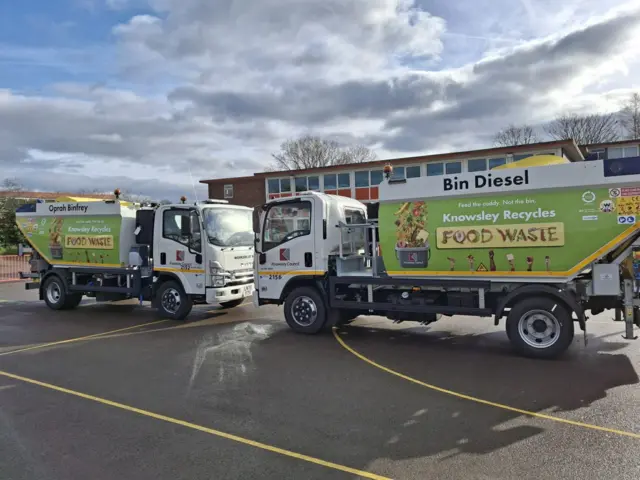
    Two bin wagons parked facing each other in a car park, with a boy aged about 10 sat in each cab. THe boys look out of the winow and hold certificates.
    Image caption,

    Harry (left) and Archie saw the newly-named wagons arrive at their school in Knowsley

    Bin Diesel, Oprah Binfrey and The Bincredible Hulk will soon be collecting one Merseyside council’s recycling.

    School children in Knowsley took part in a competition to name the borough’s new recycling wagons - and the results are brilliant.

    Winning pupils at one Kirkby primary school, Archie and Harry, got a huge surprise this morning when two bin lorries arrived emblazoned with their new names.

    Archie - who named Bin Diesel - said it was “boss”, and Harry - who named Oprah Binfrey - said he felt “proud”.

    Two bin wagons parked facing each other, one named Oprah Binfrey and the other Bin Diesel

    The competition inspired listeners to BBC Radio Merseyside to call in with their own suggestions. Binnie-the-Pooh, Obi Bin Kenobe and Bindiana Jones were some of our favourites. More than 700 names were submitted to the council - which were whittled down to nine winners.

    Another favourite was Vincent Van Scoff.

    Knowsley Council is to roll out food waste collections across the borough from 13 April. Council leader Graham Morgan said the competition was a fun way to engage the community in something which will mark a big change to the way people deal with their leftovers.

  4. Relentless fly-tipping costing us thousands, says farmerpublished at 15:15 GMT

    Jack Fiehn
    Political reporter

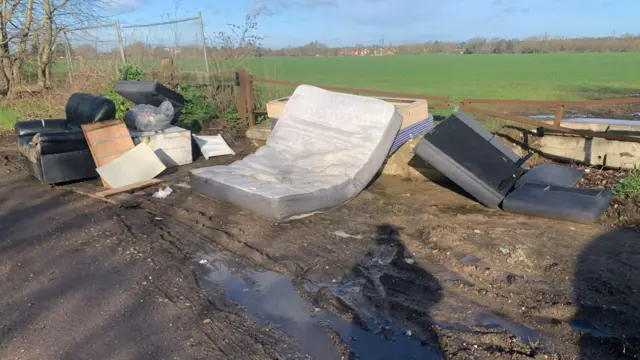
    Fly-tipping at a gate next to a field. The waste includes a sofa, a mattress and other rubbish. A shadow of the person taking the photo can also be seen.Image source, Colin Rayner

    Farmers in Surrey say that fly-tipping is "relentless" and happening "virtually every week", with the clear-up costing them thousands of pounds a year.

    Colin Rayner says the waste dumping is happening on an industrial scale and has forced him to bring in people to guard gates during harvesting.

    "We find anything from asbestos to tyres to dead dogs... you name it, we've found it," he says.

    "We then have the responsibility of taking it to a waste transfer station and getting rid of it legally."

    The Department for Environment, Food and Rural Affairs (DEFRA) said tougher checks and stronger penalties were being introduced.

  5. Waste criminal fined more than £1mpublished at 15:07 GMT

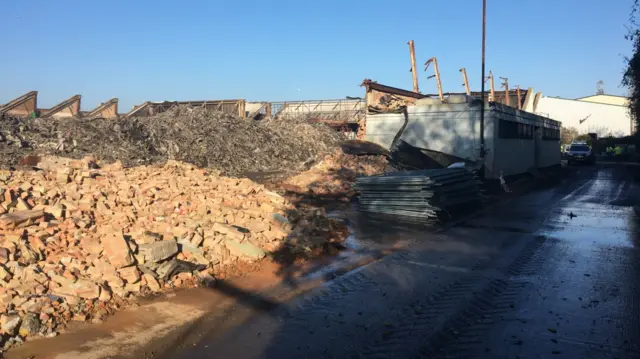
    Bricks and rubble dumped at a site in Margate, Kent, adjacent to a road. There is blue sky and a single-storey building.Image source, Environment Agency
    Image caption,

    The total dumped waste was equivalent to 600 African elephants

    A prolific waste criminal was recently ordered to pay £1.2m in compensation for illegally dumping more than 4,000 tonnes of waste across England.

    A nationwide investigation by the Environment Agency uncovered a network of 16 illegal dumping sites, including a manor house in Surrey, a farm in Cambridgeshire and a warehouse in Kent.

    The total weight of the waste dumped was about 4,275 tonnes – roughly the weight of 600 African elephants.

    Varun Datta, 36, of Central London, was handed a four-month prison sentence, suspended for 18 months.

    He must also pay £1.1m, reflecting the financial benefit from his crimes, plus £100,000 in compensation and £200,000 in prosecution costs.

    "Smell and flies were a feature at some of the illegal sites and caused a localised adverse effect to air quality”, said Judge Paul Farrar KC.

    He added that landowners were "forced to incur substantial costs in removing the illegal waste".

    Read the full story here.

  6. Fly-tipping enforcement up, data showspublished at 14:51 GMT

    Jonathan Fagg
    BBC England Data Unit

    The new Defra figures show there were about 572,000 enforcement actions against fly-tipping carried out in England in 2024-25.

    That’s up 8% from the year before, broadly in line with the 9% rise seen in fly-tipping incidents.

    In about two thirds of those enforcement actions, an investigation was carried out, but no further action has yet been taken.

    Other enforcement actions taken can range from a warning letter to prosecutions, although only 1,377 prosecutions were carried out in 2024-25.

    The second most common enforcement category was fixed penalty notices (FPNs), with about 69,000 issued in 2024-25.

    That’s up 12% from the year before.

    Of these FPNs, just over 13,400 were issued specifically for fly-tipping, with other FPNs issued for “Household Duty of Care” or littering “issued in conjunction” with fly-tipping.

  7. What happens to your empty glass bottles?published at 14:36 GMT

    Martin Heath
    BBC Radio Northampton

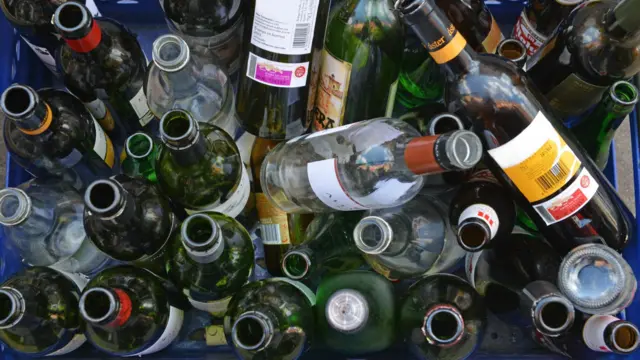
    Several empty glass bottles in a crate with the image taken from above

    The BBC has been following the journey of a bottle after it leaves its home in Hertford.

    It gets collected with other recyclables and travels 13 miles (20.9km) to a waste transfer site in Buntingford.

    There, the bottle gets picked up by a lorry which takes it to the Pearce Group MRF (Materials Recycling Facility) in St Albans.

    The glass is separated from the other waste by machinery and gravity, and any contaminates like paper or plastic are removed.

    A large lorry then takes it to one of several sites across the UK where it is sorted by colour using lasers.

    Then, the bottle gets crushed into small pieces and recycled – to become another bottle or a jar, or it might end up in aggregates or used for sand blasting.

    But the story does not end there – as glass can be recycled over and over again.

  8. ‘Rubbish investigators’ trace and prosecute fly-tipperspublished at 14:17 GMT

    Dave Harvey
    West of England business and environment correspondent

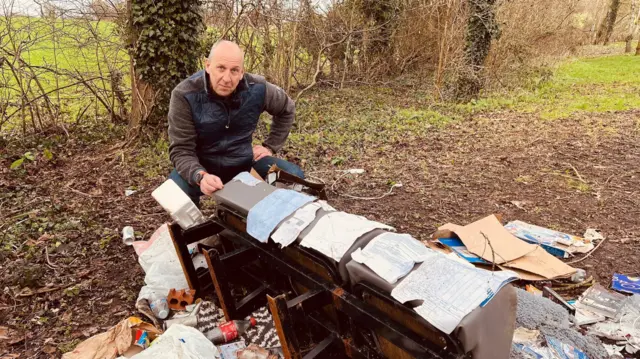
    A man squatting on the edge of a field looking at a pile of rubbish that includes pieces of paper. There is a hedgerow behind him
    Image caption,

    Bob Evely, a waste investigator, combs through fly-tips to find letters, invoices and documents

    Bob Evely is a rubbish investigator, and smiles at the double meaning.

    He says his team are actually highly effective at tracing who dumped rubbish illegally – according to South Gloucestershire Council, their “enviro-crime squad” prosecutes one case of fly-tipping every week.

    Evely is one of many council investigators going out and finding clues in illegally dumped waste piles across the county.

    "It is about names and addresses and there's vehicle index numbers, sometimes we find boxes with labels on, and we'll work those back to the companies that supplied them,” he said.

    Waste crime costs the UK more than £1bn according to the Environment Agency.

    In 2025, it closed down 743 illegal waste sites, but the Agency admitted a further 517 were still active.

    On private land, gaining access is slow and difficult, and it is often hard to identify who is actually dumping the waste.

  9. Fly-tippers to be 'named and shamed' under new guidancepublished at 14:04 GMT

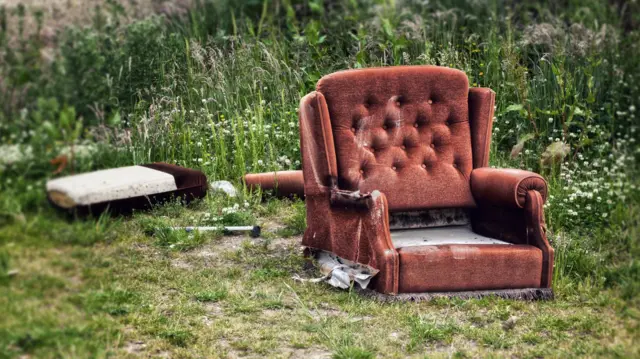
    A old sofa has been dumped on a patch of grass. There are white wild flowers in the background.Image source, Getty Images
    Image caption,

    The government said it shares the public's "fury" over fly-tipping

    The government has issued new guidance today to local authorities that recommends "naming and shaming" people convicted of fly-tipping on social media.

    Officials also outlined how councils can search, seize and destroy offenders' vehicles in a bid to boost deterrence.

    The guidance also recommended sharing images and videos of their cars being crushed online, as well as advice on taking cases to court and securing convictions against vehicle owners.

    "We are empowering local authorities to clamp down on waste cowboys and restore pride in our local areas," says circular economy minister, Mary Creagh.

    "I share the public’s fury at seeing our streets, parks and fields used as dumping grounds," she continued.

    "Fly-tippers should know – if you use your van to trash our countryside, don’t be surprised when it ends up on the scrapheap."

  10. Watch live as recycling journeys from bin to beyondpublished at 13:55 GMT

    Sarah Farmer
    Reporter, BBC South

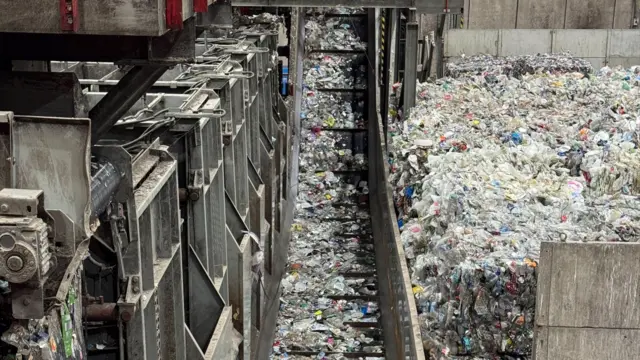
    A industrial waste‑processing facility filled with large amounts of mixed rubbish, primarily plastic. In the centre of the scene, a long conveyor belt runs vertically through the frame, carrying scattered plastic debris along its surface. To the left, there is a heavy metal structure made up of panels, machinery components, and support beams
    Image caption,

    After dry mixed recycling is tipped off collection vehicles, it is loaded onto conveyor belts

    Did you catch our Trash Cam earlier?

    Well, it won’t be long before the conveyor belt whirs back into action here at Padworth Recycling Centre in Reading.

    Right in front of me is a huge mound of mixed plastics collected from homes across West Berkshire - all about to be sorted through live by the team here.

    Keep an eye out for a bit of wishcycling as well - that’s when people pop things into the bin hoping they're recyclable… but sadly, they’re not!

    Soon you'll be able to tap the Watch Live button at the top of this page to see the whole process unfold live.

  11. 'There's only so much we can take'published at 13:50 GMT

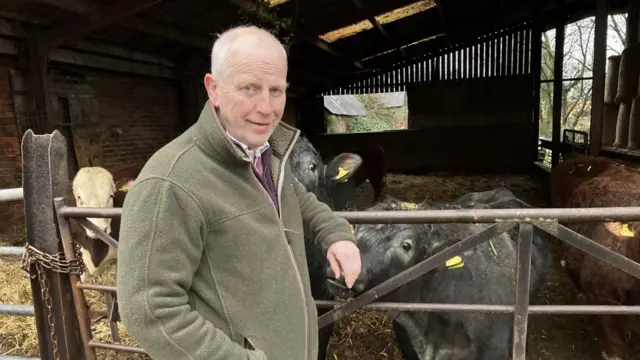
    A man has very short white hair and is wearing a dark green zip jumper. He is leaning on a metal fence into a barn. Beyond the fence there are some curious black and brown cows near him, one is sniffing his hand. There is hay on the ground of the barn and a window in the back corner showing greenery and a farm building.

    Richard Yates, a livestock farmer in Shropshire, says he has seen repeated cases of fly-tipping on his land that seem to be getting worse.

    He has found everything from general rubbish to builders’ waste, garden waste, tyres, and chemicals dumped on his farm in Bridgnorth.

    "Often it's off the back roads and they pull in, get away pretty quickly, dump their stuff," he says.

    "It's pretty annoying because it's my responsibility now to tidy it up."

    He adds that farmers were implementing their own measures to try and deter people by doing things like putting large tree trunks in front of gates, and the threat of the issue made farmers hyper-vigilant.

    "We note numbers, I made one citizen’s arrest. I wouldn't advocate that as a line of action, but I felt I needed to do it at the time, there's only so much we can take."

  12. Farmers call for new scheme to deal with fly-tippingpublished at 13:37 GMT

    Malcolm Prior
    Environment correspondent

    A sign by a field saying no fly tipping.Image source, Getty Images
    Image caption,

    The government says responsibility for clearing private land rests with landowners

    Farmers and landowners are calling for a new scheme to allow them to get rid of fly-tipped rubbish that has been illegally dumped on their land free of charge.

    The Country Land and Business Association (CLA), which represents thousands of rural businesses and landowners, said farmers “have had enough” of seeing their land buried under piles of waste.

    The CLA has called for a permit scheme to allow landowners, who did not cause or knowingly allow waste to be fly-tipped on their land, to dispose of it at landfill sites without paying the usual fees and taxes.

    Colin Rayner, whose family farm in Berkshire, Buckinghamshire and Surrey, said it was "out of control".

    “We just clear up the fly-tipping waste and bear the high disposal costs at the registered landfill site, which significantly impact our farm's finances," he said.

    "My team must litter pick the footpaths weekly, adding to our ongoing expenses.”

    The government says responsibility for clearing private land rests with landowners but, on conviction, fly-tippers can be made to pay their costs.

  13. Check your waste removal provider's licence, council warnspublished at 13:28 GMT

    Gemma Dillon
    Political Reporter, BBC Yorkshire

    Fly-tipped rubbish in woodland in Calderdale

    If you pay a waste removal company to take your rubbish and they fly-tip it, you could be liable to pay the fine, a council in West Yorkshire has said.

    Calderdale Council say it is because of a technicality which says residents must show a duty of care when disposing of household waste.

    Senior highway enforcement officer Sam Pearson said if people are paying businesses to remove things like fridges and sofas, they should check they hold an upper tier waste carrier licence.

    This can be checked on the Environment Agency website,, external he said.

  14. New figures show all fly-tipping incidents risingpublished at 13:20 GMT

    Ema Sabljak
    England Data Unit

    Fly-tipping incidents across England have risen, according to the latest Defra data.

    Local authorities dealt with 1,257,863 incidents in 2024-25, up by 9% year on year.

    Almost two thirds of those involved waste from households.

    Household waste, which included abandoned black bags of rubbish, was up 13% from 2023-24.

    Unidentified waste made up for the second highest number of the total incidents, but this dropped slightly year on year.

    Incidents involving construction waste were the third biggest category. These rose by 12% year on year but accounted for just about one in 20 of the total fly-tipping reports in the most recent figures.

    Chemical drums, oil or fuel incidents rose by 32% - the biggest rise across the different waste types - but it makes up a relatively small proportion of total incidents.

    This Flourish post cannot be displayed in your browser. Please enable Javascript or try a different browser.

    .

  15. 'Fly-tipping is dead easy round here'published at 13:10 GMT

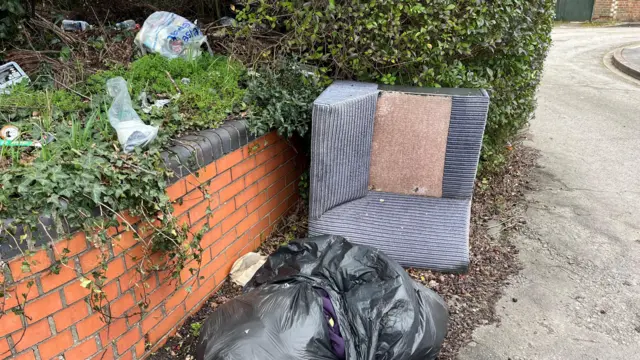
    An upturned armchair and two full black bin bags are on the ground, next to a small brick wall on a residential back road. Plastic bags, empty cans and plastic bottles are littered on grass above the wall.
    Image caption,

    Sofas, mattresses, tyres and chairs are among the items fly-tipped in Blackbird Leys

    A resident living in one of Oxfordshire's largest housing estates says fly-tipping around the area has become a regular occurrence.

    Andy Beal, who lives in Blackbird Leys, says a lot of the waste is left in alleyways, behind garages and people's gardens.

    "It's dead easy to come round here at night and dump stuff, even in the day," he says.

    "I've seen people driving vans and they have dumped all their stuff out."

    As well as waste collection fees, Beal blames a new advanced booking system at Oxfordshire's recycling centres for the increase in fly-tipping.

    In a statement Oxfordshire County Council said there was no evidence to suggest the booking system changes would lead to an increase in fly-tipping.

  16. Increase in large-scale fly-tippingpublished at 12:54 GMT

    Paul Lynch
    BBC Shared Data Unit

    A huge pile of wasteImage source, PA Media
    Image caption,

    A huge pile of fly-tipped waste was dumped in a field in Oxfordshire last year

    For years, the number of fly‑tipping incidents reported in England hovered around one million annually.

    But in 2020, the BBC’s Shared Data Unit identified a worrying trend: large‑scale incidents the size of a “tipper lorry” or bigger had been rising steadily.

    Campaign groups pointed to organised crime as the driving force. Fake waste‑clearance firms, posing as legitimate operators, were dumping commercial waste in fields, barns and parks.

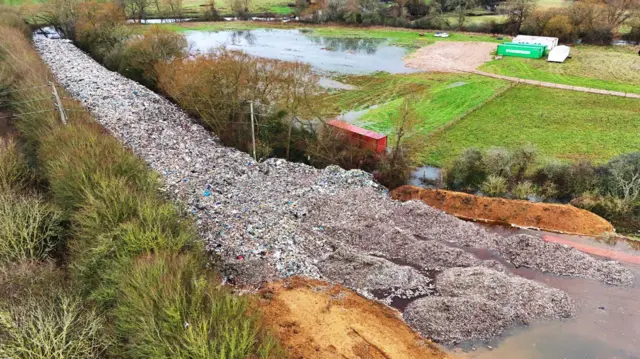
    High‑profile cases, like the 150m‑long waste mound beside the A43 in Oxfordshire, may draw headlines, but thousands more a year are still substantial in scale and are continuing to increase in frequency.

    In 2019‑20, councils logged around 31,000 incidents at least a tipper lorry in size; last year that had risen to nearly 52,000. The cost of clearing them, more than £19m.

    Yet, those campaigners still argue punishment remains too low when it comes to the bigger offences. Only 663 fines more than £1,000 have been issued to fly-tippers since 2019.

  17. Watch live as rubbish gets new lease of lifepublished at 12:49 GMT

    Inside a large waste‑processing facility, a rubbish truck is tipping a load of mixed recyclable materials onto a massive pile. The truck is surrounded by heaps of plastic, paper, and other waste, with concrete walls and industrial equipment visible around the sorting area.
    Image caption,

    The site in Padworth handles the processing of household dry mixed recycling, including paper, card, plastic bottles, pots and cans

    You have rinsed the jars, flattened the cardboard and dutifully lined everything up on the kerb - but what happens to your recycling once that bin lorry pulls away?

    We had a look behind the scenes at the Materials Recovery Facility in Padworth, Berkshire, and watched as plastics, paper and tin cans began a carefully choreographed journey through a wonderland of machinery and magnets.

    Curious to see for yourself? Tune in at 14:00 GMT for the next live stream by clicking on the 'Watch Live' button at the top of this page.

  18. Fly-tipping reports up in Birminghampublished at 12:40 GMT

    Jonathan Fagg
    BBC England Data Unit

    A Birmingham City Council report published last year found the city saw a rise in fly-tipping reports in the early months of the strike.

    "The overall numbers of cases of fly-tipping have increased significantly as an impact of the industrial action in waste management," a report for the city council's licensing and public protection committee agenda said in June.

    "This work is currently taking nearly all the available resource of the Waste Enforcement Unit.”

    The report shows the number of fly-tipping cases recorded by the city council in eight months in 2024 was 53.

    From the start of the strikes in January, the report shows an average 96 per month from January to March - with 118 cases in March alone.

  19. What's happening with Birmingham's bin strike?published at 12:29 GMT

    Kath Stanczyszyn
    BBC West Midlands

    A Brookfield Road resident looks at the pile of rubbish gathering on her roadImage source, Gabriel Bononi

    This is a strike rapidly heading for the record books.

    There is still no sign of a deal between two sides that seem completely entrenched.

    The council remains adamant about making modernising changes that will not bring about further equal pay claims. Unite says the idea of members’ pay and treatment being collateral damage for this is an unimpeachable red line.

    It is hard to see how it ends, but the ramifications are huge. The ongoing cost to the council is in the tens of millions and rising. The ongoing cost to workers is more than just financial.

    Residents in the second city have had more than enough. There have been zero recycling collections for more than 12 months and small pockets of the city are struggling to look acceptable.

    With local elections on the horizon, it would usual to assume both the Labour administration - who will likely be punished at the polls - and Unite - who so not know what will be on the cards from May - would be pushing behind the scenes for a resolution. But it seems there is no wriggle room.

    And of course, in industrial disputes there never is - until there is. Watch this space.

  20. 'Why don't they make fox-proof bins?'published at 12:13 GMT

    Nicky Campbell
    BBC Radio 5 Live presenter

    A fox stands on a garden fence. It is bushy and crimson coloured.Image source, Getty Images
    Image caption,

    Simon from London says foxes used to eat out of his bins

    Nicky Campbell's BBC Radio 5 Live programme has been taking calls from the public about the food waste systems in their area.

    Simon told the show that ten years ago he had brown bins at his home in Barnet, London, but had problems with foxes.

    "My wife and I did it and the foxes ate it all," he adds.

    "It was disgusting and we stopped doing it because the foxes kept on eating it.

    "Why don't they make fox-proof bins?," he asked.