From high seas to high fashion: The students making new clothes from old sails

 Anglia Ruskin University
Fashion students who are turning old boat sails into high-end fashion have said learning to sew and buying second-hand would help redress the balance in the "wasteful" industry.
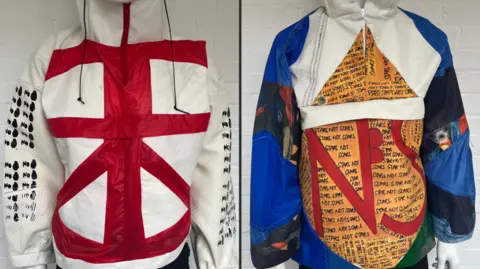
Anglia Ruskin University's Cambridge School of Art is exploring creative ways of reusing fabric from reclaimed sails.
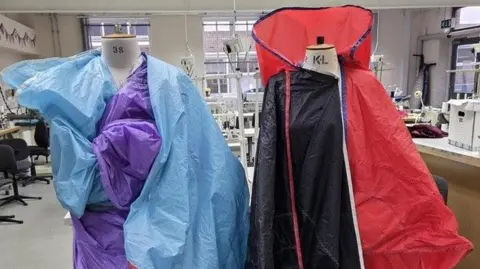
First-year students on the BA (Hons) Fashion Design programme are using end-of-life kite sails from dinghies to produce garments using minimal waste pattern-cutting techniques.
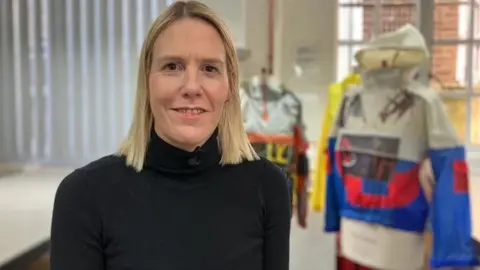
Lecturer in fashion design, Sarah Graham, said: "We like our students to leave with all the creative and professional skills expected and required by the fashion industry [and] as part of that, it's really important that we address the issues that are affecting the fashion industry."
 Anglia Ruskin University
The university has partnered with Clean Sailors, a not-for-profit organisation that aims to make the sport more sustainable and runs a recycling scheme called ReSail.
It said more than 97% of sails ended up in landfill and there were currently no formal recycling facilities for them, anywhere in the world.
Graham said: "Discovering the Clean Sailors platform gave our students valuable insight into the potential of alternative, sustainable materials.
"Sustainability is a really important issue in fashion design and the fashion industry, unfortunately, is responsible for a huge amount of degradation of the natural environment."
 Alex Dunlop/BBC
She said waste issues in fashionstarted in the manufacturing process with material left on the cutting room floor.
Then there was the concept of fast fashion and "how quickly we always seem to demand more".
"It's thinking about how we can reduce waste, try and keep things in use for as long as possible but also think about alternative material," she said.
"If we can introduce sustainable practice in the first year of our students learning then it will instil that sustainable creative practice into the rest of their careers.
"[It's about getting] away from that fast fashion mentality of wearing once or twice and then discarding and moving onto the next thing.
"It's rethinking how you think about fashion and how we can create value for fashion brands by producing clothing that can be added to or changed or adapted."
 Alex Dunlop/BBC
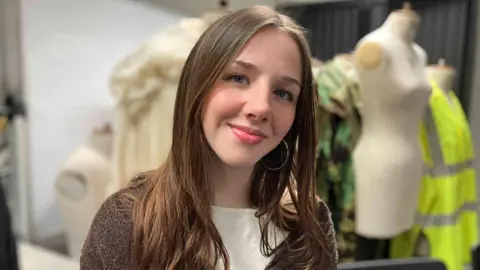
Scarlett Baker, 21, from Cambridge, said the sail fabric was "tough" but "a lot can be done with it."
She said she thought the fashion industry was probably "the most wasteful".
"For this project, we're doing a low-waste pattern, so it's very boxy because we're using as much material as we can, but that's not always possible," she said.
She said buying second-hand clothing would help redress the balance.
"There are more clothes already available for everyone; there doesn't need to be more clothes [commercially] made," she said.
"And learning how to sew should be more common than it is because you can do so much with it… and you value it so much more because you know how much work went into it."
 Alex Dunlop/BBC
Hollie Ralph, 19, from Harlow, Essex, agreed that wearing vintage clothes and making your own was a way forward.
"I've got a jacket that's my mum's and it's very 'in' to wear vintage clothes," she said.
"I don't wear brand new clothes because I can't afford them and I don't really like them.
"If you've got something that you want to throw away, just don't – you can do so many things with it. Learn to sew – it may not be easier for you, but it will cost so much less."
 Alex Dunlop/BBC
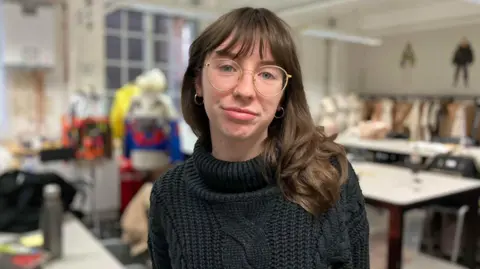
Ruby Ormston, 21, from Ely, Cambridgeshire, said waste was something she "always thinks about".
"There's waste at every point in fashion – from the start, even just cutting out the patterns," she said.
"Making more well-made products would help. You buy a shirt and wear it twice and wash it and it just disintegrates or bobbles.
"But just because something might not be the coolest, newest thing, it doesn't mean that it's bad – you can still keep wearing them."
Holly Manvell, founder of Clean Sailors, said: "Working with end-of-life sails asks students to design with responsibility in mind, turning what would be waste into objects of value.
"Just as importantly, it gives them a clear, practical vision of a fashion future where creativity is measured not only by aesthetics, but by impact and where designing better systems is part of the designer's job."
Follow Cambridgeshire news on BBC Sounds, Facebook, Instagram and X.
