Power cuts and travel disruption after Storm Dave hits Scotland

 Fubar News
Transport has been disrupted, roads have been blocked and dozens of homes have lost power as Scotland deals with the aftermath of Storm Dave.
Strong winds battered the country from Saturday afternoon through the night, with the Met Office recording a top wind speed of 73mph in Buchan, Aberdeenshire.
Many roads were blocked by trees overnight or restricted due to hazardous conditions, including the A8, A87 and A83. They have since reopened.
Homes have been left without power in southern and western areas hit the worst by the wind, with SP Energy Networks hoping to reconnect people by 18:00.
Some homes in Skye, Caithness and coastal parts of Aberdeenshire lost power overnight and SSEN, which covers areas north of the central belt, said it should be restored by 23:00.
High wind warnings are in place for the Forth Road Bridge and Tyne Bridge, while the Tay Road Bridge is only open to cars with a speed limit of 30mph.
Yellow warnings for wind covered all of Scotland on Saturday, while an amber warning was issued by the Met Office for southern Scotland, northern England and Wales.
Areas in the west Highlands, Argyll and the Western Isles saw heavy snow after the forecaster issued a yellow alert. All weather warnings have now expired.
Snow flurries also swept across parts of central Scotland on Sunday.
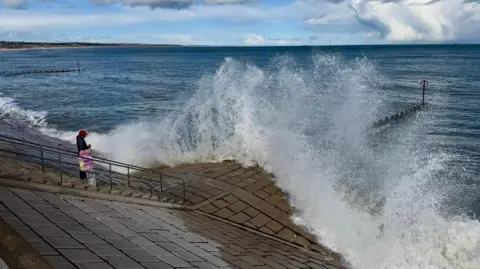 BBC Weather Watchers/clairewn
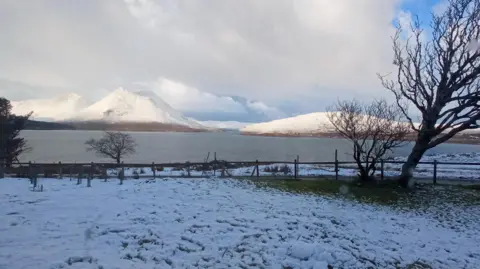 BBC Weather Watchers/Archie MacPhie
ScotRail warned that emergency speed restrictions would be implemented on sections of the network on Sunday which would result in longer journey times.
Anyone travelling is urged to check their journey before setting out.
Several sailings were cancelled by west coast ferry operator CalMac on Saturday night and Sunday morning due to Storm Dave.
It warned that some services could see disruption into Monday, such as the service between Oban and Kennacraig.
However some have resumed due to improvements in weather conditions, like the service between Fionnphort and Iona.
CalMac warned of further disruption across the network due to adverse weather and urged anyone travelling to check their journey.
Traffic Scotland urged drivers to be prepared for sudden gusts and vehicles veering off course.
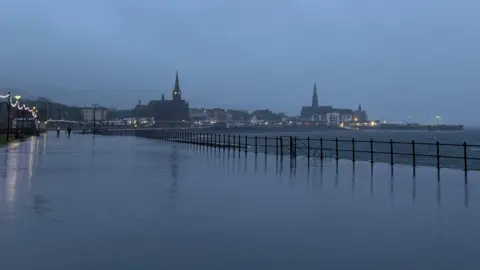 BBC Weather Watchers/Lawrence
Earlier, the Scottish Environment Protection Agency (Sepa) issued three flood warnings for Tayside covering Aberbothrie, the River Isla at Couper Angus and the River Earn between Innerpeffray to Bridge of Earn.
It warned that river levels were high after "heavy and persistent rainfall" on Saturday night.
'Storm Dave is pulling away'
The three yellow warnings across parts of northern England, Scotland and Wales had been due to remain in place until midday on Sunday.
But they were lifted by around 07:30 as the weather improved.
Marco Petagna from the Met Office said: "The winds eased down a bit more quickly than forecast across Scotland, northern England and Wales.
"Storm Dave is pulling away and the warnings are easing more quickly than forecast so the yellow warnings were no longer warranted."
The weather is expected to improve into Monday, however some southern areas could still see high winds.
A Met Office spokesperson said: "Storm Dave will clear northeast on Sunday morning, leaving sunshine and widespread showers across the UK.
"Northern areas will see the heaviest, blustery showers and feel cold, while temperatures elsewhere stay closer to average for early April."
