'This John the Baptist coin is unique and mysterious'

 Andrew Williams/Norfolk County Council
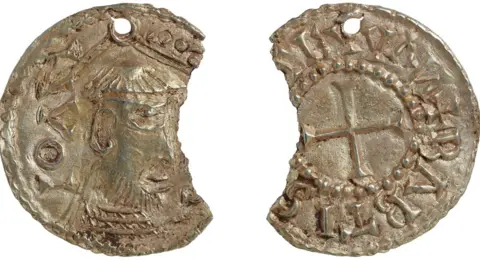
A 9th Century coin pendant that shows St John the Baptist is "bizarre - it's not like anything else I know", said an expert.
The incomplete pierced gold imitation solidus coin was found by a metal detectorist near Dunton, west of Fakenham in Norfolk.
Numismatist Simon Coupland said the discovery raised more questions than it answered, which makes it "fascinating, unique and intriguing".
The coin is going through the treasure process, meaning a coroner will determine if it is legally treasure, and Norwich Castle Museum hopes to acquire it.
 Getty Images
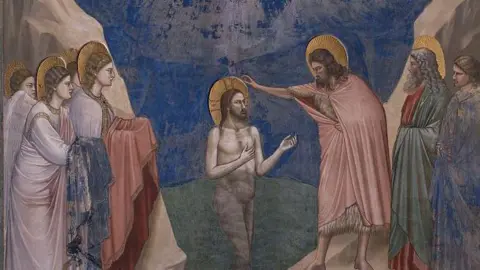
"St John the Baptist was Jesus' cousin and his fore-runner, who introduced him to a wider public by baptising him in the River Jordan and after that, his wider ministry began," said Coupland, explaining why the saint was such an important Christian figure.
"But a figure of John the Baptist on a coin is so unusual and remarkable - I don't know of another John the Baptist from the Carolingian period; it's bizarre - it's not like anything else I know."
The numismatist is an expert in coins of the Carolingian dynasty of western and central Europe, centred on modern-day France and most famous for the emperor Charlemagne (about 747 to 814).
Coupland dated the Dunton find to the late 9th Century because of the style of its lettering, which is like that found on Carolingian coins minted in the 860s or 870s.
 Simon Coupland
A chunk of the pendant is missing, but enough of the Latin inscription is left to be read.
IOAN is written on the side with a bearded man in profile and + BABTIS [...]T EVVAN on the reverse side. This was translated as "John, Baptist and Evangelist".
"If you look at who is pictured on portrait coins of the 9th Century in Western Europe it is the king, but not John, not Christ - that is a Byzantine Empire thing," he said.
"And these imitations of gold solidus tend to be made by Scandinavians, who are not Christian at this point - so what are they doing depicting John the Baptist?"
The kingdom of East Anglia had been conquered by the Vikings in AD870.
"So now you see why it is such a mysterious find; it's like a child with a hexagonal shaped object trying to fit it into squares when it doesn't fit at all," he added.
Norwich Castle Museum hopes to acquire the coin pendant.
Do you have a story suggestion for Norfolk? Contact us below.
Follow Norfolk news on BBC Sounds, Facebook, Instagram and X.
