Coping through the wettest winter on record

 Jacob King/PA Wire
The start to 2026 has seen relentless rain in many parts of the West Midlands, causing widespread flooding, waterlogged football pitches, homes and businesses counting the cost.
After heavy rain and storms in recent months, the Met Office said the region has experienced its "wettest winter on record".
For some counties, it has rained every day so far this year, with Worcestershire experiencing its wettest February since comparable records began in 1836.
But what has this meant for firms whose weather-dependent businesses operate entirely outside?
And is this record-breaking rain something we have to get used to?
 Tulleys Tulip Farm
Warwickshire is among the counties experiencing their second wettest winter, according to provisional figures from the Met Office.
Despite that, at Tulleys Tulip Garden, in Hatton, near Warwick, organisers are preparing to open to the public towards the end of March, for only their second season.
The popular tulip farm attracted large crowds on its debut in 2025, with about 750,000 tulips and more than 100 different varieties of the flower expected to bloom this year.
Sam Beare, co-owner, said the tulips were planted at the beginning of November but it was "hit and miss with the weather".
"Tulips are very, very weather-dependent as we know," he said.
"We put a lot of drainage into the fields."
Beare, who is a fourth-generation family farmer, said rotting bulbs due to the rain had a been concern, but despite recent wet weather in the region, the fields were now "looking great".
"Tulip bulbs really don't like sitting in water. If they sit in too much water and there's not enough drainage in the field, then the bulbs will rot and the actual crop won't be any good," he explained.

The farm, on Dark Lane, opened after the success of Tulleys Tulip Fest in Crawley, West Sussex.
Beare said he had noticed more rain than usual this season, but the gardens remained open during wet weather, with extra protection put in place for the bulbs.
"We put... aluminium padding down for everyone to park on so they're not parking in the mud," he explained.
Of the tulips, he says "they won't all be in bloom at the same time. It does come down to the weather".
The deluge the country experienced in early February was due to a blocked weather pattern - a high pressure system over Scandinavia is preventing the wet weather from moving away.
The Met Office estimates that at current levels of global warming, wet winters like 2023/24 have gone from being once in 80-year events to once in 20 - and with further warming this could become even more frequent.

Clive Vickers, who runs Halfpenny Green Wine Estate, said some areas of the site had been affected by heavy rain and waterlogging, but luckily, it hadn't damaged any of the vines.
"It's just as wet as we've ever seen it," he said.
"There's areas in the vineyard with waterline that we've never seen before.
"We didn't need too much data to tell us that was... out of the normal."
The vineyard, on the Staffordshire-Shropshire border, first opened in 1983 and features a restaurant, farm shop and wine-tasting facility.
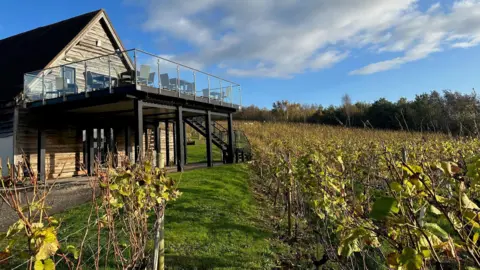
Vickers spoke of how the vines were dormant during the winter period, with bud-burst due to take place in April.
The water has since drained and as a result the vines were unaffected, but warmer weather would be needed later in the year, he explained.
The business is working out how to adapt to the changing weather.
"Certainly by the time we get into May and June they're flowering and the crop starts to fall, [so] we need some dry weather," he said.
"Last year, the 2025 season, we had four heatwaves and then we've had all this rain. It's strange."

Increased burning of fossil fuels like coal and oil over the last two centuries has released greenhouse gases like CO2 into the atmosphere, which have warmed our planet, the BBC's climate reporter Esme Stallard said.
For every 1C temperature rise our atmosphere can hold 7% more moisture, which can create heavier rainfall.
At the same time sea level rise around the UK is also accelerating, due to warmer, expanding oceans and melting glaciers.
It's having an impact right across the UK.
In Worcestershire, Astwood Bank was one of several locations that recorded rain on every single day of 2026, up to early February.
At Clive's Fruit Farm, in Upton-upon-Severn, the wet weather has also impacted fruit trees.
The farm produces raspberries, cherries, plums, apples and pears, with fruit picking usually starting from June.
Owner Charlie Clive, said it had "rained every single day" at a nearby village and he therefore wasn't surprised the county had recorded its wettest February in almost 200 years.
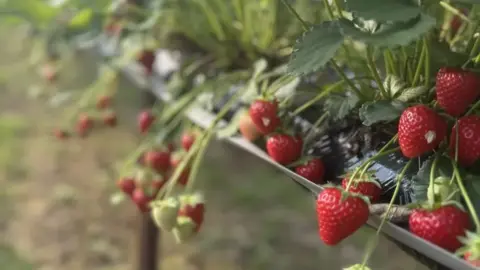 Clive's Fruit Farm
Clive said although the farm didn't experience flooding itself, the rain often had an impact on his crops.
"The fruit trees don't like being in wet soil all winter," he explained.
"It's because it kills it. It kills the roots that causes phytophthora.
"They just don't like it. And so when they wake up in the spring, a lot of the roots will have died."
Last year, the National Farmers Union (NFU) wrote to MPs to lay out the severe risks the sector was facing.
The wet winter of 2024 – the second wettest on record – saw the sector experience £1bn losses from damaged crops.
The true cost of this year's deluge will become clear throughout the year.
Follow BBC Coventry & Warwickshire on BBC Sounds, Facebook, X and Instagram.
