'A letter from Attenborough started my wildlife filming career'

 BBC
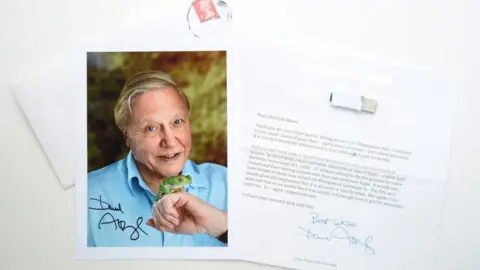
BBCChristian Marot never thought he would get a reply to the letter he sent to Sir David Attenborough, at the age of 19, which included a copy of his wildlife filming.
But 10 days later, one came, containing both praise and a considered critique - the original USB stick taped neatly to the personalised stationery bearing the broadcaster's name.
"It was just surreal," says Marot, and "hugely encouraging for a budding wildlife filmmaker".
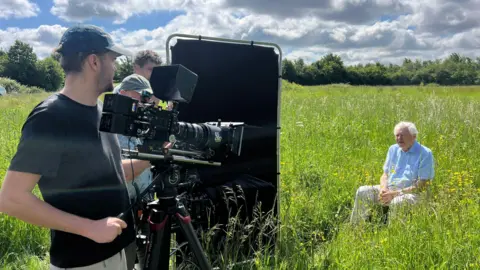
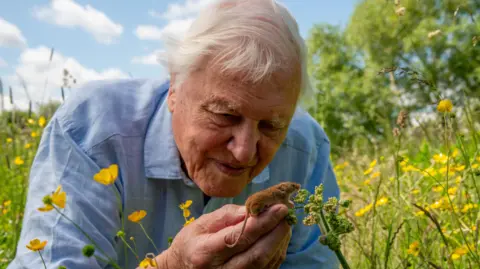
A decade later, now a professional camera operator, he found himself in a sunny field in Greenford, filming close up shots of Sir David releasing harvest mice on to a grass frond.
It was a real "pinch me moment" for someone who "found words to be difficult" because of his struggles with dyslexia and, on several occasions, was told by teachers he "would not succeed in life".
 Christian Marot
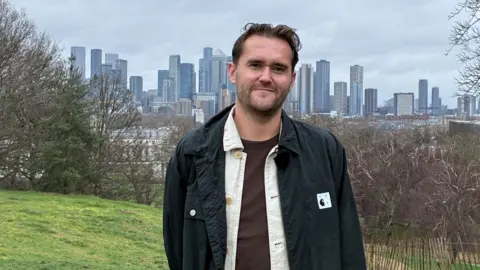
It is a rainy winter's day when I meet Christian in Greenwich Park, not far from where he lives between Hither Green and Catford in south-east London.
Quite a contrast to the hot, hazy days last summer when he was working as one of the principal camera operators for Sir David's new documentary, Wild London.
But the mix of skyscraper horizon and natural foreground fits perfectly with the theme of this programme - to draw our attention to the wildlife around us, something Marot has been interested in all his life.
He became "absolutely hooked" after getting a box set of Sir David's films when he was 12 - and shortly after, picked up a camera for the first time.
He started photographing the wildlife around him.
"I was literally in my back garden in London. I'd basically camp out and wait for whatever it was to come into the garden," he says.
At first, it was stills photography and he soon became a finalist in the prestigious International Garden Photographer of the Year competition.
 Christian Marot
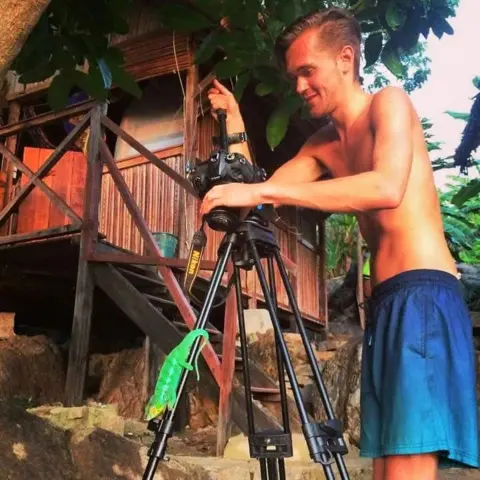
When he was 19, his grandmother died and left him a small inheritance which he used to fund a trip to Madagascar, having seen Sir David's programme about the African island.
"I just took a very rudimentary, basic kit with me," he says. "I mean, I really had no idea what I was doing."
Yet he gathered some beautiful footage and was eventually satisfied with the edit of a short film.
His family encouraged him to send it to the esteemed naturalist and helped him track down an address.
Much to his surprise, a reply came a short time later.
 Christian Marot
"I thought, how amazing for someone of his stature to have written back to someone like me, just a young boy who had a passion for wildlife," he says.
"That is almost his calling to encourage and inspire people of our generation to make a difference and appreciate the natural world around us."
Over the next few years, Marot gained experience in nature filming, with camera assistant and second camera roles - but never thought he would get to work with Sir David himself.
That was until the call came to work on Wild London.
Marot says: "It was the opportunity to work on something with my hero, but also the opportunity to work on something that's in my home town. And I never thought those two worlds would collide."
 BBC/Passion Planet
It was on the first filming day, in Greenford, West London, when Marot finally met the man who had inspired him as a boy.
He arrived early with, he says, "nerves going like crazy".
But Sir David arrived, introduced himself and quickly put him at ease.
Marot's job was to film close up shots of Sir David's hands as he gently encouraged a harvest mouse to cling to the grasses of a meadow.
He says it was an "amazing day" and "really special".
 BBC/Passion Planet
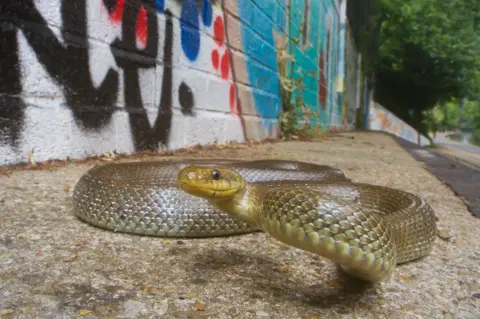
For the documentary's other filming days, he chased deer sightings in east London, lay on his stomach waiting for pigeons to hop on to Tube trains and spotted snakes along the Regent's Canal.
Marot said: "It has come full circle. There I was as a 12-year-old, picking up a camera for the first time and immediately drawn to photographing the animals in my garden, and here I am 20 years later doing the exact same thing but for a BBC, David Attenborough series."
He never mentioned the letter to Sir David, which rather disappointed his mother.
But when he spotted our article on the new programme and invitation for Londoners to get in touch about their wildlife encounters, he contacted us to tell his story - in part to give thanks.
"Attenborough did have such a profound effect on the course of my career," Marot says. "I wouldn't be here without him.
"And it really does show that with a bit of drive, dedication and putting yourself out there, it is possible."
