I went to rural Wales to bathe in starlight, and the Milky Way blew me away

 Siân Harrison
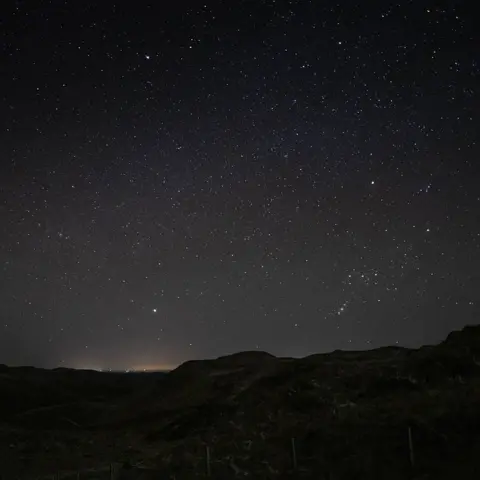
The first thing that strikes me is the darkness. I can't see any stars - only clouds.
Four-and-a-half hours later, at 22:30, the stars finally emerge, and it is breathtaking.
The stars extend as far as the eye can see, in every direction.
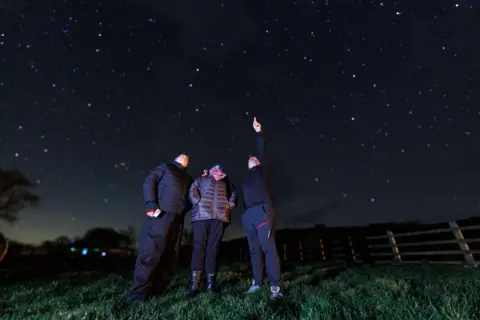
I'm with Siân and James Harrison, two avid star fans who've travelled from Cardiff to the tiny hamlet of Gogoyan, in the sweeping Ceredigion countryside in west Wales.
We're here to immerse ourselves in the night sky with the help of a guide.
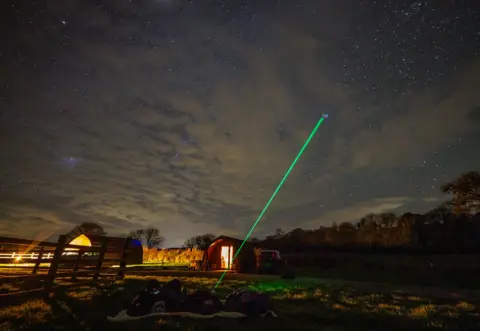
Lying on a blanket spread out on the ground, we gaze up at Jupiter, one of the brightest planets in the sky.
Poiting with a green laser which extends into the night sky, Dafydd Wyn Morgan, owner of astrotourism company Serydda, shows us three stars in a line, telling us he loves Orion's Belt.
James chimes in, saying it's his favourite constellation, as the region surrounding it is a part of space where stars are constantly being born.
"I'll focus on something and it'll be 150 million light years away," James says. "I can't quantify that."
A sense of calm washes over me. I feel like I'm looking at the same sky my ancestors would have seen.
 BBC/Thomas Winstone
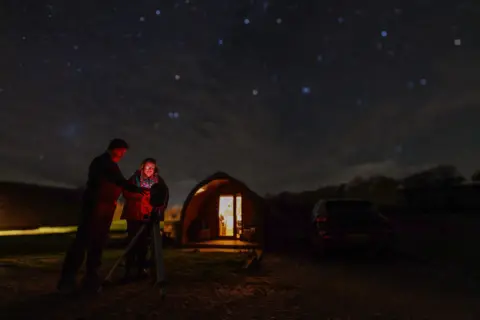
Wyn Morgan's star bathing sessions involve setting up a smart telescope then lying on the ground looking up at the sky and talking about the sights on show that night - as well the myths and legends connected to them.
It's similar to forest bathing, which emerged in Japan in the 1980s and has now become part of a range of astrotourism and wellness practices.
"It's about the feeling at that precise moment," Wyn Morgan says, "how it makes you feel emotionally," rather than something more scientific which requires you to know about everything you see.
But he says the experience might lead you to stargazing by giving you the confidence and interest to discover more.
 BBC/Thomas Winstone
Wyn Morgan began Serydda in January 2025 after having organised events for years with friend and world-renowned astrophotographer Alyn Wallace, who died in 2024.
Since then, 107 people have attended his workshops, with some returning two or three times at different dark sky locations.
It's an experience which has seen rising interest - with 72% of people considering visiting darker sky destinations with star bathing experiences in a Booking.com survey of 27,000 travellers.
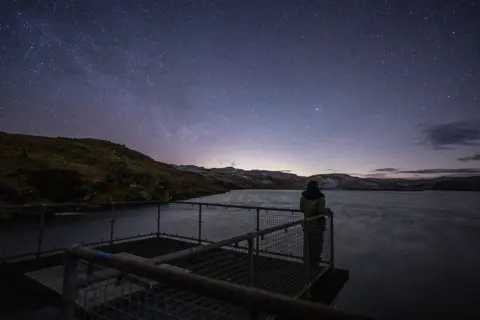
Having driven up to Llyn Teifi in the Cambrian mountains, we stand on a bridge, surrounded by rocky outcrops and marshland.
"Can you smell that?" Wyn Morgan asks. "Breathing in the night sky is something totally different: Cool, cold, fresh and pure - like drinking water from a well."
 Serydda/Dafydd Wyn Morgan
Humans have always been attracted to the night sky.
"It goes back to the very core of humanity," explains Dani Robertson, a dark skies officer for Snowdonia National Park.
She says 98% of the UK population lives under a light-polluted sky. We're getting to the third or fourth generation of people who see very few stars - if any, she explains.
Wales is home to two of the six UK national parks with International Dark Sky Reserve status. People travel from places like London to her events, she says, because it's their only opportunity to see the stars and experience true darkness.
Robertson arranges stargazing in her mobile observatory, night hikes, swims and meteor watch parties.
One man, who'd come for his 50th birthday and had always wanted to see shooting stars, sobbed as he saw them streak across the sky, she tells us.
For people who live in urban environments, "it's hugely moving, it's a once-in-a-lifetime opportunity".
"I can't run enough events to keep up with demand," Robertson says. "Every event has a huge waiting list."
 BBC/Thomas Winstone
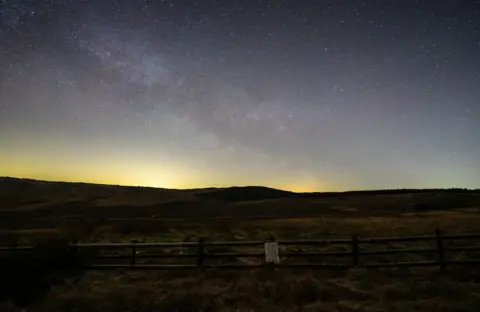
Nature can have a positive effect on regulating our brain and body according to Annalisa Setti, senior lecturer of applied psychology and sustainability at University College Cork.
"When we 'get lost' observing nature, we experience an optimal level of arousal. We are not bored, nor too excited - and that gives us the feeling of 'positive relaxation'," she says.
And areas of the brain linked with "ruminating on negative thoughts" are less active when looking at, or being in, nature, Setti adds.
 Serydda/Dafydd Wyn Morgan
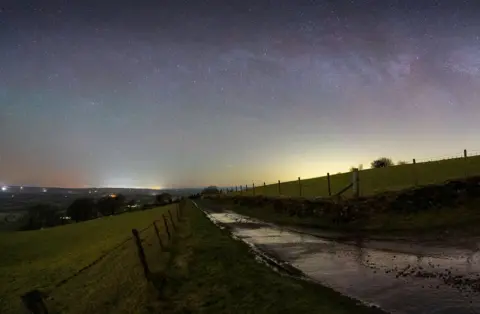
But there is a threat to these benefits. Although the night sky is not going anywhere, our view of it is at risk.
Robertson says light pollution is increasing, which affects human circadian rhythms, and the lives of other species.
But there is a simple solution, she says. Dark-sky friendly bulbs, turning lights off when not needed, and closing the curtains at night.
 Serydda/Dafydd Wyn Morgan
Standing in the mountains at about 02:00, a cloud-like formation becomes visible in the night sky.
It's only the excited energy of Siân and James that makes me realise it is actually something else - the Milky Way.
We stand in silence and stare at the collection of gas, dust, dark matter and billions of stars.
"To be able to look at these things and appreciate the beauty," James says, "the majesty and the scale of it - it's just amazing."
