Rare fungus spotted for first time in 50 years

 Manx Wildlife Trust
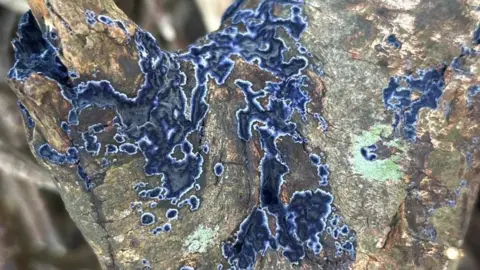
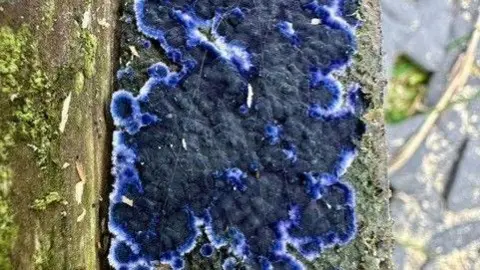
A rare blue fungus has been spotted on the Isle of Man for the first time in more than half a century.
Terana caerulea, known as Cobalt Crust, which forms on the underside of dead wood and tree branches in warm, damp forests, was spotted in Onchan on the island's east coast.
The rare fungus, most commonly found in southern England and Wales, helps to break down natural matter, but is also used in medicine, to create an antibiotic which treats infections like strep throat and scarlet fever.
Liz Charter, founder of the Isle of Man Fungus Group, said the increase in sightings is thanks to more people looking for it and ideal weather conditions.
 Graham Makepeace-Warne
Charter said: "We need lots of different types of fungi as they're an important part in our environment.
"They play a massive role in the rotting down of dead flies or the horns of dead sheep as well as wood and plant materials."
She said there had now been three sightings of the rare Cobalt Crust this year.
"We're at the north end of its distributions on the British Isles and it's really not that common in Britain".
The fungus grows on natural matter and allows its nutrients to go back into the soil, forming part of "nature's recycling".
"I find them endlessly fascinating", she said.
 Liz Charter
Despite the fungus first being recorded in the 16th Century by French naturalist Jean-Baptiste Lamarck, little is known about how Cobalt Crust, first spotted on the island near Lezayre in 1976, is transported.
Charter said: "It's very difficult to know how fungi has come to the island, perhaps on peoples feet or in the airstream - it's one of those mysteries".
Read more stories from the Isle of Man on the BBC, watch BBC North West Tonight on BBC iPlayer and follow BBC Isle of Man on Facebook and X.
