Schools pioneer SEND student inclusion scheme

 BBC
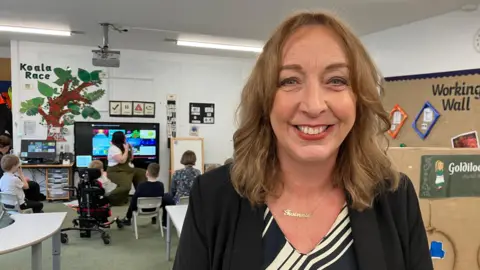
BBCThe school day starts twice at Field Lane Primary in West Yorkshire. Excited playground voices are followed by a line of minibuses bringing children with Special Educational Needs and Disabilities (SEND) to the gate.
It's actually two Rastrick schools in one. The number of pupils had been falling at Field Lane, but the nearby specialist Highbury School had a waiting list.
A partnership between Polaris Multi Academy Trust, which operates Field Lane, the local authority and Highbury has seen a "co-located" school established with a growing register. At its heart is a pioneering approach to improve inclusion of SEND pupils in the mainstream, according to teachers.
Prioritising inclusion within mainstream settings is a key theme in the government's recently published Schools White Paper.
But the National Education Union (NEU) warns further funding will be required for the proposals to completely work.

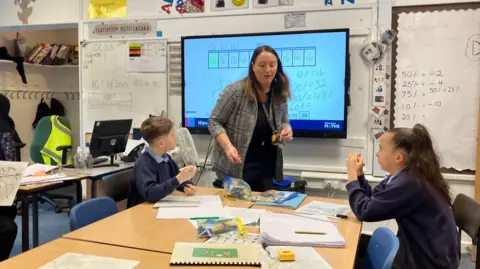
The Friday morning routine is well underway, with Field Lane pupils crunching percentages.
In a room along the corridor, Highbury children are in a movement class with the help of some brightly coloured animated dinosaurs on a screen.
"We didn't want to just rent a room," explains Debbie Sweet, head of Highbury School.
"We've done that before with satellite provision in mainstream schools.
"It worked well, but we wanted to have a wider impact so we came up with the idea of a co-located school."
"We've moved four classes of children," she adds.
"We're harnessing the expertise of the specialist staff and using it to develop wider inclusive practice across the school."
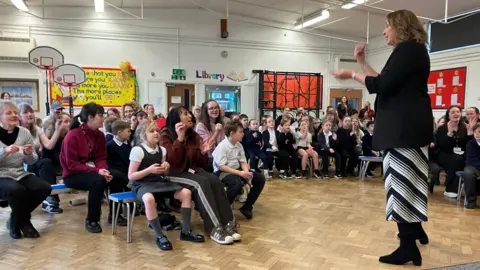
Children from the mainstream and specialist sections of the school come together at break times and during assembly to mix freely.
"The mainstream children are doing as much teaching as the adults," Sweet explains.
"They are showing them how to play, how to take turns, have conversations and resolve conflicts.
"In the classroom they are still being taught a specialist curriculum with specialist approaches."
Sweet adds: "At Field Lane I have met the most amazing children who are developing empathy, understanding and acceptance - they are learning about autism and physical disability."
Just under 20% of all pupils (1.7m) in England receive some sort of support for special educational needs or disabilities.
Among a number of proposed changes is a promise of billions of pounds to be invested directly with schools to improve access to specialist teachers and speech and language therapists.
"We want to see a stronger commitment from the government to put their money where their mouth is," says Hamish Heald, the joint secretary of the Calderdale branch of the NEU.
"We want to improve the educational outcomes of children, whether they are in the mainstream or have additional needs and are being educated in an inclusive way like we're seeing at Field Lane."
The new approach has been welcomed by parents at the school near Brighouse.
Tiffany's daughter Mirren attends Field Lane.
"It's a wonderful school, all four of my children have come through," she says.
"Mirren has made great bonds with the children who have come in."
She continues: "We're all together in society and to do it at this stage gives a better knowledge of what happens in the real world."
Chelsea is mum to Tilly and also has a job working at the school.
"Tilly started at a mainstream primary school but she was struggling," she says.
"We moved her to Highbury and she's doing so well."
She adds: "I think it's an amazing idea - Tilly gets to mingle with mainstream children and they get a better understanding of children with additional needs."
Steve Evans, chief executive of the Polaris Multi Academy Trust, says: "I believe this is the right approach.
"With the support from local authorities and the funding from Polaris, we're seeing the roll at Field Lane increase.
"You can see the enjoyment from the children but we're also seeing collegiate attitudes amongst the staff."
As break time comes to an end, children from each stream skip back to the door together and head back to their classes.
"It takes commitment, and over time," Sweet concludes.
"We're not going anywhere."
Listen to highlights from West Yorkshire on BBC Sounds, catch up with the latest episode of Look North.
