The government is reforming the SEND system. This is what those impacted want changing

 BBC
BBCLeaked plans for reforms to the special educational needs and disabilities (SEND) system in England suggest ministers are planning a radical overhaul of how children get the support they need.
In recent years, the National Audit Office has called the system "broken", with councils projected to spend £14.8bn on SEND this year, up from £5bn a decade ago.
The Schools White Paper, the government's formal policy document setting out its proposals on SEND, is expected to be published in the coming days, though some details were leaked earlier this week.
BBC News has been speaking to families, teachers, pupils and councils about their experiences of the current system, and what they hope will change.
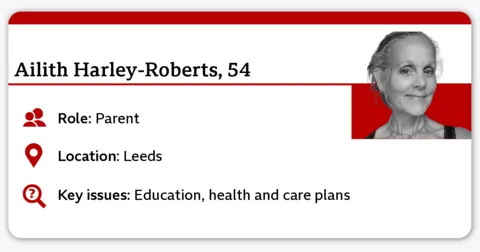
Ailith, whose daughter Thalia has Down's syndrome, says education, health and care plans (EHCPs) - the legal documents which identify a child's needs and set out the support they should receive - provide "vital, legally enforceable rights" for a child.
She says the leaked government proposals to review children's EHCPs after primary school - and again after GCSEs - is causing increasing anxiety among the families she is in contact with through running Sunshine and Smiles, a charity supporting families of children with Down's syndrome.
"With the current system already struggling to manage one assessment, introducing three raises serious concerns about capacity, resources, and who will ensure plans are followed through," she says.
She worries that children with lifelong conditions might face unnecessary reassessments and risk losing the support they need.
"Legal safeguards protecting them seem to be eroding," she says.
Her daughter attends a mainstream school with an inclusion hub, and Ailith believes flexibility is key to meeting Thalia's needs.
"While the system is far from perfect, I'm grateful my daughter's needs have been properly assessed and recognised," she says.
Without EHCPs, she says children are at risk of being placed in settings which are inappropriate for their needs, or missing out on education altogether.
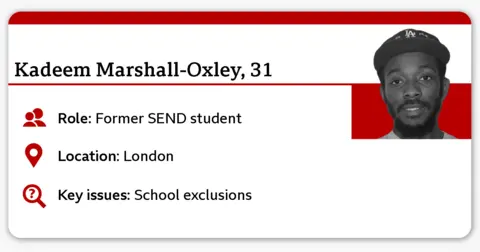
Kadeem was diagnosed with oppositional defiant disorder (ODD), a behavioural condition associated with frequent bouts of becoming angry or irritable, when he was nine years old.
He believes his diagnosis should have brought him more support, but that the lack of it led to him becoming isolated, and his behaviour worsening.
"I was permanently excluded from two primary schools, sectioned, home-tutored, and placed in a pupil referral unit," he said.
Kadeem says exclusion can play a huge factor in children's mental health, and thinks there needs to be better communication between different parts of the SEND system to focus on a child's needs, rather than on punishing their behaviour.
If there is a focus on more mainstream inclusion in the government's plans, he says he would like to see children with SEND supported within smaller class sizes, and with regular breaks, to help prevent the worsening behaviour which can lead to suspensions and exclusions.
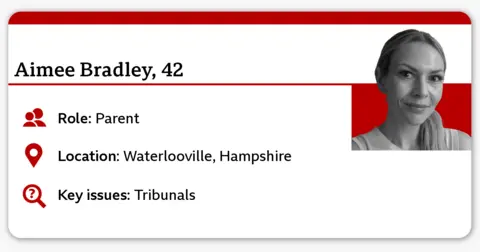
Aimee, who has three children with SEND, says there "simply isn't enough provision" and that families are forced to go to tribunals to secure appropriate support "far too often".
Tribunals take place when there are disputes between local authorities, which provide SEND support, and parents who believe their child isn't getting the right help.
Families often have to pay their own fees for assessments, reports and representation, which can cost thousands.
Aimee won at her own tribunal, after challenging the council's decision to place her son in a mainstream school, but said the experience was "incredibly hard".
"The forms are difficult to navigate and the whole process adds emotional stress that doesn't need to be there," she said.
Now she says her son is "thriving", and that finding the right placement was "life-changing for the whole family".
A Hampshire County Council spokesperson said they did not comment on individual cases, but that they strive to deliver the best for children in the area, including those with SEND.
They said the "exponential" rise in demand for SEND support had made finding available and suitable placements "increasingly challenging". This had led to a rise in tribunals, they said, adding that free and impartial support was available to those families.
"Locally, we're doing all that we can to address challenges in the SEND system," they said, adding that they were waiting for more details from the government's White Paper on what changes will be coming to address the issues nationally.
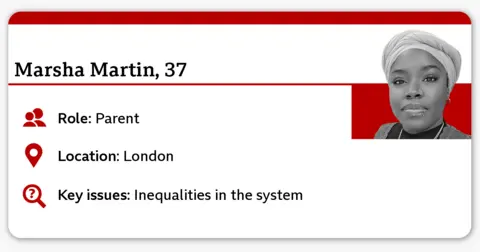
Marsha and her three children are autistic and have ADHD.
She founded Black SEN Mamas in 2020, a peer support network bringing together families with similar experiences, and it now supports thousands of parents across the UK and abroad.
She says non-white families, particularly those from low-income backgrounds, face "additional barriers at every stage".
She believes her own daughter has been treated unfairly in the past and says her experience, working with parents through Black SEN Mamas, is that unconscious biases may play a part in the way decisions are made about children's needs - but that it's hard to prove. She wants the government's reforms to include specific training for staff to help tackle racism and unconscious bias.
She has been eagerly awaiting news of the reforms to SEND support, and says she was disappointed by proposed plans to reassess the support children are entitled to after they finish primary school.
Under the leaked proposals, fewer children will retain their EHCPs which set out support a child is entitled to - such as placement in a particular school, speech and language therapy, or extra one-on-one time with specialist teachers - into secondary school.
The move would save money for the government, which has announced billions in funding to pay off the debts councils have built up paying for EHCPs and other SEND provision, with future SEND costs also being managed centrally going forwards.
But Marsha fears it could mean vulnerable children lose the support which has helped them progress in primary school once they leave Year 6, which could lead to many slipping through the cracks.
"Children's rights are being compromised, and their needs don't disappear - they escalate when unsupported," she says.
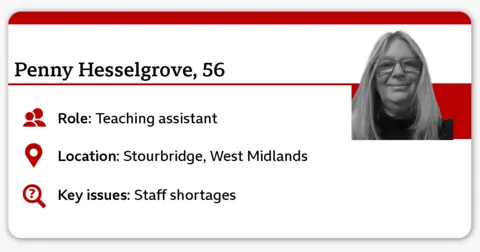
Penny has worked as a teaching assistant in a mainstream primary school for over 22 years, supporting children with SEND, mostly on a one-to-one basis.
She supports the government's mission to make mainstream schools more inclusive for children with SEND, including recently announced plans to introduce inclusion hubs in every school.
But she says the system is currently too stretched, and risks becoming more so as experienced teachers leave the profession.
"Staff are routinely asked to supervise playgrounds of over 300 pupils, with no time to implement individual support plans or interventions," she says.
"Experienced staff, including head teachers and SENCOs [special educational needs coordinators], are leaving, and children's needs are going unmet."
She also says urgent issues around safeguarding, pupil behaviour and staff shortages are contributing to the unmet needs of children in schools.
She wants the government changes to focus on the support children with SEND can get in mainstream schools.
That means strong leadership, well-trained staff, clear communication, and the freedom to share expertise between schools, she says.
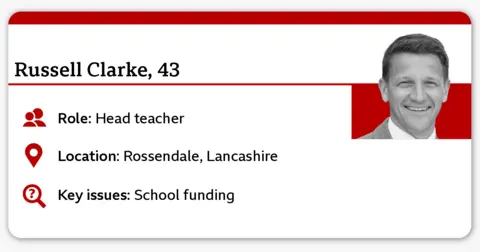
Russell, head teacher at Haslingden High School and Sixth Form in Rossendale, Lancashire, says the biggest issue with the SEND system is the funding - "both the amount and how it's distributed".
"Schools need more funding to provide inclusive teaching and timely access to specialist support," he says.
With over 300 students on his school's SEND register, Russell says he needs more specialist staff, better facilities, and more training to broaden the school's provision - things he hopes will be addressed in the upcoming White Paper.
He also says there needs to be more practical consultation between schools, families, and the authorities on how to deliver the support a child needs.
"Honest, practical conversations are vital to meeting young people's needs effectively," he says.
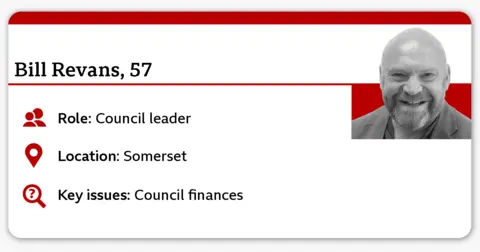
Cllr Bill Revans, leader of Somerset Council, says urgent reform is needed to prevent the SEND system becoming financially unsustainable.
"The present SEND system is in crisis," he says. "The number of young people needing EHCPs is rising faster than ever before, while the cost of that support is increasing significantly."
He says councils like his are facing mounting pressures, with families waiting longer for assessments and placements. In Somerset, demand for EHCPs has doubled over the past five years, and the county's special schools are now full.
As a result, the council is increasingly relying on private school placements, which are significantly more expensive for councils than children being supported in mainstream schools - though the government has said the price of those placements will be capped as part of its reforms.
Somerset Council plans to create more than 250 new high-needs places within mainstream schools over the next three years, including specialist units with smaller class sizes and staff trained in neurodiversity and emotional regulation. But Revans says councils cannot solve the problem alone.
"Anything short of root-and-branch reform risks trapping councils in a vicious cycle of overspending and worsening services for families," he says.
