More than one in five pupils in England getting special educational needs support

 Getty Images
More than one in five pupils in England - around 1.8 million children - are receiving support for special educational needs and disabilities (SEND).
That's according to the first annual statistics published since the government set out plans to overhaul the SEND system and change the level of support children can get.
Ministers say billions of pounds will be invested to make all mainstream schools "truly inclusive", but some have criticised the proposals, with one SEND charity saying they could "strip away" legal protections for children needing support.
How does SEND support work?
SEND support is provided to children and young people who need extra help to meet their physical, communication, social, emotional or mental health needs.
In England, if a child or young person needs more support than is typically provided in mainstream schools, their parent or carer can apply for an education, health and care plan (EHCP). This identifies their needs and sets out the support they should receive. Local councils are responsible for ensuring EHCPs are followed.
EHCPs can stay in place until the age of 25, as long as the young person remains in the education system.
How many children get SEND support and why has the number risen?
Over 1.8 million pupils in England's schools receive support for special educational needs, more than one in five. That is an increase of 91,400 (5.2%) since 2025.
The latest Department for Education figures show what 6% of all students (539,000) - or just under a third of those with SEND - get the highest level of support through an EHCP. That is up from 5.3% in 2025.
In total, 639,000 young people up to the age of 25 have EHCPs in England, a number that has more than doubled in a decade.
Most of that increase has been driven by a rise in autism spectrum disorder (ASD) diagnoses. The condition is now listed as the primary need in a third of all EHCPs.
Demand for speech and language support has also risen since the Covid pandemic, and more young people are asking for help with social, emotional and mental health needs.
Overall spending on SEND has risen by two-thirds in the past ten years, according to the Institute for Fiscal Studies (IFS), driven by the growing demand for support.
Who pays for SEND support?
Councils are projected to spend £14.8bn overall on SEND in 2025/26, according to the Office for Budget Responsibility (OBR), which assesses government spending. That is up from £5bn in 2015/16.
In England, up to £6,000 of the initial cost of supporting a pupil with SEND must come from mainstream school budgets.
Further costs of EHCPs and the full cost of supporting those in special schools are covered by a local authorities, but will be taken on by central government by 2028.
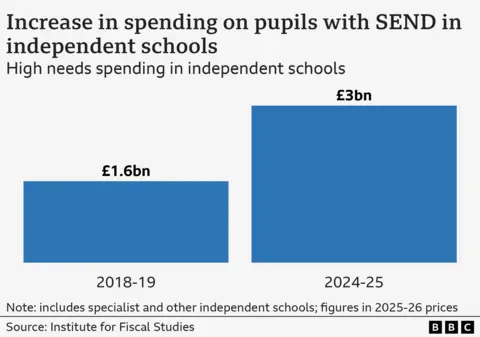
Councils also pay independent special school fees for around 38,000 pupils, partly because of a lack of specialist places in the state sector.
The average cost for an independent special school place is about £61,500 a year per pupil, compared to about £24,000 per pupil in state-funded special schools, according to the IFS.
Transport to and from school for pupils with SEND is funded separately by councils. In 2023/24, councils spent £1.5bn on school transport for 470,000 students, more than double the amount in 2015/16.
In recent years, the cost of providing SEND support has regularly outstripped the funding councils receive from central government, leading to rising debts.
That overspend is being artificially held off council budgets until 2028. By then, the OBR predicts £14bn of SEND deficits will have built up.
In February 2026 the government said it would spend £5bn to pay off 90% of any SEND deficits that had been built up by councils to the end of March 2026.
It said that by 2028, SEND costs will be managed centrally rather than by local authorities.
What are the problems with the current SEND system?
 Getty Images
The Labour government said it inherited a SEND system "on its knees".
In 2024, the National Audit Office warned the system was "financially unsustainable" for councils, and was not delivering better outcomes for children with SEND, despite a 58% increase in funding in the decade up to 2024/25.
There has been increasing pressure on mainstream schools to provide support, as well as a shortage of specialist school places and staff.
The process for parents and children to get an EHCP can also be lengthy, with fewer than half issued by the 20-week legal deadline in 2024.
There was also a record number of tribunals in 2024/25, where parents disagreed with a refusal to offer support, or were challenging the level of assistance offered.
How is SEND support changing?
In February 2026 the government set out plans to reform the SEND system in its Schools White Paper, an official document detailing policy proposals.
Ministers said that from September 2029, children's EHCP entitlements will be reassessed as they move between education stages, such as between primary and secondary school.
By 2035, EHCPs will be reserved for children with the most complex needs.
New "individual support plans", or ISPs, will also be introduced for all children with SEND. They will be drawn up by schools and categorised as "targeted", "targeted plus" or "specialist".
"Targeted" support might involve pupils receiving help in small groups and other reasonable adjustments, while "targeted plus" will give a child access to specialists like speech and language therapists and educational psychologists.
"Specialist" support plans will provide help for more complex needs, and entitle a child to an EHCP delivered by the local authority.
To help deliver these changes, the government said it would invest £4bn in SEND over the next three years to make "every school truly inclusive".
The government also said it would cap how much private schools can charge for specialist school places.
But the proposals have faced some criticism.
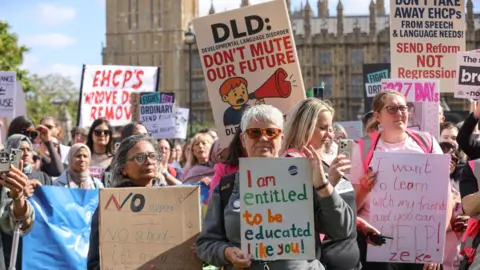
The Independent Provider of Special Education Advice (IPSEA), a charity specialising in English SEND law, said the reforms could weaken individual pupils' rights to receive support.
It is concerned that the new ISPs won't have the same level of legal protection as EHCPs.
Elsewhere, the National Education Union has said that schools don't have enough staff to be able to support more children with SEND within the mainstream sector.
What SEND support is available in the rest of the UK?
Education is a devolved issue, and each nation in the UK has its own system for supporting students with additional needs.
In Scotland, pupils are assessed as having additional support needs (ASN), under a broader definition than is used in England. Legally-binding "coordinated support plans" are reserved only for those with the most complex needs.
Wales introduced major reforms in 2021 for children with additional learning needs (ALN). Most individual plans are managed by mainstream schools, with local authorities managing plans for those with more complex needs or in specialist provision.
Northern Ireland also uses the term SEND, but its legally-binding individual plans are known as "statements of special educational needs".
