'It is lovely to talk about St Brigid in a school named after her'

 BBC
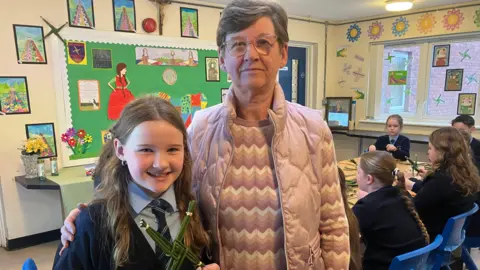
BBCFor more than 20 years Carmel Hayes has been visiting St Brigid's Primary School in Drumilly, south Armagh to teach children how to make St Brigid's crosses.
"The whole secret is to hold them good and tight," she said.
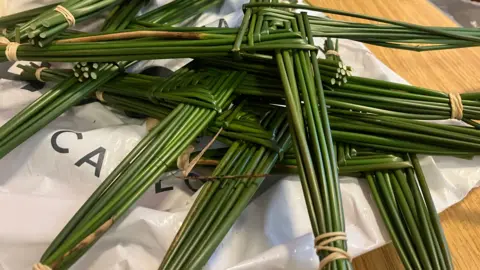
The 'them' to which she is referring are rushes, the thick grass-like plant that farmers may wish wasn't in their fields.
Among Carmel's most attentive students is her granddaughter Mya. She said the art of a good St Brigid's Cross is to fold the rushes, hold them tight and add in more and more on each side.
In the corner of the room sits a basket of rushes, some of them were collected by Olivia.
"I went to the fields and cut them down and brought them into school," she said.
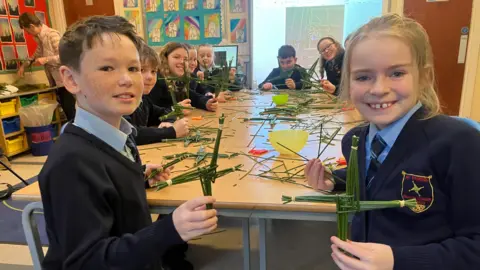
As well as cross making, Carmel is teaching the children some of the stories associated with St Brigid and how her feast day, February 1, marks the start of spring or Imbolc, in the Celtic calendar.
"It is lovely to talk about her in a school named after her," Carmel said.
"It's a tradition every year for 1 February, getting out of the winter blues and getting into spring, looking for snowdrops and looking for flowers because the start of the spring is so linked to St Brigid."
Among the stories the children have been learning is how Brigid asked the King of Leinster for land for her work. He said 'no'. She convinced him to give her whatever land her cloak could cover.
Riona said: "She wanted land to build a church and she had a cloak and it grew all over the land but the king didn't want her to have the land."
With land acquired Eadaoin adds, "She built that church in Kildare and it was her most famous church but she was from near here in Louth."
Faughart in County Louth is just over 10 miles from the primary school.
And although Louth and Kildare may well have the best-established connections to St Brigid, Downpatrick in Co Down also has a strong claim.
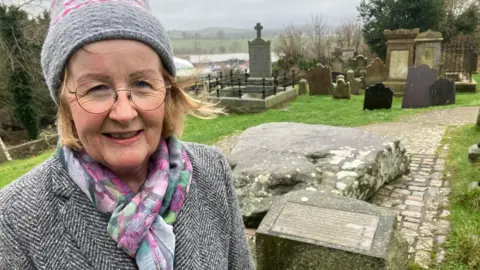
The County Down town may be better known as the home of St Patrick, but it's said Ireland's two other patron saints, Brigid and Colmcille are also buried there.
Standing at the three saints' grave at Down Cathedral is the appropriately named tour guide Brigid Watson.
"When she died she was buried beside the high altar in Kildare," she said.
"But because of Viking attacks it was decided in 878AD to bring her remains here to Downpatrick where she is buried with St Patrick and also St Colmcille – so the three patron saints of Ireland are buried together here on Cathedral Hill."
Today, Watson said it is unclear just how much of St Brigid's remains remain in Downpatrick as relics, including her skull were taken elsewhere.
"I've actually been to the church on the outskirts of Lisbon where her skull is kept," Watson said.
"It was brought there by three knights who left there in the 12th Century."
In recent years St Brigid's Day has grown in prominence. It is now a public holiday in the Republic of Ireland. Although it is not a holiday in Northern Ireland, more and more events take place each year to mark her feast day.
Among those events is a weekend long festival at Down Cathedral, just yards from her grave.
