Government wins case to prevent release of secret intelligence

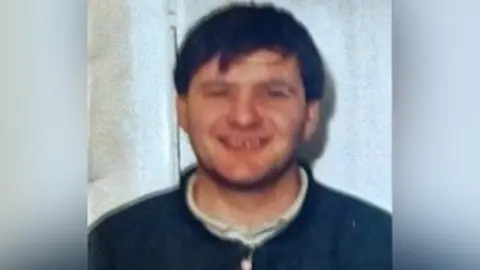 Family handout
The government has won a UK Supreme Court case to prevent the disclosure of intelligence information in a Troubles inquest.
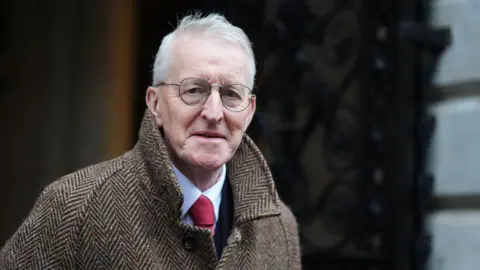
The case was brought by the Northern Ireland Secretary Hilary Benn.
He was appealing a decision in which a coroner intended to release details about the loyalist murder of Paul Thompson in 1994.
The victim's family believes the case involves collusion.
Benn had said he was awaiting the ruling before making a decision on identifying the British Army agent in the IRA known as Stakeknife.
Lawyers for Benn argued disclosure would "be contrary to the public interest in protecting national security".
In a statement released after the ruling, the NI minister said the government welcomed the "unanimous judgement".
What was the Paul Thompson inquest?
Mr Thompson, 25, was travelling in a taxi which was fired upon by the Ulster Freedom Fighters (UFF) at Springfield Park in west Belfast.
Coroner Louisa Fee had planned to disclose "gists", or summaries, of intelligence at his inquest in March 2024.
But the government intervened with court action.
The Supreme Court heard the case over two days in June and delivered its findings on Wednesday.
It found six errors in the coroner's decision.
 PA Media
The judgement stated: "The Supreme Court holds that the balance of the public interest clearly lies against disclosure of the two gists."
The PSNI chief constable Jon Boutcher had supported releasing the information.
Judges said they had "considerable sympathy with the desire of the chief constable to demonstrate that the PSNI is seeking to be transparent".
They added: "The national security interest should not be treated as a point of dispute between the chief constable and the secretary of state to be brought to court for a resolution.
"In the case of disagreement... the ordinary position is likely to be that the court will look to the secretary of state for the relevant assessment."
Campaigners believe the outcome will have implications for state secrecy in other Troubles legacy cases.
What have people said about the judgement?
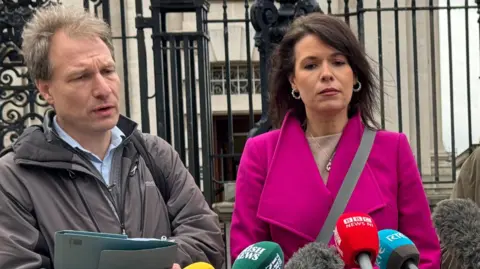
Amnesty International, Relatives for Justice and the Committee on the Administration of Justice (CAJ) had supported Mr Thompson's family.
They said the case raised "critical questions" about the government's Neither Confirm Nor Deny (NCND) policy, which is used "to prevent the disclosure of information on national security grounds".
Daniel Holder, Director of CAJ said there was a concern the ruling would enable a secretary of state "to conceal the involvement of state agents" in Troubles' killings and violations.
"The ruling itself implies that doing so is an appropriate application of the governments' NCND policy," he said.
"This is despite ministers being ultimately responsible for the security agencies that were running the agents."
Gráinne Teggart, Northern Ireland Deputy Director of Amnesty International UK, added: "Today is a grim day for truth.
"National security cannot be a blank cheque to conceal state wrongdoing or human rights violations."
What does this mean for naming Stakeknife?
Benn said it was a "highly complex case with wide-ranging implications".
"The government will therefore take time to fully consider all aspects of this judgement, including those relevant to the request made by Operation Kenova for the Government to name Stakeknife," he added.
 PA Media
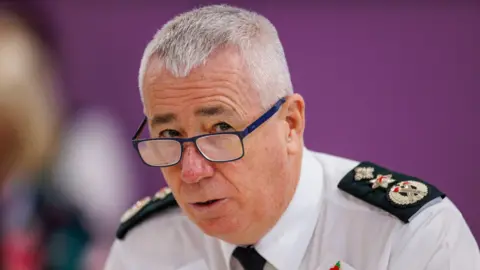
Chief Constable Jon Boutcher said the PSNI will now "study today's judgement" and "carefully consider its implications".
"If we are to build a safe, confident and peaceful society, then we must find a way of dealing with the legacy of our past and we are committed to playing our part in that process.
"We are very much looking forward to meeting with the NIO and other stakeholders in the New Year to discuss the judgement."
