Cameras monitor one of Britain's most-hit bridges

 Cambridgeshire Police
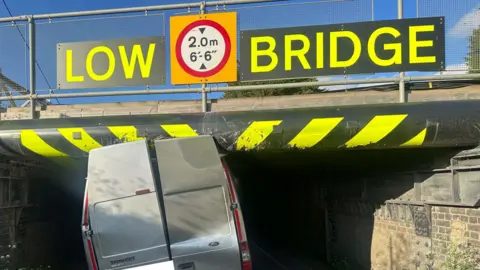
New traffic camera systems have been installed to monitor one of Britain's most frequently struck railway bridges.
Network Rail said the Stonea Road bridge, near March in Cambridgeshire, was the joint second "most bashed", with 17 strikes recorded between 2023 and 2024 - although residents believe the true number is much higher.
The two-metre-high (6ft 6in) structure would be monitored for at least three months before a decision was made on whether to take further action, said the county council.
Denise Martin, who has lived in Stonea for 11 years, said it was an "excellent idea", with the number of road closures caused by incidents becoming a "total nightmare".
 John Devine/BBC
The new cameras aim to monitor the location and collect data, such as general traffic information and near-misses.
Cambridgeshire County Council said reviewing this data would help it better understand the reasons why bridge strikes occur.
Resident Bill Nattrass said although there had been many bridge strikes, there were also numerous near-misses.
"Sometimes you have to stop, you can't fit two modern-day cars underneath," he said.
Ms Martin, 59, added: "When the bridge is shut it is a total nightmare.
"People cant see the signs or aren't reading them properly. It clearly states the height but they still go under and next thing we know, it is all shut."
A local lorry driver said the actual number of bridge strikes per year was likely closer to 40 or 50, rather than the reported 17.
"After hundreds of strikes over the years you have to stop blaming drivers and start blaming the infrastructure," said James Fuller.
"[The cameras] are an absolute waste of time and money... it has been hit hundreds of times over the years, do you really need data to work out 50mph is too quick?"
 John Devine/BBC
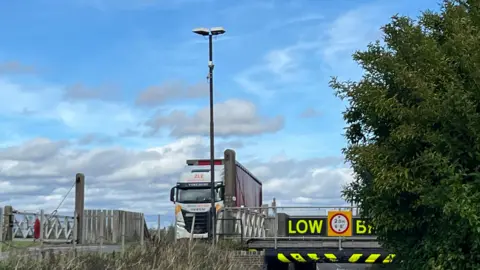
Cambridgeshire County Council said the road would be monitored so it could "draw proper conclusions" and identify if there was a need to carry out further works.
Stephen Deaville, from Network Rail, said an impact protection beam had been installed to protect the bridge from strikes.
"Network rail runs, operates and maintains the railway structure which does include the rail bridge that goes over the road," he said.
"It also includes the manual level crossing which is next to the underpass... we don't maintain or operate the road network."
Follow Cambridgeshire news on BBC Sounds, Facebook, Instagram and X.
