End of an era as semaphore signals are taken down

 Getty Images
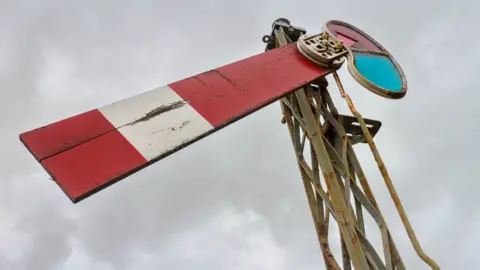
A railway historian says he believes the traditional semaphore signals removed from a rural railway station could have been the last in use in the entire Eastern region.
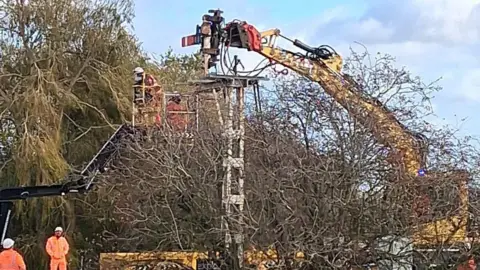
The wooden signals were dismantled from the trackside at Manea, in Cambridgeshire, on 1 November.
Network Rail confirmed they were the last semaphore signals on the Ely-Peterborough line, but the company was not completely sure if they were the last on the East Anglia system.
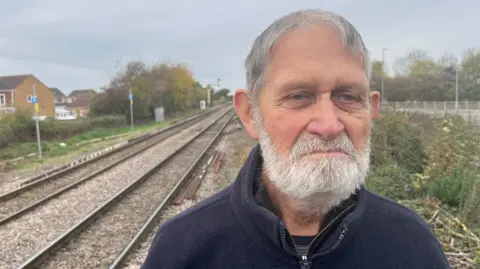
Peter Wright, a volunteer at the March and District Museum, said: "As far as everyday commuter services go, they could have now disappeared forever in our region."
Semaphore signals have been part of railway life since the 1800s and are currently being upgraded across the network - being replaced by a modern light system.
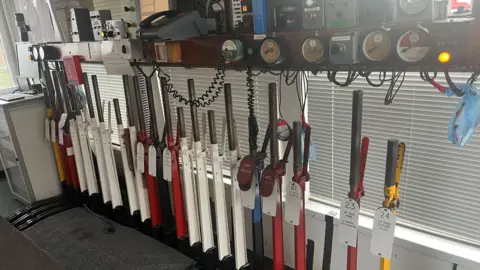
They were controlled by a system of levers within a signal box.
 John Devine/BBC
 John Devine/BBC
Mr Wright, 78, the son of a Fenland railway man, said that Manea was, to his knowledge, the last bastion of Victorian mechanical signalling systems in East Anglia.
He said that signals and points were all controlled by wires and rods, levers and pulleys, with the whole system known as "mechanical signalling".
"The semaphore signals are being replaced with colour light signals (like traffic lights)," he added.
"Heritage railways do continue to use semaphore signals - so you can still see them at places like Nene Valley Railways in Peterborough, but as far as everyday commuter services go, they could have now disappeared forever in our region."
 Charlie Marks
Richard Foster, the associate editor for Trackside railway magazine, said semaphore signals had quite a history.
"The signals themselves were called semaphores, dating back to the days of the flags," he said.
"If the signal arm is in the horizontal position, the line ahead is not clear; with the arm either pointing up or down, the line is clear."
Mr Foster said he thought the Peterborough-Ely section of railway was probably the last line in East Anglia to be converted, but he added that some isolated signals in yards and depots could still be in place.
Follow Cambridgeshire news on BBC Sounds, Facebook, Instagram and X.
