Scotland's first modern railway marks 200th anniversary

 Don Martin
It was a 10 mile route running from the Lanarkshire coal mines to one of Scotland's most prominent canals.
This otherwise unassuming stretch of land is where the roots of the country's modern railways can can be found.
The line between Monklands and Kirkintilloch opened 200 years ago - on 17 May 1826 - and played a key part in the industrial revolution which transformed Scotland.
An exhibition in Kirkintilloch is currently paying tribute to the historical importance of the railway, while some experts and historians feel its significance has been unjustly overshadowed.
The country's first railway had been constructed in 1722, with the Tranent Waggonway in East Lothian. However it used wooden rails, wagons and wheels- like all early railways.
A line between Kilmarnock and Troon had been authorised as a public railway in 1808, but it was the Monklands and Kirkintilloch line that was the first to feature the elements associated with what people would recognise as being a modern railway.
Heavily inspired by the Stockton and Darlington Railway that opened the previous year in England, the new line used rails that could have locomotives running on them at a reasonable speed, although it took another few years for them to - quite literally - get on track.
"The first train arrived carrying a load of coal," says Don Martin, a Kirkintilloch man and local historian with a passion for the railway.
"It largely copied the Stockton and Darlington line, and in doing so it was the first public railway in Scotland for all comer traffic, rather than just private traffic.
"It was the start of the modern railways in Scotland. Locomotives are an essential part of a modern railway and although it didn't use the locomotives right away, it was the first in the country to bring them in eventually."
 Don Martin
Martin, who has written books and articles about the Monklands and Kirkintilloch line, believes it was one of a small cluster of routes that essentially formed a testing ground for other railways across Scotland.
"People think that because I'm Kirkintilloch born and bred, that I exaggerate the importance of it, but I don't", he laughs.
"There's some inaccurate myths about the line, and I'm happy to say that. For example, it was clamed the line used the first locomotive built in Scotland, but it wasn't – it was the second one.
"The first one had actually been built for use at the Rainhill trials in 1829, although it was not successful. But by 1831 there were locomotives on the Monklands line.
"So the claims that have been made and are accurate about the line, they are truly worthwhile."
Among these claims is that the line played a huge part in establishing the Coatbridge area as an industrial powerhouse.
Being able to transport coal quickly to canal boats, and then move it onwards to not just Glasgow but the likes of Edinburgh, helped the region as it became dominated by iron works and furnaces during the 1830s.
"You were able to really connect the coal field with industrial centres," says Dr Alexander Tertzakian, a lecturer in political and international studies at the University of Glasgow.
"You had this linkage that now lowered the costs involved. There were transport links that had grown up before this with the canals, like the Monklands canal, but the railways really supplanted that, and undercut it to an extent.
"You had a situation where coal and iron ore was being transported to fuel burgeoning industries, and they really take off once you hit the 1830s."
 Don Martin
Tertzakian says there was an ongoing specialisation of regions ongoing in the 1830s, partly caused by the growth in modern railways kick-started by the Monklands and Kirkintilloch line.
"Those areas really start expanding directly, and the railway played a crucial role in fostering the industries that powered the expansion of those areas," he said.
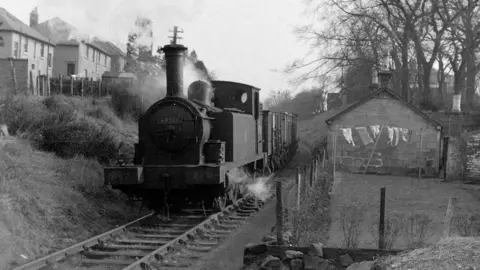
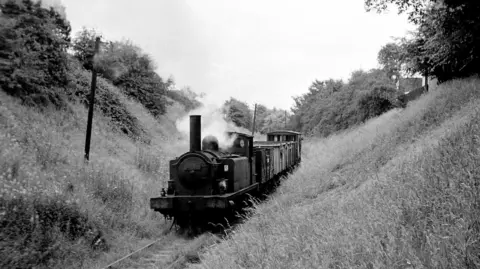
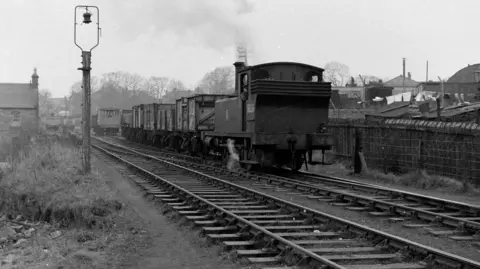
The railway line itself outlasted the area's time as a industrial giant, and continued to be used into the 1960s.
A small section of the line is still open near Coatbridge today, around Coatbridge Sunnyside Station.
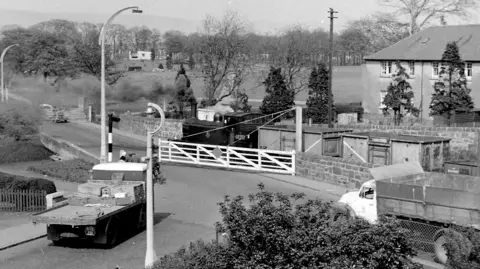
And there remain many locals with memories of riding bikes slightly too close to the tracks for comfort or clambering about the level crossing gates to scare passers-by.
 Don Martin
An exhibition about the railway history is on at the Auld Kirk Museum in Kirkintilloch until Wednesday, with Martin one of the people who worked on it.
Last year saw considerable attention lavished on the anniversary of the Stockton and Darlington line, and he felt there should be attention paid to to Scotland's trailblazing area too - which helped bring the exhibition about
Tertzakian can understand this viewpoint, too.
"Scotland was absolutely central to the industrial revolution, though it can be overlooked relative to England within a lot of literature," he says.
"Glasgow and the outlying regions were at the core of that."
