Having a guide dog 'makes me feel I can fly'

 Trudy Sherwood
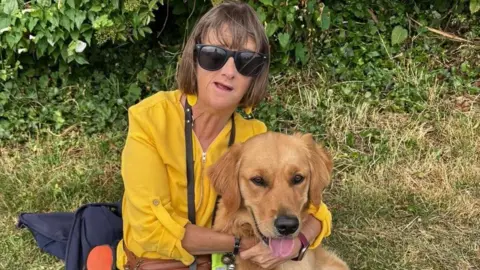
A partially sighted woman who felt isolated and nervous to venture out says her life was "changed completely" by having a guide dog.
"I used to sit on the bus and just feel so alone, so isolated, but with a guide dog people talk to you and I'm not invisible anymore," said Trudy Sherwood, from Plymouth.
She has always found it difficult to get around with just the use of a cane, and some days she did not want to leave her house.
Trudy got her first guide dog in 2016 and said it made her "feel [like] I can fly".
'Like losing my right arm'
"With Connie everything felt like a breeze – navigating the roads, getting on the bus. It opened up my world.
"Living with a lack of sight is frightening... people just don't understand what it's like."
After six years together, Connie retired and Trudy was forced to return to life walking with a cane.
She said: "Connie just stopped one day. She literally sat down as if she knew she had to retire.
"I was devastated of course. It was like losing my left arm. I'd always told Connie that when she was ready to retire, she should tell me, and this was her telling me that she was ready to stop."
 Trudy Sherwood
How guide dogs are trained
Getting a new guide dog takes time with training taking 16-20 weeks.
"It's the staff, puppy raisers, the fosters whilst they are training, and then you have to have training yourself, and you don't always click with a dog – it has to be right," Trudy said.
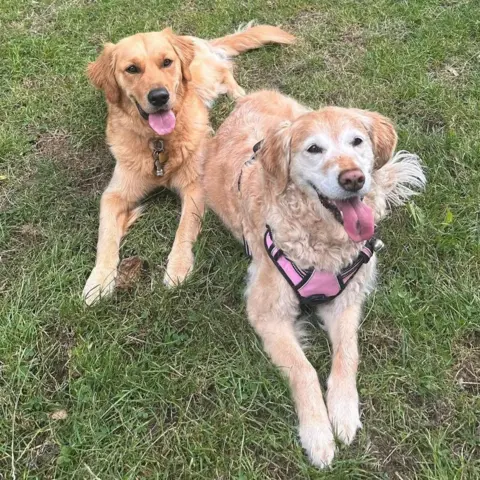
She is now with her third guide dog, named Kal-El after Superman, and said she felt like she was flying again.
When in training the dog lives with volunteer fosterers evenings and weekends.
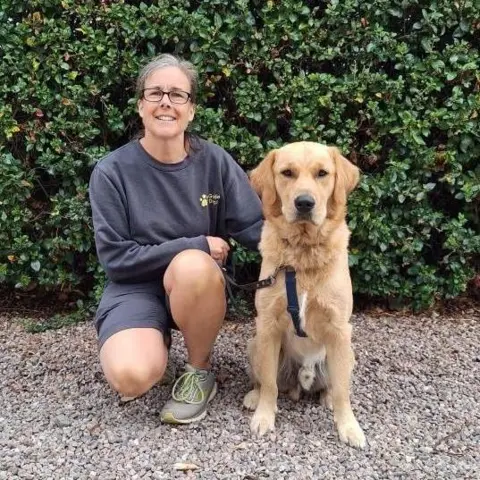
Bev Brenton, who trained Kal-El, said: "Once a dog is allocated to me, I visit the dog at home with the puppy raiser - they are generally between 13-18 months old.
"The dog is technically a blank canvas when it comes to me. I assess the dog's previous knowledge and train it according to its temperament, sensitivities, capabilities and any other issues.
"I introduce the working harness, work tasks including pavement position, kerbs, obstacle avoidance, transport, distractions (mainly dog/cat/bird), traffic, recall, social behaviour."
She said: "It is a rewarding job that I have done for 25 years. No two walks, days or dogs are ever the same."
Bev described Kal-El as a pleasure to train: "A bright gentle boy, he learnt the work tasks quickly and has continued to grow in confidence since he qualified with Trudy."
 Bev Brenton
The Guide Dogs charity says it is the only organisation to breed and train guide dogs in the UK.
A spokesperson said: "In the South West there's around 56 people waiting for a guide dog at the moment, and we're working hard to reduce their waiting time - this year we hope to breed more guide dog puppies and we're looking for volunteer puppy raisers across the South West to help be a part of their journey to become a life-changing guide dog."
They said: "According to our research, 95% of people with sight loss have been forced to walk in the road because of cars parked on pavements.
"Cars blocking pavements are a nuisance for everyone, but especially dangerous for people with sight loss, who can be forced into the road with traffic they can't see.
"When pavements are blocked, people with sight loss lose confidence, independence and the freedom to travel safely.
"This stops people accessing work, education and social opportunities."
Trudy said she could not thank Guide Dogs enough.
She raises funds and gives talks about its work.
Trudy said the dogs were lifesavers and anyone who has one would know that.
But she added they were dogs as well, and loved their treats and free runs when they were not working.
Follow BBC Devon on X, Facebook and Instagram. Send your story ideas to spotlight@bbc.co.uk.
