Major: The dog who guided me through eight years of TV and radio

 BBC
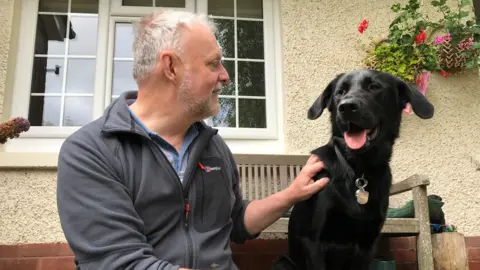
BBCFrom a quiet test walk to eight years on the road, Major never put a paw wrong.
He guided, he worked, he kept me safe.
We'd been a team since I arrived at a hotel in East Kilbride in August 2017 to start training for my seventh guide dog.
I'd done this six times before, but it never feels routine. You're standing there thinking, right… is this the dog who'll guide me through the next stretch of life?
Major certainly made an entrance.
A cross Shepherd-Retriever, black as midnight with a shiny, smooth coat. Only 20 months old, sharp as anything, and he knew it. Much sharper than me on most mornings. In fact, every morning.
Nothing pleased him more than getting his harness on and getting to work.
I'd met him once already, two months earlier, in a quiet corner of the Merchant City in Glasgow, well away from home and work.
We wanted to keep things under the radar until we knew if he and I actually matched.
The instructor said we'd just take a walk and see how it felt. The whole experience felt like a John le Carré novel.
I'd been without a guide dog for a year after Renton, my large German Shepherd, died suddenly after a short illness.
That first walk with Major felt awkward after not having a dog for so long.
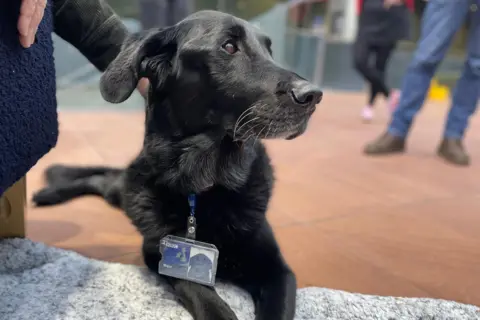
I was out of rhythm, trying to remember how it should feel, how my feet should move, and how to trust a dog again. But within a few minutes something clicked.
He found his stride, I found mine, and suddenly we were moving properly.
I hadn't realised how much I'd missed that feeling. That sense of weaving through a street, avoiding obstacles you don't even know are there.
With a cane you meet your environment one thing at a time.
A pole. A wall. A bin. A car parked where it shouldn't be.
With a dog, you glide through it. Fast, smooth, certain. It's a completely different kind of experience.
By the end of the test walk I knew. He was the dog for me.

Over the next eight years he proved it again and again.
Major was calm, focused, and carried himself with a quiet authority. He worked hard, but he had this formal air about him at home too.
Friends would walk in and he'd lead them straight to me as if he'd been put in charge of hospitality.
We often joked he was a guide when out, and a butler at home.
We travelled all over the country together.
Trains, buses, ferries, taxis, planes, he handled the lot without fuss. He slipped into the life of a reporter's dog without blinking. Busy places, long days, last-minute changes… none of it bothered him.
Flying always made me smile. He liked the attention from cabin crew, and they liked him.
Once, when the seats were far too tight for him to lie down, he simply climbed up beside me and rested his head on my lap.
I clipped the seat belt through his harness to make sure he was secure for take-off and landing. Not standard procedure, but it kept us both comfortable, so we left it at that.
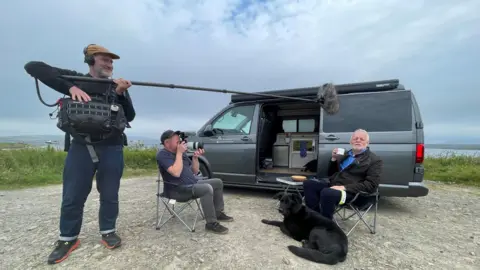
He even became a big part of My Kind of Town, the TV series I present. Major appeared in all 20 episodes. Every walking shot, every retake, he just got on with it. Never confused, never hesitating. He understood the job.
Whenever we visited a coastal town, and needed those all-important dog running on a beach shots, he was never worried about the many retakes we needed. Every time, he would chase a tennis ball and never got tired of resetting and starting again. Funny that.
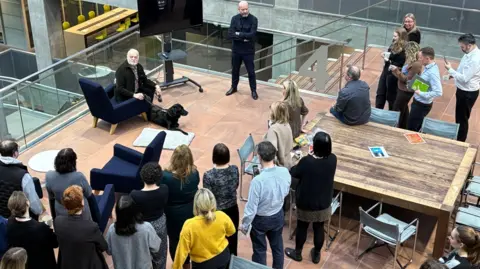
Studio days were much the same. If I had voiceovers to record, I'd leave him with the TV news desk. He'd sit through their meetings like a well-behaved producer.
I used to joke that every time Major attended one, he doubled their IQ. It amused me. I'm not convinced it amused some on the desk.
Routes were easy for him. Show him once and it was fixed in his head. Train stations, coffee shops, stairs, awkward buildings… he memorised the lot.
Above and beyond his guiding and butler duties, he always had an important role when out and about. Major always proved to be the best ice-breaker a reporter could have.
Often that meant relaxing a contributor who wasn't used to TV and was unfamiliar with the process. But more often than not, people would come and talk to me, since Major broke down barriers.
This always came in handy when visiting Holyrood. Although, I think Major got more scoops out of the MSPs than I did.
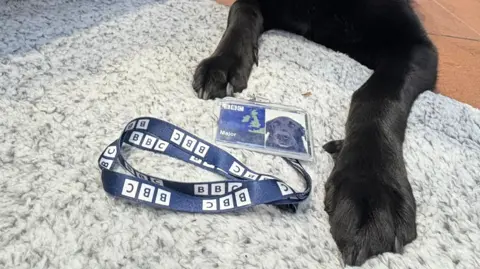
Now he's 10, and retirement is here.
His health has dipped recently, which has been hard to watch after so many years of him being very healthy. But he'll stay with us.
He'll enjoy slow walks, pottering about the garden, and lying by the fire.
As part of his retirement, I've been making a documentary about the process of getting a new guide dog.
Part of that involved me, and of course Major, visiting the woman who raised him as a puppy before he went to guide dog school.
She was telling me that when she took him to those puppy classes, there was nothing the instructors could teach him. He was described as "a total swot".
I'm very glad to say that attitude continued throughout his working life.
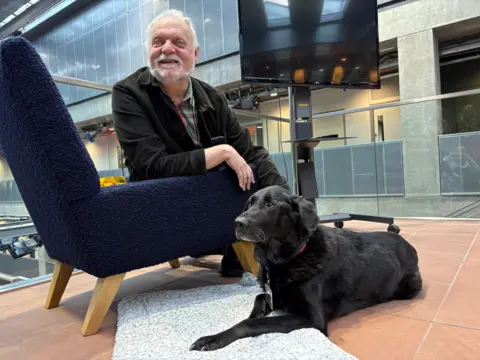
As for me, I've now been through the reassessment for my next guide dog.
You start right back at the beginning again. They look at your mobility and orientation, check how you move, and work out what kind of dog would suit your pace.
I'm eight years older now, so they need to know I can still manage the work a dog demands.
Age isn't a barrier. They just want the right match for my fitness and lifestyle. I'm pleased to say I passed everything, so I'm officially back on the waiting list.
The Guide Dog Association said it might take a year or more for a replacement.
So it's me and the white stick again.
It's never easy retiring a guide dog, but Major has done his bit, and it's time for him to put his paws up and enjoy being a dog of leisure.
