Driverless vehicle takes islanders for a spin in Orkney

 BBC
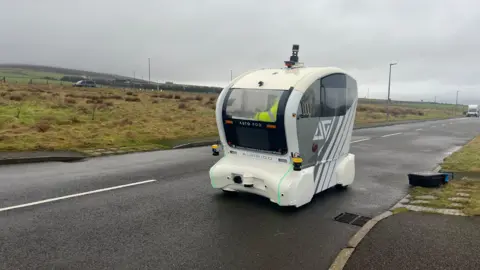
BBCA driverless vehicle has been taking to the road in Orkney - and could eventually be used to take passengers between the historic monuments of its Unesco World Heritage Site.
The project - led by consultants Urban Foresight and supported by autonomous shuttle firm Aurrigo and regional transport body Hitrans - is ultimately aiming to provide a shuttle service between Kirkwall Airport and Kirkwall Harbour.
However, the interim step of connecting the likes of the Ring Of Brodgar, Maes Howe and the Standing Stones Of Stenness is also being looked at.
As part of the project, members of the public have been given the chance to have a ride in the Auto-pod vehicle and give their feedback.
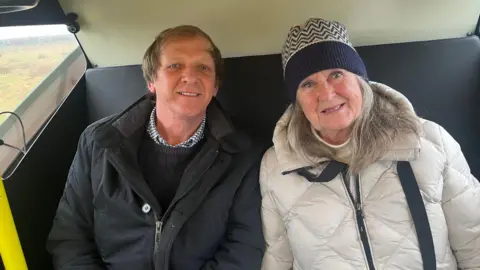
One of the people giving it a go, Judith Fawcett said it was "a bit bouncy" and "awfully slow" but that she could see a future for it.
"I think it wants to be more aerodynamic, particularly in Orkney, but I just think it is the way forward," she said.
Terry Thornhill said he found it "an easy ride" and felt "very safe".
"I think it will come in, the technology is here, I think we will be able to use it for going from one place to another," he said.
"I like to see what the future is like and what to expect - I thought it was a great opportunity to get a chance to have a go."
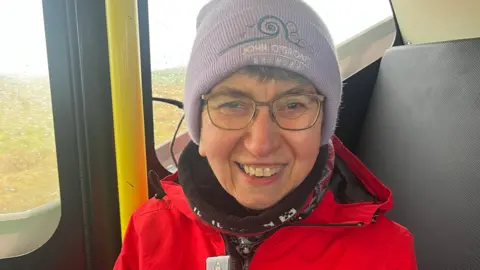
Sarah Wilkins said her main question was how the vehicle would interact with obstacles and that it reacted "right away."
"It was quite interesting actually, it was quite smooth," she said.
"It was a smooth ride and there was a screen showing the route."
The driverless shuttle project is investigating whether a self-driving vehicle would be a feasible option on certain routes between historic sites.
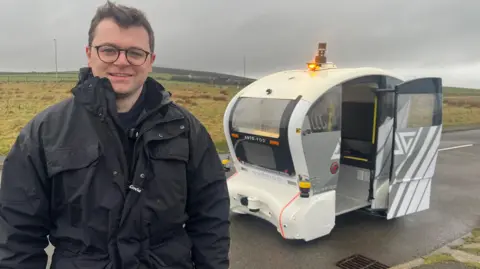
Callum White, head of zero emission mobility at Urban Foresight, said: "They are situated on very fast 60mph (96km/h) roads and there's not really much safety if you're an independent walker in getting between the different sites."
He said the technology was "getting better all the time" and vehicles could carry up to 11 people with the smaller ones travelling at about 15mph (24km/h) and the larger ones capped at 30mph (48km/h).
White admitted that there was always a "slight concern" with the weather in a place like Orkney.
"With the wind, there's definitely no problems there," he said.
"The batteries are lowered down, just like you would find in an electric vehicle, so the actual centre of gravity on the vehicle will keep the vehicle on the road."
He said that although snow could have an impact on sensors and cameras there were "ways around that".
However, he said there were "a few more steps" before they got to the stage of running vehicles between the harbour and the airport.
He said they were currently at the point of "seeing what people think about the vehicle once they've been in it and that gives us more information to help us".
"We want to use this event to kind of solidify where those next steps would be," he said.
He said the current study would finish at the end of March before looking at the potential for a full trial either this year or next year.
