'Lingering questions' for family over baby's death

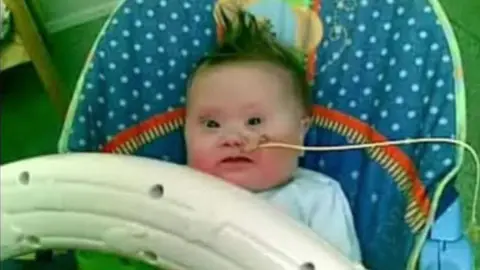 HANDOUT
A family has been left with "lingering questions" about the death of a baby at the Royal Victoria Hospital in Belfast, an inquest has been told.
Darrach Smyth, an infant from the Ardoyne area of north Belfast, died in 2008 following cardiac complications.
A decision was subsequently taken to transfer children's heart surgery from Belfast to an all-Ireland centre in Dublin.
The death of Darrach, who was born with Down's syndrome and was subsequently treated for heart and lung problems, was part of a review conducted prior to the decision to move the services from Belfast.
On the first day of the inquest into the baby boy's death, evidence was heard from his parents.
Cora and Joseph Smyth both outlined their ongoing concerns about a decision to temporarily stop the sedation - or pain relief medication - of their son about a week before he died.
'Praying for a miracle'
In a statement to the inquest, his mother, Cora Smyth, explained how her son, who died almost eight months after his birth, had been receiving routine hospital treatment during his short life.
He died shortly after cardiac surgery.
She wept on the witness stand as a barrister for the coroner read her statement, in which she said her family had been "hoping and praying for a miracle" before Darrach died.
She said her son's death had "a huge impact" on their lives and they had "lingering" unanswered questions.
These questions are about the pausing of sedation for a period during and after Darrach's transfer from the Cardiac Intensive Care Unit to the Children's Hospital, shortly before his death.
Cora Smyth explained that the family was not aware of this at the time, and only discovered it when they requested hospital notes, following a BBC News NI report four years later in 2012, about a review of children's congenital cardiac services in Belfast.
She said no one at the hospital has ever adequately answered their questions about this issue.
The child's father, Joseph Smyth, explained in a statement that the family had tried to cope "by helping others" who have been dealing with similar situations.
He added: "Our lives were turned upside down."
He said they had "lingering questions" and he asked: "Was it an error to stop Darrach's sedation?"
He said finding the truth remains the family's objective, adding: "The grief doesn't go away."
'Constellation of problems'
A retired cardiac surgeon at the RVH told the inquest that Darrach had "a constellation of problems".
Dr Denis John Gladstone told the Coroner's Court that he performed cardiac surgery on Darrach about a week before he died and he believed at the time that "the operation went well".
Asked for his opinion about a 45-minute gap between the administration of sedation at the completion of the hospital transfer, for which he was not responsible, Dr Gladstone said he would have expected it to occur "much sooner than that" after a gap of "about 10 to 15 minutes".
However, he also expressed the view that sedation given before the commencement of the child's transfer could possibly have had about "80% activity" on arrival, even before the administration of any additional sedation.
The inquest heard that Darrach arrived in the Children's Hospital at 12:15 and sedation didn't resume until 13:00.
The Coroner's Court hearing resumes on Tuesday.
