Bird 'almost extinct' in Northern Ireland found behind bin

 Doolittle's Wildlife Rescue
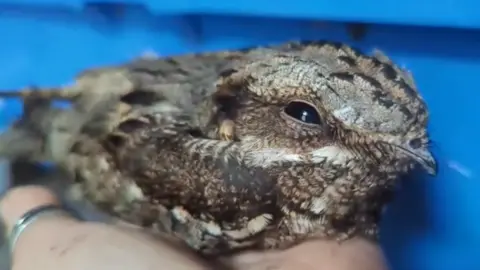
An elusive bird which is now considered to be extremely rare in Northern Ireland made an unexpected visit to a Belfast street, where it was found behind a bin.
Office staff who spotted it on the Lisburn Road thought it might be a bird of prey and called wildlife rescuer Debbie Nelson, who works under the name Debbie Doolittle.
She was surprised to find it was in fact a nightjar - a bird she described as "almost extinct" in Northern Ireland, with only a handful of sightings since the 1950s.
"They were about to put some rubbish in the bin and they saw the bird behind it," she told BBC News NI.
Doolittle explained nocturnal birds can sometimes become disorientated by street lights and collide with tall buildings, so it may have bumped into something.
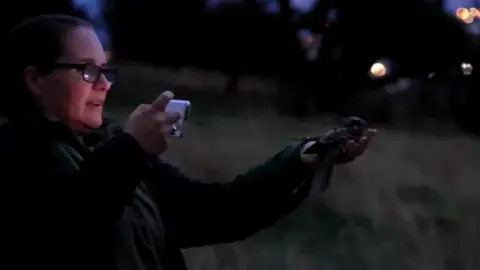
She brought it back to the rescue centre she runs near her home in Antrim so the bird could rest until she felt it was fit and well enough to set free the next day.
"It's very rewarding getting to release something back into the wild and knowing you've given it that second chance," she said.
'Most special' rescue of 2025
 Doolittle's Wildlife Rescue
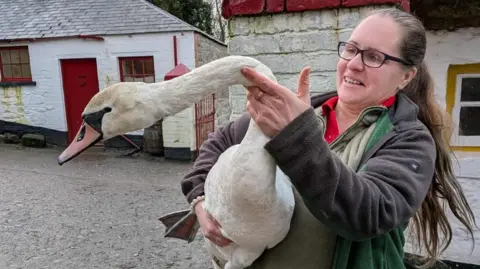
Doolittle has been taking in sick and injured animals since she was child, and last year alone her organisation helped more than 2,000 creatures.
The nightjar was discovered in September, but Doolittle waited until the new year to share the footage, describing it as her "most special" rescue of 2025.
She told the Belfast News Letter it was a "once in a lifetime" experience.
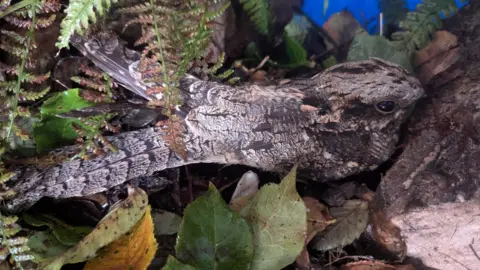
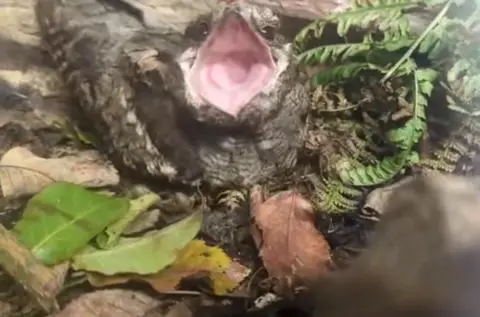
Her video shows the bird resting in Doolittle's hand before being lifted into a plastic crate kitted out to resemble a forest floor.
"We got branches and logs and wood chip bark to make it feel safe," Doolittle said.
She then fed it "lots of juicy bugs" to help it recover and regain its strength to fly.
The time and location of its release were top secret because Doolittle did not want it "frightened with dozens of birdwatchers and big cameras scaring it".
 Kevin Rice
Nightjars are found in other parts of the UK during the summer months, most commonly in southern England, but it is very unusual to see one so far north.
The Royal Society for the Protection of Birds (RSPB) told BBC News NI there has been "no confirmed breeding of nightjar in Northern Ireland recently".
They also described the Belfast incident as "an exciting discovery".
Why are there fewer nightjars?
 Doolittle's Wildlife Rescue
Nightjars were once a more common sight and sound on the island of Ireland, according to Birdwatch Ireland's Conservation Officer, John Lusby.
He points out their distinctive call used to be so well-known that Irish speakers named the bird túirne lín, which means spinning wheel.
This name refers to the churring sound made by the male of the species.
Lusby said nightjar numbers "diminished dramatically" across Ireland in the latter half of the 20th Century,
He puts the decline down to the loss of habitat and pesticide use, because nightjars feed mainly on insects.
In fact, a few years ago, the "general consensus was that we had effectively lost nightjars" according to a 2024 report by Lusby.
But that summer he coordinated a survey which found evidence of a very small number in the south east of Ireland, described by Lusby as the "last remaining stronghold" on the island.
The study concentrated on counties Kilkenny and Wexford where researchers recorded "hundreds of hours" of birdsong.
They detected nightjar calls from two of the survey sites, but could only find one pair breeding successfully.
The team has since conducted a wider study which also incorporates Waterford and Tipperary.
This time they managed to get footage of the breeding pair's nest, monitoring it from a safe distance using a drone with a thermal sensor.
The location of the nest is being kept secret so the birds are not disturbed.
Lusby was surprised to hear a nightjar was found as far north as Belfast.
But he explained it is a type of bird that stays "under the radar" and "may be present" in small numbers in areas that researchers are not yet aware of.
The results of Birdwatch Ireland's 2025 nightjar survey are expected to be released within weeks.
How do you spot a nightjar?
 RSPB
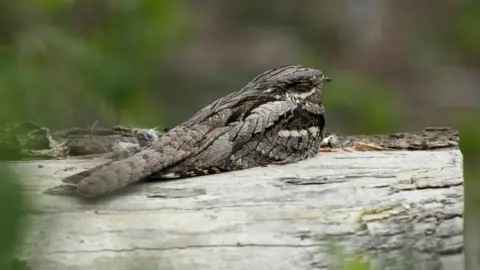
RSPBA nightjar is small, nocturnal bird with large dark eyes, pointed wings and long tail.
It has a short, narrow beak but its mouth opens very wide to enable it to hunt insects and moths in mid-flight.
Its feathers are a mottled mix of brown, grey, beige and white, enabling it camouflage itself as it nests in open ground on heaths and moors.
The RSPB describes nightjars as slightly smaller than a kestrel but appearing "falcon-like" when in flight.
It says its call sounds like "a strange clockwork toy steadily unwinding".
 Doolittle's Wildlife Rescue
Where are nightjars found?
Nightjars migrate to some areas of the UK and Ireland in late April and May with southern England being their most popular choice for a summer stay.
They are also found in smaller numbers in parts of Wales, northern England and southwestern Scotland, while a handful have been detected in south east Ireland.
They return to sub-Saharan Africa in August and September.
The UK's population of nightjars decreased during the latter part of the last century, falling by 51% between 1972 and 1992 due to loss of habitat.
But conservation efforts in recent years, including the restoration of lowland heath, has helped numbers recover, according to the RSPB.
