Sonic boom like an 'explosion', police logs show

 Getty Images
A sonic boom heard across parts of the East and South East of England sounded like "an explosion", shook houses and set off car alarms, according to police emergency call data.
The loud bang was heard in Essex, Cambridgeshire, Suffolk, Norfolk, Kent and parts of London at about 11:40 BST on 15 August.
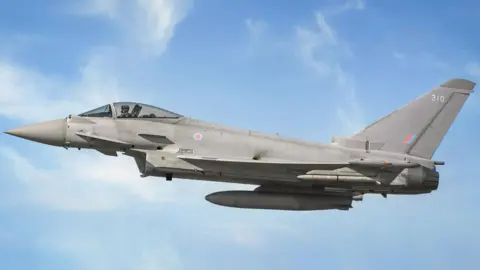
The RAF confirmed at the time three Quick Reaction Alert (QRA) Typhoon fighter aircraft from RAF Coningsby in Lincolnshire were launched to escort a civilian plane that had lost contact with air traffic control.
A Freedom of Information Act (FOIA) request by the BBC revealed the full extent of the area from which 999 calls were made, with many people believing something had exploded.
A sonic boom occurs when an aircraft travels faster than the speed of sound, generating shockwaves that rapidly compress and decompress the air, producing an explosive noise.
While the speed of sound varies depending on the altitude, it is about 660mph (1,060km/h) at 60,000ft (18,300m).
The sound, often described as an explosion or thunderclap, can be heard over a large area because it moves with the plane, similar to the wake spreading out behind a ship.
August's sonic boom was caused when the Typhoons were called to respond to an incident.
The Ministry of Defence (MoD) confirmed the location of the sonic boom between Spalding in Lincolnshire and Wisbech in Cambridgeshire.
An Essex Police spokesperson said at the time: "A flight has been escorted into Stansted Airport after it lost contact with the ground.
"Contact was re-established with the plane, which had been travelling from Nice, and was escorted into the airport by RAF aircraft."
Essex Police received 12 calls that day about the loud bang, from people living in Basildon, Braintree, Brentwood, Chelmsford, Thurrock, and near Stansted Airport.
Seven of those were to report an apparent "explosion".
People also took to social media or called their local BBC radio stations, describing their houses being shaken.
Cambridgeshire Police also received calls from concerned people, although no damage was reported.
"A caller reported they had heard two loud explosions which had shaken the house and set off a number of car alarms," the force said, responding to the FOI request.
A second caller "reported hearing a really loud bang which had shaken all the houses, and... sounded like someone had crashed their car into a house".
The sonic boom was also heard in parts of London and Kent.
The Met Police said that "during the short timeframe of the sonic boom", it received 955 calls about various incidents but was unable to determine how many were related to it "within the time and cost rules of responding to an FoI request".
However, Kent Police said it received five calls from the Swanley and Dartford areas reporting a "loud explosion" or a "loud bang... with no smoke" while one person from Dartford told call-handlers "it shook the houses".
Suffolk Police and Norfolk Police said they received no reports, although calls to local radio showed it had been heard across both counties.
The MoD was also asked about reports of the sonic boom, or any resulting claims for damage compensation.
It was able to confirm where the sonic boom occurred and carried out initial inquiries at RAF Wittering in Cambridgeshire, and with the MoD complaints and media teams, but no reports had been received.
The MoD was unable to check for reports elsewhere as it said "such an undertaking would undoubtedly far exceed the cost limit under the Act as set out in Section 12 of the FOIA".
Follow East of England news on X, Instagram and Facebook: BBC Beds, Herts & Bucks, BBC Cambridgeshire, BBC Essex, BBC Norfolk, BBC Northamptonshire or BBC Suffolk.
