Who was Archibald Knox and what inspired his designs?

 MNH
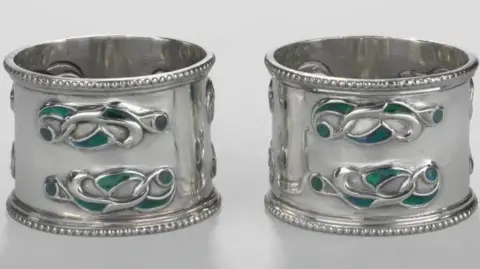
MNHThe largest ever exhibition showcasing the work of one of the foremost designers in the Art Nouveau movement at the turn of the 20th Century – Archibald Knox – is about to draw to a close at the Isle of Man's national museum.
Knox: Order & Beauty contains about 200 examples of his work, including metal work, paintings and sketches – each design containing links to his Manx roots.
The year-long display, put together by Manx National Heritage in conjunction with the Archibald Knox Forum, has clocked up 60,000 visits by people from both on and off the island.
But what made his designs so special, and what inspired them?
Who was Archibald Knox?
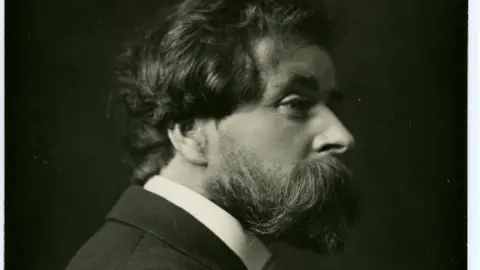
Born on the Isle of Man in 1864 to Scottish parents, Knox was a Victorian-era artist and designer whose family had a background in engineering.
Trained at the Douglas School of Art – where he would also go on to teach – he became known locally as an excellent draughtsman and watercolourist.
At the age of about 30 he moved to London to become an art master at the newly established Redhill School of Art, which was being headed up by a former school friend.
Exhibition curator Katie King said it was around that time that he became involved with a design studio called the Silver Studio.
"Basically they were sort of a co-operative you could sell your designs to and they would pitch them to all the big companies," she said.
 MMH
MMHWhat was his association with Liberty
King said that coincided with a time when Liberty – a high-end department store in London's West End – was "scavenging around looking for a new British look, a new British design".
"They liked what Knox was putting forward so that was that really, they decided to work together," she said.
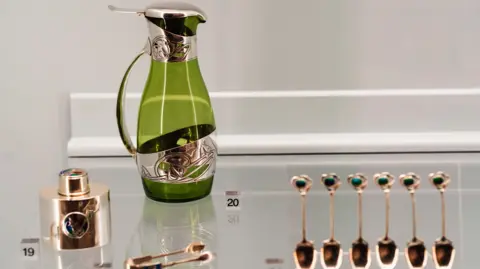
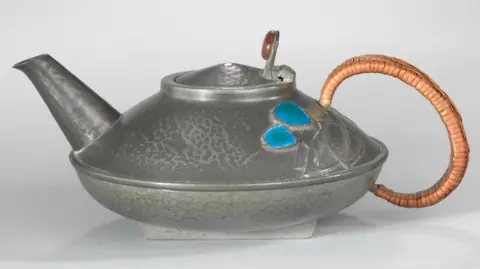
Knox returned to the Isle of Man to work on the new product line - know as the Cymric range of high-class homeware products - initially designing for silver and other precious metals, but later also for pewter and other materials including pottery and textiles.
A prolific designer, he created about 4,000 pieces during his years with Liberty between 1898 and 1906.
King said, while it was a very short period of time, it was also a very exciting period as the designs swept Britain and Europe.
"This new look, this new Liberty style as it was known, became massive," she said.
When did Knox come to prominence?
 MMH
MMHKing said while the designs had become well known, Knox was working as a "ghost designer" and not allowed to attribute his name to any of them.
For that reason it was only decades after his death that the prolific nature of his work for Liberty became clear.
"The backwards unpicking of Knox's story really began in the 1960s,"she said, "when they first started realising just how much of this project line had been designed by him."
"While at first it was thought there was many designers working on the project, in fact there were only six, and now we know that Knox was the lead designer.
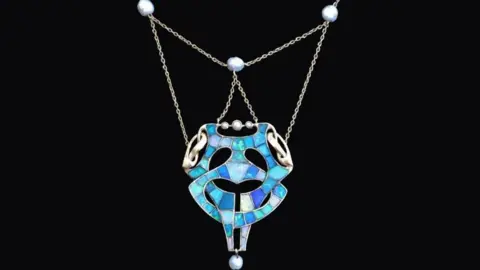
"We know that 80% of this product range was designed by Knox, so what they were calling Liberty style, we could now call Knox style."
 PEARTREE COLLECTION
What inspired his designs?
As a teenager, Knox developed an early fascination with the Manx stone cross, offering inspiration that would show itself in his designs throughout his career.
King said he "grew at a time when the Isle of Man was rediscovering its own identity" and as an early Antiquarian Society member would go out on pilgrimages "to rescue the crosses that had been treated quite badly in the landscape".
"He was sketching them and recording them and became very interested in them and that's where his design work came from - just playing around with these Celtic knotwork patterns and these Viking stories that you'd see woven into the stones".
Surrounded by people who were "championing how unique the Isle of Man was", it was something he "took with him throughout his whole life", King said.
However, King said not all of his work was based on the Celtic knot designs.
"In fact he was staggeringly modern in his style, he was very brave and he was very bold," she said, something attributed to his art training on the island, which was "a very progressive education".
"They weren't regimented by these sort of strict rules that art schools had in the UK at the time, they were encouraged to see but not copy."
And ultimately, it was that boldness that led him to part ways with Liberty, King said.
"When Liberty in 1906 decided they wanted to move away from this particular style they tried to encourage him to do other things he chose to stop working for them rather than compromise what he wanted to do."
 MNH
MNHWhat did he do post-Liberty?
After leaving Liberty, Knox spent another spell teaching art in London, before returning to the island permanently in 1913.
As well as teaching locally, he also became the go-to designer for many Manx businesses.
He was a Freemason, and became involved in the church, as well as the annual Manx Music Festival.
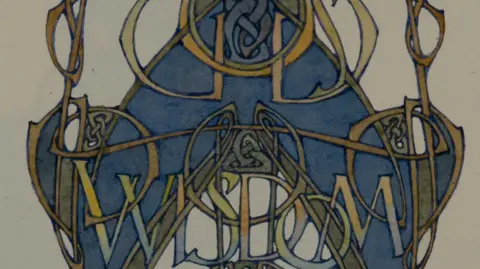
Although not known on the island for his work with Liberty at the time, those designs filtered into one of his most revered works in later life - an illuminated manuscript called the Deer's Cry - St Patrick's Prayer.
King said he had spent his final decades perfecting the piece, which pulled together features most prominent in his earlier work.
"Everything he did for Liberty, everything he did up until the age of 40, he then poured into this beautiful manuscript as a sort of pulling it all together to celebrate his own spirituality."
 MNH
MNHWhat is his lasting legacy for the island?
Knox died from a heart attack in 1933 at the age of 68.
King said, as custodians of the island heritage and history, Manx National Heritage would describe him "as perhaps the island's most famous artistic export".
She said his designs were known worldwide but "often his story - his Manx story - is not really known or celebrated".
But the widespread interest the exhibition has generated from around the world had begun to turn the tide on that, she said, and that story was now coming to more prominence.
The "fantastic archive that shed so much light on his story that was lost for so long" was now "out there in people's consciousness", she said.
"I don't think that'll end when the exhibition closes because there's so much you can see inspired by Knox and walk in Knox's footsteps."
"Everything he did was drawn from his powerful connection to the Isle of Man."
Knox: Order and Beauty is on display at the Manx Museum in Douglas until Sunday.
Read more stories from the Isle of Man on the BBC, watch BBC North West Tonight on BBC iPlayer and follow BBC Isle of Man on Facebook and X.
