'I felt really ashamed to be homeless'

 BBC
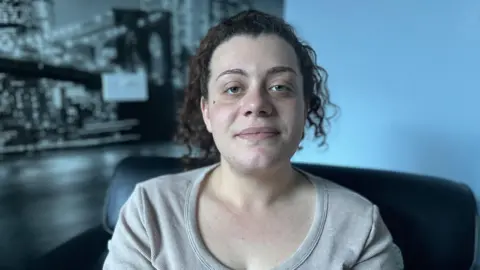
BBCA woman from Kent who ended up living on the streets for 18 months after struggling with drug addiction and mental health issues said she felt "ashamed".
Kimberley, who lived in a tent and dilapidated caravan in Folkestone, has reflected on her experiences after she was helped into rented accommodation by homeless charity Porchlight.
"I just felt dirty, I just felt really ashamed as well...I didn't want people to see me," she said.
The government, which has released statistics confirming that the numbers of rough sleepers are at their highest since the pandemic, has pledged to halve long-term rough sleeping by the end of this parliament.
Kimberley, who has also spent time in prison, has identified hygiene as one of the most difficult aspects of being homeless.
"You are living outside so you still feel dirty," she said.
After a period of "going in a circle constantly" and "screaming out for help", she was eventually referred to Porchlight.
The charity's chief executive, Tom Neumark, believes that "too many people in Kent are living without safety, stability or hope".
According to the recently released government figures, some 482 people were estimated to be sleeping on streets in Kent, Sussex and Surrey on a single night last autumn.
This is the highest figure since 2019.
While the majority of rough sleepers in the South East are men, female numbers have increased steadily over the past five years.
In 2025, there were 77 women sleeping rough compared with 63 in 2024 and 35 in 2020.
Neumark added: "We need emergency, immediate action right now. We can't see a situation where the numbers keep going up...it needs a coordinated effort."
Kimberley said she was doing "a million times better now".
"I've done a lot of work on myself," she said. "I've had a lot of support."
The government has committed £50m of funding to councils and frontline homelessness services over three years.
Alongside committing to halve long-term rough sleeping, the government has also promised to end the unlawful use of bed and breakfasts for families, and to prevent more households from becoming homeless in the first place.
Follow BBC Kent on Facebook, on X, and on Instagram. Send your story ideas to southeasttoday@bbc.co.uk or WhatsApp us on 08081 002250.
