Grid charge changes set to make going green easier

 Getty Images
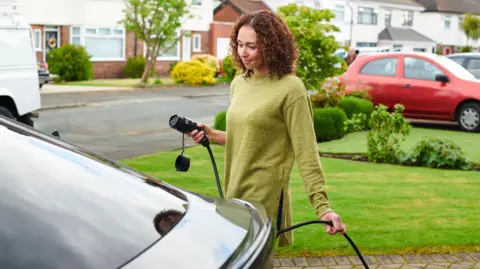
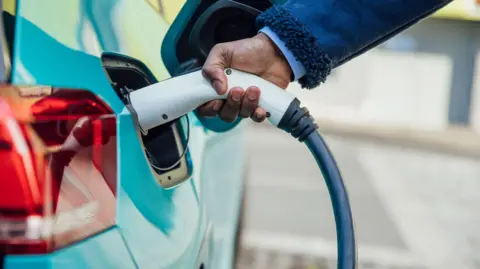
Adding green technology like electric car chargers and heat pumps to homes and businesses in Northern Ireland is to be made easier and more affordable.
At present, somebody installing green technology at a home or business can be hit with an added cost if an upgrade is needed to bolster the network. Those who follow do not have to pay.
It's called the first mover disadvantage, because one person pays but everyone who comes after benefits and Economy Minister Caoimhe Archibald said that was "unfair".
Changes being brought in next year mean the start-up costs will be shared across users and businesses.
It's an issue that particularly affects rural communities.
Home and business owners would still pay for their own connection, but the charge to secure electricity supply, known as grid reinforcement, will be spread.
That charge will also be capped - according to the consultation documents, it will be a matter of £3 or so a year for households, while large energy users will pay upwards of £2000.
'A significant step'
 Getty Images
The director of the Confederation of British Industry (CBI) Northern Ireland welcomed the announcement.
Angela McGowan said it was a significant step forward for the local business community, which has "traditionally faced connection charges that could run into hundreds of thousands of pounds and deter investment".
She added that the change will help to "level the playing field" for investors by bringing Northern Ireland into line with the rest of the UK and Ireland.
Stuart Anderson, from the NI Chamber, said the decision would bring Northern Ireland "into line with neighbouring regions, improving our competitiveness as a destination for business investment and decarbonisation".
Stimulate competitiveness
Industry as a sector has reduced emissions by two-thirds since 1990. Moving to electricity is a significant part of that reduction.
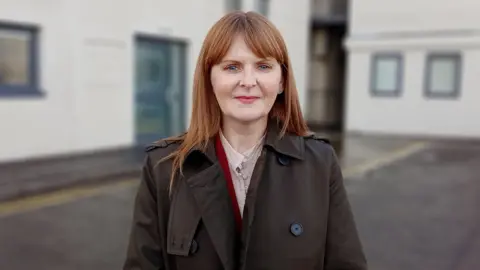
But Economy Minister Caoimhe Archibald said the current system had sometimes proved "prohibitive" for businesses seeking to decarbonise or even expand.
She said changing how the charge is applied would improve regional balance, as rural customers had often found themselves at a particular disadvantage.
"I think there won't be an elected representative from a rural area who will not have been lobbied on this issue.
"It impacts everyone from somebody building a house in a rural community to businesses.
"This change will mean that some people will be able to go ahead and make investments, and the sharing of the costs will make it much more fair."
The Sinn Féin minister added that it would also help with "the uptake of renewable energy technologies", like heat pumps and electric vehicle chargers both in homes and businesses.
Desire to 'go green'
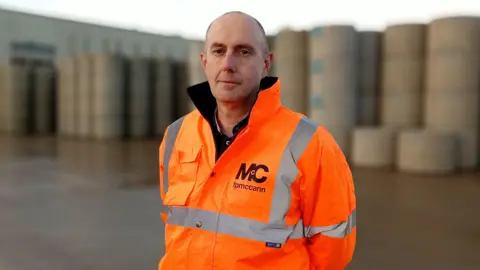
Concrete manufacturing is a significant industry in Northern Ireland and also a high-intensity energy user.
Many companies like FP McCann are trying to reduce their carbon footprint by installing renewable technology and moving to electricity where possible.
But the connection charge can run to millions of pounds, which can slow the move to greener production for some businesses or even put them off.
At the plant in Knockloughrim near Magherafelt, Estates Manager Paul Hamill said the difference the change in connection charging will make is "probably most prominent" for companies operating in a rural setting.
"We're away from centres and the main grid infrastructure, so it takes that financial burden away from us to a large extent."
'Welcome boost'
The hope is the change will stimulate interest in moving to greener, lower emission technologies, as well as making Northern Ireland more attractive to businesses.
Brian Donaldson, chair of the Confederation of British Industry (NI), said it was a "welcome boost" for business confidence.

"If you want to invest in solar, you want to invest in heat pumps, or if you want to invest in building more plant, more capacity in your business, you're going to need more electricity," he said.
"So this is a good signal that now is the time to look at Northern Ireland."
He added that the move puts Northern Ireland on "a level playing field" with its closest neighbours.
"This is going to be very welcome news certainly for the transition to a greener, lower carbon emissions future."
The change is expected to take effect in the first half of 2026.
