Children's author pens letter to future baby amid diabetes tech wait

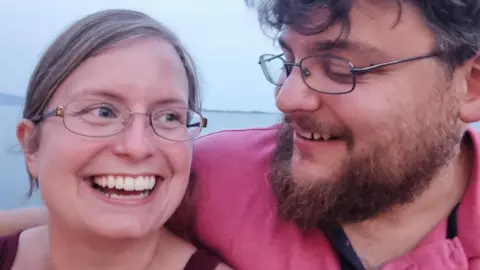 Alyssa Czaja
A children's author has described her dreams of becoming pregnant as a "great act of hope" in a poignant letter she has written to "her future child".
Alyssa Czaja has Type 1 diabetes and for a long time felt motherhood was not an option, but "closed loop" technology - often referred to as an artificial pancreas - could better manage the known complications during pregnancy.
There are five-year plans to roll-out the technology, but Diabetes UK Cymru said they have not been funded in Wales, meaning some health boards had paused the plans.
The Welsh government said it was working with the NHS in Wales to improve access.
Alyssa, 35, said she and her husband, Gareth, are also considering adoption, as they would not want to pursue a pregnancy without the closed loop system.
The technology works by automatically injecting insulin, based on details patients input to an app about the food they have eaten.
It removes the need for people to constantly make the adjustments and calculations manually, which has been described as "relentless".
The children's author said she was advised by her hospital diabetes team to be on the closed loop system for three months before trying to get pregnant, so that the range of her blood sugar levels could be tightly managed.
She also has a number of other chronic conditions, including rheumatoid arthritis.
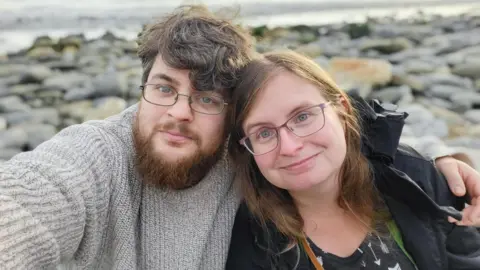 Alyssa Czaja
She said for years she told herself that her conditions made her unsuited to motherhood, but counselling helped reframe her thoughts.
As part of the process she was encouraged to write a letter to her future child, who she described as her "investment in better".
The letter reads: "You are my radical, not rational choice… you are made of love, whether that's biological with me and my husband or whether you have been knit together in another womb."
She said she and her husband Gareth had a "really empowering" appointment with the team at the University of Wales Hospital, Cardiff, where they were reassured a reasonably safe pregnancy was possible.
But a few months later she described the "whiplash" moment they received a letter telling them the roll out of the technology was being suspended for a year because of funding issues.
"It was pretty devastating," she said. "My journey has very much hinged on wanting to be as responsible as possible. We wouldn't want to pursue pregnancy without this."
During pregnancy for people with Type 1 diabetes, high blood glucose levels pose a risk of complications for both mother and baby. These include having a larger baby which can make the birth more painful and the baby may be born with serious health problems.
Alyssa said it had taken a long time to reach the decision to start a family as she has a number of chronic conditions, though she said diabetes had the biggest "mental and emotional load".
"When you're chronically ill you're very aware of your own limitations. You exist in a world that doesn't accommodate you all the way, and the amount that I have to do to survive a fairly normal life is different from other people," she said.
"A lot of my experiences around my diagnoses has been naming a want and having some kind of limitation being placed on it.
"Just naming a desire in itself is kind of asking to be hurt. So it was a lot to get to that point."
She said when she was told there would be at least another year's delay, she fought the thoughts telling her "this is a sign your body is broken and you don't get to have a baby".
Instead she reframed it as: "This isn't my fault, it's not a failure of my body, it is a failure of the healthcare system I'm trying to access."
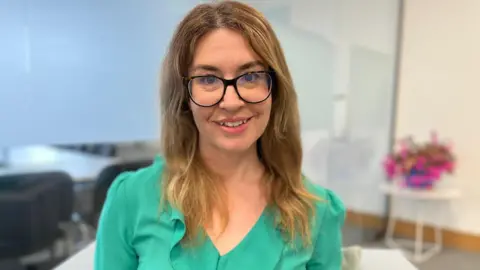
Rachel Burr, director of Diabetes UK Cymru said while commitments had been made by governments in Wales, England and Scotland to roll out the technology over five years, the Welsh government had not allocated ring-fenced funding.
"I think there's an absolutely urgent need for funding," she said.
"What we're seeing in Wales is that it's a very variable picture, it's inconsistent."
She added that, in some parts of Wales, there was no access at all, or very long waiting lists.
"This is technology that is life-changing - that can make a huge difference to individuals with type 1 diabetes or anybody who's using insulin.
"Not only their day-to-day life, their mental health, their well-being, but their outcomes, and whether they're likely to go on to develop what can be pretty horrible complications of diabetes.
"We are seeing that across the border funding is available, we don't want people living with diabetes in Wales to be left behind."
The Welsh government said the the number of people eligible for this technology was "significantly expanded" in December 2023, with a five-year implementation period to allow the NHS sufficient time to provide access to those eligible.