Fears skinny jabs affecting demand for spuds

 BBC
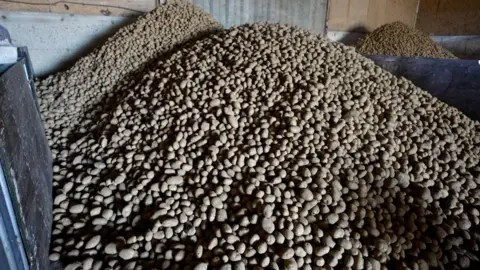
BBCA farmer with 600 tonnes of potatoes about to go to waste believes a trend for "healthier alternatives" and smaller portions are putting people off the humble spud.
Andy Goodacre, from Grantham, Lincolnshire, said shoppers wanted fewer chips, crisps and other processed products, meaning he was unable to find a buyer for his crop for the first time in 45 years.
The National Federation of Fish Fryers said it was telling chip shops to offer a smaller portion for people using weight-loss jabs.
GB Potatoes, the industry body, said growers were facing a "tough market" because of oversupply caused by a bumper crop, but weight-loss jabs would affect the whole food sector and not just potatoes.
Goodacre said his "mountain" of potatoes would usually be worth about £120,000.
He was calling potato merchants daily, only to be told: "No orders, no orders, no orders."
He felt "very distraught" that the spuds would be "fed to cattle" or go to an anaerobic digester if no buyer could be found.
"I would prefer to send them to a food bank, if anybody is willing to come and collect them," Goodacre said.
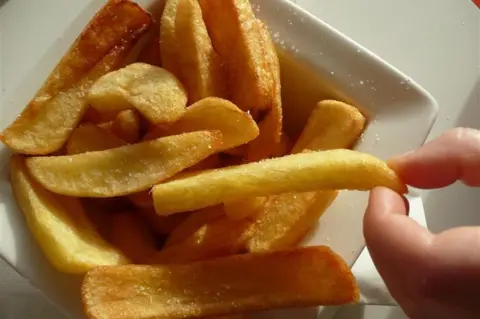
Andrew Crook, president of the National Federation of Fish Fryers, said fewer bags of chips were being ordered at fish and chip shops.
He partly blamed the rise of weight-loss jabs, which act as an appetite suppressant.
"People are buying one portion of chips and sharing it," Crook added.
Greggs previously said there was "no doubt" that the drugs were making customers look for "smaller portions".
In January, boss Roisin Currie said the bakery chain would be targeting customers with protein-rich products.
Tesco said a trend towards healthier eating had contributed to growth in its fresh produce sales, while other supermarkets have introduced nutrient-dense ranges of ready meals or smaller portions.
Crook, who runs an independent fish and chip shop in Euxton, Lancashire, said he was previously buying up to 600kg (1,320lb) of processed chips per week.
This had now fallen to 400kg, though the desire for fish remained strong.
In 1974, British households were buying more than 1.3kg (2.9lb) of fresh potatoes a week, but by 2024 that was down to 326g, according to statistics from the Department for Environment Food and Rural Affairs (Defra).
During the same period, purchases of processed potatoes, including chips and crisps, rose from 119g to 225g, though this was down from a high of 286g in 1996.
Scott Walker, the chief executive of GB Potatoes, said more potatoes were grown last year than any other time since 2017, causing a surplus.
However, he argued weight-loss drugs would affect everyone in the food sector.
"It's far too early to say what people will eat less of, but they'll eat less overall.
"We see that as a potential boom for the industry, because nutritionally every bite has to count.
"Potatoes are nutrient dense – they're ideal for small appetites."
Goodacre said he has not yet bought seed to plant next year's crop and would decide on the future of his land in the next month.
Listen to highlights fromLincolnshire on BBC Sounds, watch thelatest episode of Look North.
Download the BBC News app from the App Storefor iPhone and iPad orGoogle Play for Android devices
