Why this school will ditch a shirt, tie and blazer from its uniform

 BBC
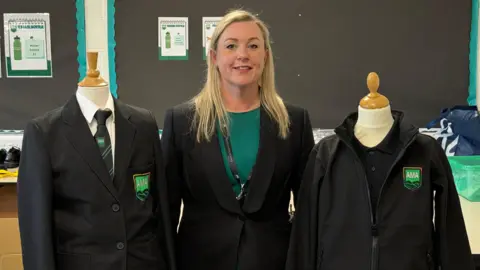
BBCA secondary school in Derby recently announced it will ditch its traditional uniform of a shirt, blazer and tie - in favour of a black all-weather jacket and polo shirt containing the school crest.
Alvaston Moor Academy said the change - which would come into force for Year 7 pupils from September - had been adopted after a consultation with pupils, staff and parents.
The school said the new uniform was more "practical", as it could be used both in school and outside, and better suited the needs of pupils with sensory needs.
The change has sparked a huge reaction on social media, and prompted conversations locally and nationally - but will it make a real difference?
Perhaps unsurprisingly, Gemma Tyers - the school principal - believes it "will boost attendance, engagement and achievement for students across the board".
She explained the school ran a "Big Student Ask" consultation on possible changes - and a new uniform was a big part of the response.
She said: "Essentially we listened to the community, we worked with them, we listened to them and responded.
"This was the overwhelming positive response in what they wanted.
"They wanted more practical, they wanted more affordable, they wanted a uniform that was more inclusive for everybody.
"All communities in Derby have responded with such positivity around the choices - and even other colleagues and educational leaders nationally have asked questions about what we are doing and why."
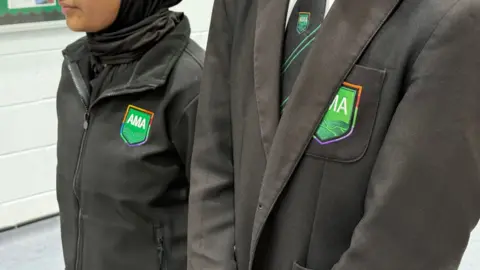
Tyers said the change would also help a number of children who had sensory issues, who found shirts and ties restrictive and distressing.
But she said she strongly supported the idea of a uniform preparing children to both learn and represent the school.
She said: "It's still branded, it's still a really clear sense of community and it maintains our school identity.
"We have the highest standards and expectations, and we want students to leave with choice and opportunity and this is just another part of our school improvement journey."
While the uniform will be compulsory for students starting Year 7, students going into Year 8 and onwards will get the option to switch to the new uniform - but purchasing those items will not be mandatory.
It is not the first time a school has looked into different uniforms for its pupils.
One school in Shropshire tried out pupils wearing PE kit all the time, with school-branded tracksuits and trainers, last year, while in 2024 a school in Bristol decided to bring in a more relaxed uniform - with the aim of allowing pupils to be more active during the day.

Debates over school uniforms - especially the enforcement and cost - have continually made headlines and reached the highest levels of government.
In November, some parents near Dunstable in Bedfordshire said they feared their children were being "treated like criminals" after being sent to isolation for what they felt were justifiable breaches of uniform rules.
The average cost of a full school uniform and PE kit for a child at secondary school is £442, and is £343 for a primary school pupil, according to the latest Department for Education data.
A poll carried out on behalf of national charity The Children's Society found that almost two in five parents or carers (38%) were still struggling to pay for school uniform.
Existing guidance, introduced by the previous government, says schools must consider the cost of their uniform, so it is not a deciding factor for parents when choosing schools.
But the Children's Wellbeing and Schools Bill, which is currently moving through Parliament, will require schools in England to reduce the number of compulsory branded items to three - plus a branded tie for secondary students.
The government estimates this will affect about four million pupils - but it does not actually cap the cost of the uniform.
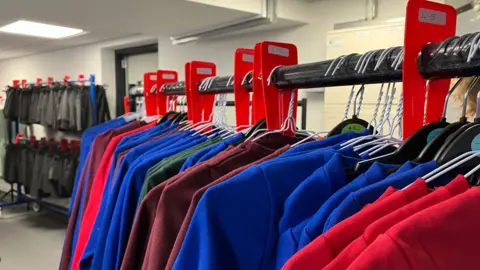
In addition to responding to rising costs, another factor mentioned by pupils at Alvaston Moor Academy was that they found the old uniforms difficult to move and run in - a concern echoed by children's charity Youth Sport Trust - which is running the Always Active Uniform campaign that "recognises that traditional school uniforms can sometimes act as a barrier to spontaneous physical activity".
Ali Oliver MBE, Youth Sport Trust CEO, said: "We are delighted to see more schools like Alvaston Moor Academy embracing practical approaches to school uniforms.
"Their smart new uniform proves high standards and modern, inclusive designs can go hand in hand, while better reflecting the needs of today's young people.
"Our Always Active Uniforms campaign suggests this change as a low-effort way to help children become more physically active, without adding more pressure on schools or parents."
Prof Helen Dodd, a child psychology expert at the University of Exeter Medical School, spoke to the BBC last year after a survey by the Active Uniform Alliance suggested that 77% of parents and 67% of teachers supported a shift toward uniforms that encourage physical activity.
She also challenged beliefs that formal uniforms improve academic performance.
"The evidence shows that uniforms make little to no difference in terms of concentration or achievement," she said.
"Even when it comes to behaviour, the benefits are minimal and can come at the cost of the teacher-student relationship due to constant uniform policing."
'Schools remain confused'
However, the Schoolwear Association - which represents the uniform industry - said new legislation had caused confusion in both retailers and schools, adding government plans could mean parents spend more on replacing lower-quality generic garments, which might not last as long as branded items.
They say branded uniforms also play a role in reducing inequality in schools and improving behaviour.
Its chairman, Matthew Easter, said: "It's no surprise most secondary schools have incorporated blazers as a part of their uniform policies.
"They have proved to be practical and durable, lasting longer than any other schoolwear garments, which in practice reduces the long-term costs for parents and ensures that children look smart and enter the school environment ready to learn.
"We're aware that some schools are now exploring alternative approaches, but the wider picture is more complex. Many schools remain confused about what the cap [on uniform items] means for them or how to implement it in practice.
"We're urging the government to increase the cap for secondary schools to five branded items plus a tie to ensure its uniform policy works for families, pupils and schools alike."
Back in Derby, Alvaston Moor Academy feels its move better reflects changes in society.
Principal Tyers added: "We're quite traditional, in terms of our uniform within the UK and actually, as we move with the times and we respond to what's happening post-Covid, and flexible working and other elements that are happening within the working environment.
"We need to be responsive to that."
Follow BBC Derby on Facebook, on X, or on Instagram. Send your story ideas to eastmidsnews@bbc.co.uk or via WhatsApp on 0808 100 2210.
