Assembly Rooms demolition approved despite concerns

 BBC
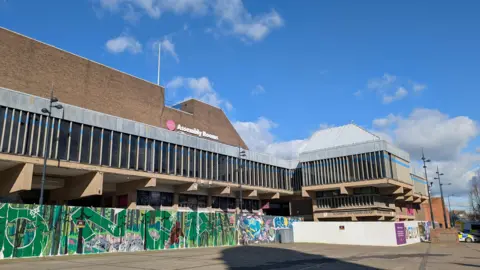
BBCThe demolition of the Assembly Rooms in Derby has been approved despite concerns of a years-long "hole in the ground" if plans to replace it change.
The city council's planning committee agreed this week to approve the demolition alongside altering conditions that attempted to safeguard the site from being bulldozed in isolation.
The original demand for a "contract" to be in place with developers has now been replaced with the need for a "development agreement".
Council officers insisted the conditions have not been "weakened" and the change still represents a "legally binding agreement".
However, heritage experts said the change in wording "does not guarantee funding, construction or delivery".
The Derby Civic Society said in a letter of objection that the site "could remain empty for years after demolition" and create a "scar on Derby's cityscape in an important conservation area".
Historic England said it would not stand in the way of demolition but warned the council it should be "satisfied that the proposed change will still deliver a suitable development in a timely manner".
A date will not be set for the demolition of the building - which has been unused for more than a decade following a fire - until a final planning application has been submitted and approved by the council.
The site was originally earmarked for demolition in 2024 but this was postponed due to planning concerns.
Two developers have submitted an outline planning application to Derby City Council to redevelop the derelict venue, the multi-storey car park, and 34 Full Street and build a "multi-purpose visitor destination" named DerbyMADE.
According to planning documents, the proposed redevelopment could also include an office building named DerbyWORKS and a four-star hotel named DerbyHOTEL.
'Hole in the ground'
The council's conservation and heritage committee said it had "strong concern about the use of a development agreement...without knowing how robust and secure such an agreement would be, particularly the consequences of breaking the agreement by either party after the Assembly Rooms has been demolished".
It added: "Members were concerned that a repeat scenario of the "hole in the ground" in Tenant Street, which remained for many years prior to the construction of the Quad."
The leader of the Derby Conservatives Steve Hassall had objected to the new wording over similar concerns.
"I'm deeply concerned by the decision," he said, describing the change of wording as "fundamental".
"They can demolish it, but if they find things they don't like...they can add clauses in there in which they can just walk away," he added.
Hassall said he feared a "hole in ground that's left unoccupied for years on end" in the middle of the city centre.
Laura Neale, the city council's major projects officer, told the meeting such agreements were "common practice".
"A development agreement remains a legally binding agreement between the relevant parties and will be signed and sealed by the council like any other contract," she said.
She also noted that the change would provide developers Ion and VINCI "greater control than the contract" on areas such as responsibility over risk management, meeting project milestones and quality standards.
"Development agreements are common practice and this change of wording reflects the approach of modern, multi-phase schemes," she added.
"The amendments do not weaken the requirements of the condition.
"An agreed development scheme is still required before demolition can take place, with the demolition not being considered in isolation."
Follow BBC Derby on Facebook, on X, or on Instagram. Send your story ideas to eastmidsnews@bbc.co.uk or via WhatsApp on 0808 100 2210.
