FA apology to women's team who defied football ban

 Films Not Words
Members of a women's football team who defied a 50-year ban on female participation in the 20th century have received an "historic" apology from The Football Association (FA).
The Corinthians were founded in 1949 on a muddy field in a park in Manchester, at the height of a ban on women's football after the FA had ruled that women were not allowed to play matches on FA-affiliated football grounds.
Former player Monica Curran said: "It is amazing. I'm 80 and we have received an apology from one of the biggest sporting organisations in the country."
An FA spokesman said the team "through their unwavering spirit, talent and determination blazed a trail for women's football around the world.
"We are sorry that a ban on women's football was introduced in 1921 and not revoked until 1971."
The spokesman added: " We recognise the courage of the teams and individuals who continued to play the game during this period.
"In more recent times, our ongoing commitment and investment into women's and girls' football in England has achieved unprecedented success and growth across all levels of the game – and we will ensure it continues to thrive in the future."
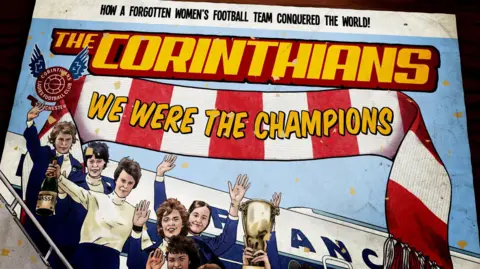
The story of Manchester Corinthians Ladies FC is being told in a new documentary titled The Corinthians: We Were The Champions.
Director Helen Smither said the decision is "historic" and added "the FA has never apologised for any ban on women."
Curran joined in the 1960s after a local newspaper article on the team's tour of South America and went to a trial.
"I was football mad and just wanted to play," she said. "We didn't even know there was a ban."
 Films Not Words
The Corinthians was set up by Percy Ashley, who was a scout for Bolton Wanderers and a well-known referee in the local area.
He wanted to create a team where his daughter Doris, who was deaf, could play in Manchester.
Despite training on a field on Fog Lane Park in Didsbury with no facilities, the team went on to draw in huge crowds in massive stadiums including Sporting Lisbon.
They defied the rules to win silverware from across the world, becoming one of the founding teams of the Women's FA.
During World War One, women's football had enjoyed a surge in popularity with some matches drawing in crowds of more than 50,000 fans.
At the time, any man fit enough to play football had been sent to fight on the front line.
Back home, women not only took on their jobs but also their places on the pitch.
Women had been encouraged to play the sport to improve their health and well-being while working in factories, but it was a different story once the war had ended.
On 5 December 1921, the FA claimed football was "quite unsuitable for females and ought not to be encouraged".
The ban changed the course of the women's game, forcing teams to be side-lined to public parks for 50 years until it was overturned in 1971.
Listen to the best of BBC Radio Manchester on Sounds and follow BBC Manchester on Facebook, X, and Instagram. You can also send story ideas via Whatsapp to 0808 100 2230.
