Cautious welcome for village flood defence funding

 Gary Manning
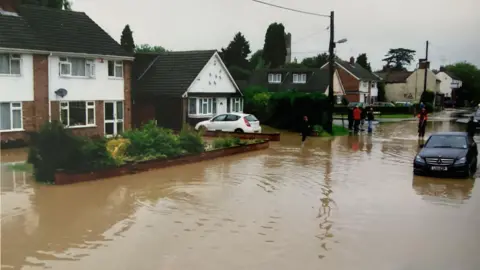
People living in a flood-hit village have said protection measures "cannot come soon enough" after £3m of funding was announced for several schemes.
Lavendon, near Milton Keynes, has flooded three times in the past decade, including in 2024.
Now the city council is set to match funds from the Environment Agency to target flood hot spots, which would also include cash for residential areas such as Beanhill, Netherfield and Woughton.
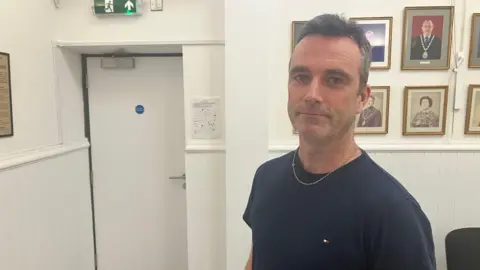
Steve Smith, who lives in the village but has spent half of the past five years in temporary accommodation, said: "This feels like it is the closest to something happening, but I will be relieved when it actually does happen."
 Amy Holmes/BBC
The funding, which is subject to final approval in the council's 2026-27 capital budget, would see better protection for 30 homes in Lavendon and more than 100 in Woughton.
Work could start in Lavendon as soon as the summer to manage water run off, while in Woughton, near central Milton Keynes, money would be spent on modernising drains.
Labour council leader Pete Marland said: "We should not forget that a lot of this flooding is because there is more rain in shorter bursts."
He added the authority was "at a stage now where we are mitigating against the impact of climate change".
He also hoped funding would be announced for larger schemes for places like Wolverton, Stony Stratford and Newport Pagnell for the next financial year.
 Steve Smith
Milton Keynes has been designed in a way where, in theory, less flooding should happen in residential areas.
In the 1970s and 1980s, man-made lakes at Willen, Caldecotte and Furzton were built to divert rain water from the River Ouzel away from people's houses.
Natural floodplains in the city have parks on them instead of housing, although with 2,000 new homes being built a year, that could change.
Newer estates like Brooklands and Oxley Park have sustainable drainage systems that look like dry ditches but can store rainwater that runs off roads, paths and roofs.
Marland said spending £2m to protect 30 homes in Lavendon and Marland was "the right thing to do" due to insurance costs, the loss of money to businesses and having to put people up in hotels.
Smith said the cost of repairs and temporary accommodation after two floods amounted to more than £500,000 and "insurance covers some of that, but not all of it".
He told the BBC he was "probably about £100,000 out of pocket" and said it had been a "huge emotional drain" for his family.
He said they had "bought this property, a beautiful place and dream home, thinking it is in the middle of the countryside and you never expect this to happen".
"Every time it rains we are anticipating flooding again, so the measures cannot come soon enough," he added.
 Amy Holmes/BBC
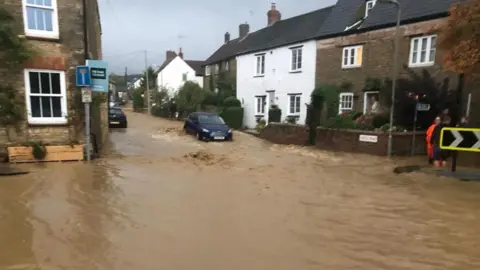
Lavendon suffers from flash flooding with water running off fields.
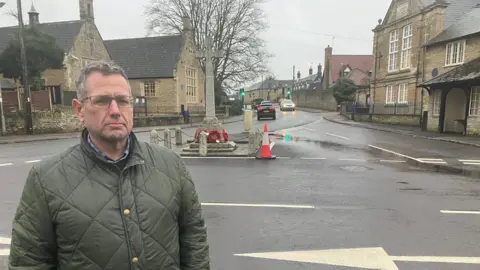
Local Conservative councillor Peter Geary said: "When you start getting heavy rain on saturated ground, you have got about 15 minutes between the it starting and flooding starting.
"We get a metre of water around the perimeter of the house, so it is get the family out, start preparing what you can to carry as much as you can upstairs."
He said, at its worse, roads in the centre of the village would be "knee-deep in water with 40 plus properties, including the church, shop and garage around the corner flooding".
Follow Beds, Herts and Bucks news on BBC Sounds, Facebook, Instagram and X.
