Businesses pledge 1,000 T-Level work placements

 BBC
BBCCompanies have pledged to offer hundreds of "quality work experience placements" to more than a thousand young people in Greater Manchester as part of a special new push.
The 45-day industry placements will be available to students doing T-Levels, which focus on technical skills and are equivalent to three A-Levels.
It comes as the Greater Manchester Combined Authority pledges to work with local colleges and businesses to make more T-Level work placements available.
Dylan Nomovi, from Middleton, who has begun a placement at the technology giant IBM, said: "The company was really welcoming, the people were amazing and they really helped me settle in."
The 17-year-old, who is studying for a T-Level in digital software development at The Manchester College, said: "Its the best thing I could have hoped for because I can be in the workplace and have an education too.
"After college, I'm hoping to do a degree apprenticeship in a subject like software design."

T-levels are available to young people after their GCSEs and were launched in 2020, with the time of students split into 80% classroom learning and 20% industry placement.
The courses last for two years but there have been concerns about drop-out rates.
A 2024 report by the Education Policy Institute found that nearly a third of first-year health and science T Level students dropped out of their course.
Ella Tsui-Lau, an assistant principal at Manchester College, said: "The key to retaining students on T-Level courses is the quality of education and the partnerships with employers.
"Its so rewarding to see students go on to a higher national apprenticeship or even full-time employment."
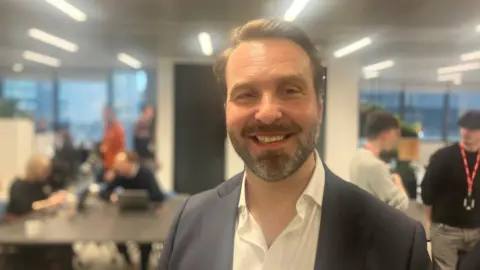
Leon Butler, the Chief Executive of IBM in the UK and Ireland, which employs some 600 people in Manchester, said: "The students are developing an e-commerce website and they're programming with HTML, as well as using new technologies including artificial intelligence.
"Everyday I'm blown away by the capabilities of students on T-Level courses and apprenticeships schemes," he added.
"Importantly, we make sure they get used to business environments, including doing presentations, so they are well versed in a corporate environment."

There are currently more than 20 T-Level subjects to choose from including accounting, craft and design, engineering and media production.
The classroom-based element of the courses includes English and Maths.
Declan Brooks, who is studying digital software development, said: "The T-Level programme meant that I could get a guaranteed placement at a company like IBM so to me that was a no-brainer.
The 16-year-old from Hazel Grove in Stockport said: "Getting into the world of work is how I want to get my foot in the door and further ahead. I'd like to start my own business."
In Greater Manchester, a technical alternative is being rolled out to the existing English Baccalaureate, with strong links between colleges and local firms.
The Greater Manchester Baccalaureate aims to give young people a clear line of sight to high-quality jobs in sectors that are growing in the local economy.
The combined authority is rolling out more college places and wants it to be available to all young people in the region by 2030.
