Are hospital wait times in the North West improving?

 PA Media
Everyone agrees that the NHS struggles each winter – and each year it seems to get worse, but the statistics tell a more nuanced story.
In A&E particularly, it's much worse than 10 years ago, but there has also been improvement over the past three years.
One of the major benchmarks is the percentage of people getting through there within four hours from arrival to leaving for a hospital ward, home, or somewhere else.
In December 2018 in the North West of England, 74% of the people going into a major hospital A&E managed to do that.
Last December it was just 57% - a huge fall.
Even so, that percentage has been steadily improving since a low point of 47% in 2022, when the region was emerging from the pandemic.
A more eye-catching and more worrying figure is the number of people waiting very long times to be admitted to hospital.
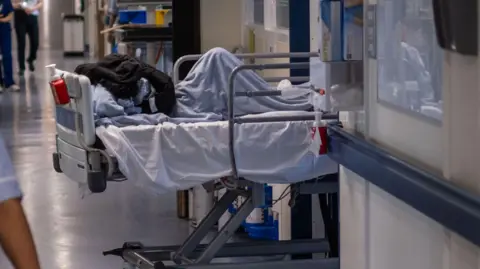
They are sometimes known as "trolley waits" or "corridor care".
In December 2018 the number of people who had to wait longer than 12 hours was 101.
In December 2025 it was 10,658 - an astonishing increase.
That figure is better than December 2024 when 11,750 patients had to endure half a day or longer waiting for a suitable bed but few would argue that the situation is under control.
"Trolley waits" largely happen because every bed in the hospital is already taken, so there are none for the people in A&E to go to.
Often this is because of a lack of social care or community health care provision, so people who are medically fit to leave have nowhere safe to go, and end up staying longer than they need to.
This causes problems for everyone.
The patients in the beds are losing muscle strength and are at risk of picking up infections.
The patients in A&E can't get out of there.
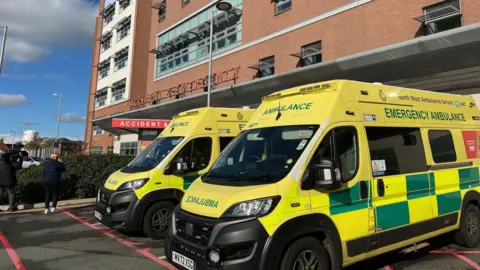
At this time of year in this region, fewer than half of the patients who could have been discharged actually get to leave that day.
Taking 9 January as an example, the figure was 43%.
That meant, of the 3,942 patients who were ready to go, 2,255 were still there at the end of the day.
In other words, 2,255 beds that couldn't be taken by the patients in A&E.
But on the same day in 2023, just 30% of those eligible patients were discharged.
So although 43% may seem unimpressive, it's actually a big improvement, and it's a figure which has been going up steadily over the past three years.
The most rapid progress has been in waiting times for planned surgery and procedures.
The pandemic caused huge problems here because so much non-urgent surgery and treatment was cancelled.
The most recent figures are from November and at that point 24 people had been waiting more than a year and a half.
But in the same month in 2023 that figure was 1,403.
There are still huge numbers of people waiting a year or more – 28,671 – but that's still far better than November 2023 when it was 68,233.
All governments since 2022 have put a big emphasis on getting waiting lists down and it shows.
The percentage of people being seen within the national target of 18 weeks is also slowly but steadily going up (currently 57%).
No one thinks that the NHS is where it should be.
There are also huge financial pressures in this part of the world now because the NHS in this region is facing significant budget cuts, and that's playing out in cuts to many services.
But at the same time the past few years have seen some steady improvements which hopefully will continue.
Read more stories from Cheshire, Lancashire, Greater Manchester and Merseyside on the BBC, watch BBC North West Tonight on BBC iPlayer and follow BBC North West on X.
