AI hope for doctor's 'most precious patient'

 Rare People - The Research Charity
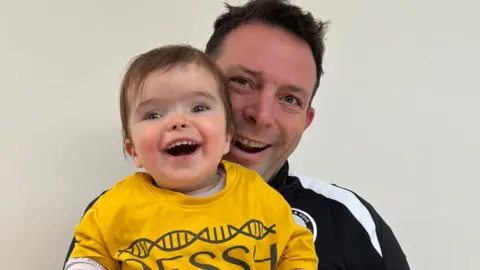
A senior emergency doctor has launched a research charity after his daughter was diagnosed with an ultra-rare genetic brain condition affecting about 200 people worldwide.
Prof Rob Galloway's daughter, Frankie, has DeSanto Shinawi syndrome for which there are no existing treatments.
Galloway, who works at the Royal Sussex County Hospital in Brighton, described his daughter as "the most precious patient I've ever felt responsible for" but that despite his work he "didn't have a clue what to do".
However, he said he moved from "despair to determination" after meeting scientists in the US using artificial intelligence (AI) to identify existing medicines that might help rare genetic disorders.
DeSanto Shinawi syndrome leaves patients unable to make certain proteins crucial in early brain development.
Galloway said researchers at the Mayo Clinic in the US had tested an epilepsy drug in the cells of a child with the condition.
Scientists there said they had seen signs of possible benefit when the child later took the medication, though they have stressed it is not proof.
The case inspired Galloway to set up Rare People - The Research Charity, which will fund clinical trials of repurposed medicines identified by AI.
He said: "This new strategy to treat rare genetic diseases is so different, so novel and so new, that many of us in medicine (myself included) couldn't see the significance of what was happening in plain sight.
"I had underestimated just how remarkable it is, and how much potential it could offer children like my daughter.
"This would be an impossibility unless using Artificial intelligence computing power, analysing all the world's experimental data out there and bringing it together."
 Kelsie Scully Photography
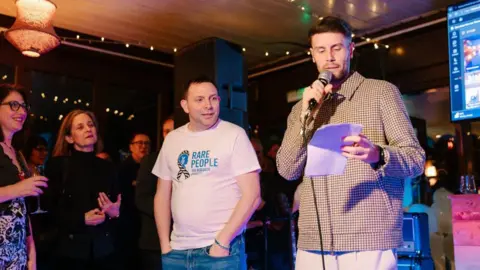
Galloway is the senior medical advisor to Brighton & Hove Albion Football Club during match games, and the club turned out to support the charity's launch.
Club manager Fabian Hurzeler told the launch party he had spent a lot of time in his work talking marginal gains.
"Small improvements make a big difference," he said.
"For these children, a small breakthrough could be walking, communicating, living more independently.
"That is not marginal, that is life-changing."
Dr Dragana Josifova, consultant in clinical genetics at Guy's and St Thomas' NHS Trust in London, described Frankie's parents as "the most enthusiastic parents I've ever met".
Josifova is working with the new charity to try to establish the world's first clinical trial using AI repurposed drugs on rare genetic conditions.
She said: "The emphasis at the moment is to try to identify new treatment options.
"We call them targeted treatments, that would address the specific problem in the genetic pathway, rather than giving them more generic treatments that are potentially helpful, but not specific."
Galloway said his charity's first funding priority was to support a trial of children - and in time, adults - with DeSanto Shinawi syndrome.
He said: "We are working through the process of how children outside of the US (including in the UK) can be part of the trial."
He argues that, if it were proven that the improvement was real, that it was drug-driven rather than coincidence, then "the entire model could be applied to thousands of rare genetic diseases".
He said: "Frankie is a perfect, wonderful, loving, joyful little girl.
"I wouldn't change her for the world. But I do want her to have the same hopes, the same opportunities, the same freedom to dream about her future that my other children will have as they grow older.
"This new model of thinking in rare disease, and the charity we are building around it, gives us something we never thought possible: hope that medical treatments can help her.
"And hope, when it is grounded in science, changes everything."
Follow BBC Sussex on Facebook, on X, and on Instagram. Send your story ideas to southeasttoday@bbc.co.uk or WhatsApp us on 08081 002250.
