Can hydrogen fuel replace petrol and diesel in cars?

 BBC
BBCIt's a challenge affecting every country in the world - how do we wean ourselves off fossil fuels?
The UK is already leading the way with renewable energy, with 2025 being a record year for wind and solar generation. However, there is often too much renewable energy in the system, so farms are paid by the grid to switch off.
There are also times when there is not enough wind and solar generation because of the weather. But Keele University in Staffordshire thinks it may have the answer.
The Low Carbon Energy Generation Park on campus generates around 50% of the power needed to run the university and often runs with surplus energy. Rather than waste that excess power it has decided to produce so-called "green hydrogen", as a firm in Germany is already doing.
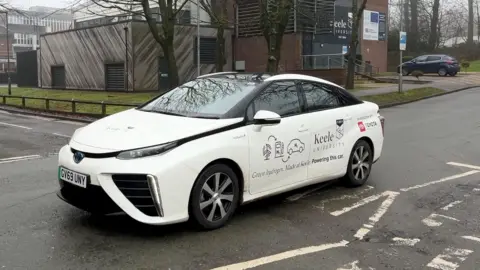
Dr Charlie Creissen, a senior lecturer in chemistry, says they've been using the fuel to power to two Toyota cars.
"It's a very unique situation, because we have too much energy produced here by our wind and solar farm and this is also a situation often seen nationwide when there is too much wind and solar than the national grid can handle," he says.
"At times when we have too much energy, rather than switch off we use it to create green hydrogen and it's that fuel we put in the cars.
"Essentially, with this being green hydrogen there is no carbon emissions the only element that comes out the car's exhaust is water.
"Hydrogen is everywhere, it's in the food we eat, the water we drink. It is the most abundant element in the universe."
Only emission is water
It's that abundance that has led Keele to develop their hydrogen generation capabilities.
"The process of creating hydrogen is simple," says Creissen. "You electrify pure water, which splits the oxygen and hydrogen atoms. It's then compressed into a liquid and it's that we put into the cars."
The process Keele uses does not require any use of fossil fuels, so the only emission from the car's exhaust is water.
However, thus isn't currently standard practice in the UK, since most industrial producers currently use fossil fuels in the creation process.
Instead of being labelled "green", the industrial process uses natural gas, resulting in blue hydrogen, as it is known.
However, what Keele have proved is that green hydrogen can easily be produced and used as a fuel.
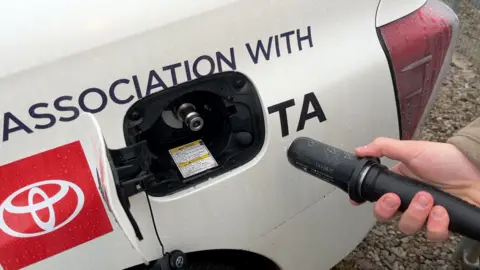
Dr Michaela Kendall, from Adelan a hydrogen technology company based in Birmingham, is also backing the transition to green hydrogen.
"I've driven a hydrogen car for three years and distance wise a full tank gets me around 400 miles," she says. "The problem is finding a place to fill up.'
"This country doesn't have an energy crisis, it has an energy management crisis, because wind and solar farms are often paid to switch off because they produce too much energy for the system."
Data from the National Energy System Operator (NESO), which run the UK's power grid, shows that under £2bn was spent in what it calls constraint payments, although it could not provide a breakdown of how much of that was spent on renewables.
In a statement it said: "The delivery of new electricity network transmission infrastructure and future electricity market arrangements will be vital to lowering these costs for consumers in the long term."
Meanwhile, Kendall says "what Keele is doing is great. Rather than switch off, they are using energy that would otherwise go waste to create hydrogen".
"The first hurdle is cost, the price of hydrogen is often down to what type of energy is used. Fossil fuels are expensive, so if gas, has been used in the process to create it that will drive the price up," she says.
"By using surplus renewables Keele have shown they can effectively get that price down to £0."
Hydrogen cars are already on sale in the UK, so the issue isn't with the technology but in how those vehicles don't run out of fuel.
However, it is hoped that with the likes of Keele's research into green hydrogen the fuel can then be rolled out to other vehicles such as lorries and trains, and a network of refuelling stations can be set up across the UK..
Follow BBC Stoke & Staffordshire on BBC Sounds, Facebook, X and Instagram.
