Farmer 'not surprised' by toxic waste test results

 BBC
BBCTests have found there are "potentially unacceptable risks" from toxic waste, including banned "forever chemicals", at a former Cheshire landfill site
Testing for a BBC podcast in 2024 found elevated levels of Polychlorinated Biphenyls (PCBs) at the site in Alvanley, near Frodsham.
The preliminary assessment for Cheshire West and Chester Council found "low to moderate" risks to human health at the site, and "moderate to high risks" at a brook that carries drainage water to the Mersey estuary.
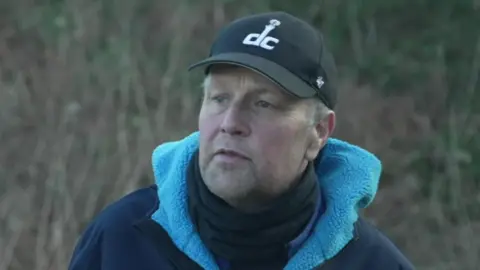
Paul Jackson, who farms the adjoining fields, told the BBC he was "not surprised" by the findings.
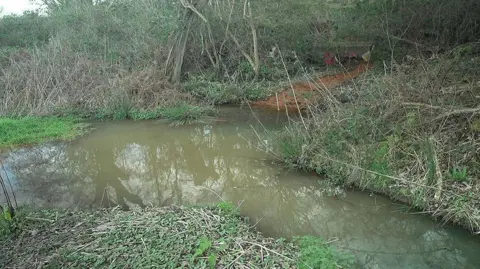
Testing for the BBC podcast Buried found levels of PCBs that were 1,000 times over the recommended UK level in mud next to the Foxhill Brook, which runs to the north of the site.
"I'm not surprised, not at all," Jackson said.
"I know the facts, I've seen the test results. You don't need to be a brain surgeon to know that's a risk," he said.
The site, known as Commonside, accepted PCB waste from the former British Insulated Callender's Cables (BICC) factory 2km (1.2 miles) away in Helsby when it operated as a landfill site between 1956 and 1975.
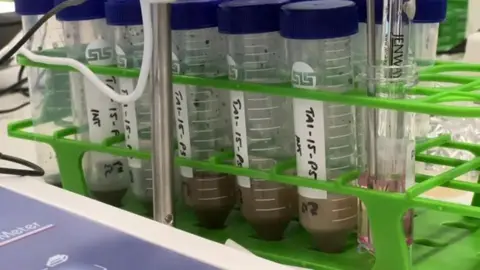
Testing of mud at the BICC site for the Buried podcast found PCB levels that were more than 12,000 times over the recommended safe level - higher than scientific equipment could measure.
PCBs are a group of chemicals that were widely used in the manufacture of cables and electrical equipment because they are fire resistant - but in high doses they have been linked to serious health concerns including cancer and fertility issues.
They were progressively banned in the UK from the 1970s and have now been banned by 151 countries, but scientists say they are still a threat to marine wildlife.
Cheshire West and Chester Council commissioned consultants to carry out a "preliminary risk assessment" of Commonside.
It is part of an investigation under the Environmental Protection Act (EPA) launched in 2024 to establish if the land should legally be regarded as contaminated.
A designation of contaminated land can then lead to a process to decide how it can be remediated and who should pay for it.
'Strong chemical odour'
A summary of the assessment of Commonside said the identification of potentially unacceptable risks "does not mean that harm or pollution is occurring" but that "further assessment would be needed to understand the significance of the risks".
The assessment said the potential risks to human health "are associated with possible exposure to impacted soils, water and sediments in Foxhill Brook and drainage ditches, as well as vapours and landfill gas".
The brook had "a strong chemical odour in places" and testing found contaminants from the landfill were present, the assessment said.
It said the "moderate to high" risks to the brook and surrounding drainage ditches were a "priority risk for further investigation".
The consultants said the risks to shallow groundwater from the site were "moderate" but would also be a priority for further investigation.
The risks to deeper groundwater under the site, used as a source for local drinking water, were low but "further information and evidence is needed to better understand this risk", the report said.
Water provider United Utilities has previously said routine testing of the water quality from its borehole was "consistently good" and enhanced testing also produced "clear" results.
'Same circles'
A successful prosecution was brought in 1991 because PCB waste from the former landfill site was flowing into the brook.
But no remediation took place because the then landowner "did not have the means to pay" and the former National Rivers Authority "was unsuccessful in its attempts to identify funds for remediation," a separate council report said.
The council said there is currently no registered owner for the site.
The assessment recommends a more in-depth investigation, including digging exploratory holes in and around the site, sampling water and sediment from the brook and drainage ditches, and monitoring soil, groundwater and landfill gas.
"I'm not confident with anything the council are going to do and have done in the past," Jackson said.
"We just seem to go round in the same circles."
Read more stories from Cheshire on the BBC, watch BBC North West Tonight on BBC iPlayer and follow BBC North West on X. You can also send story ideas via Whatsapp to 0808 100 2230.
