Investigation into 'forever chemicals' waste near ex-factory

 BBC
BBCAn investigation has been taking place into toxic waste on land where some of the highest levels of banned "forever chemicals" in UK soil were found.
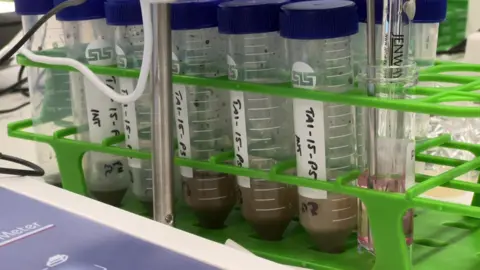
Sampling for BBC podcast Buried in 2024 found levels of Polychlorinated Biphenyls (PCBs) more than 12,000 times over the recommended UK level on land adjoining a former cable factory in Helsby, Cheshire.
Cheshire West and Chester Council has now confirmed it is investigating, and is coming under pressure from campaigners to release a report commissioned by the landowner after fresh ground sampling.
The authority argues the report, from landowner Balfour Beatty, is commercially sensitive and could prejudice its own investigation.
Campaigner Paul Cawthorne said: "This is of national and potentially international significance," adding the 2024 sampling "shows there's a major problem".

Dr David Megson, from Manchester Metropolitan University, conducted 2024 sampling on behalf of the Royal Society of Chemistry for the Buried podcast.
He said the testing from mud by a drainage ditch, which feeds into the Mersey estuary, uncovered "pretty much some of the highest PCB levels that have ever been found in UK soils".
"To get something back to our lab, test it and not be able to accurately see how high the concentrations were because they were too high for our instruments to measure - it was just phenomenal, it blew me away from a really sobering perspective."
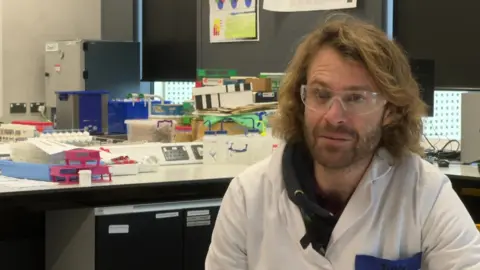
PCBs are a group of chemicals that were widely used in the manufacture of cables and electrical equipment because they are fire resistant - but in high doses they have been linked to serious health concerns including cancer and fertility issues.
They were progressively banned in the UK from the 1970s and have now been banned by 151 countries, but scientists say they are still a threat to marine wildlife.
'Containment cell'
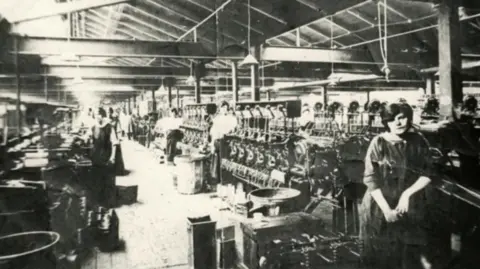
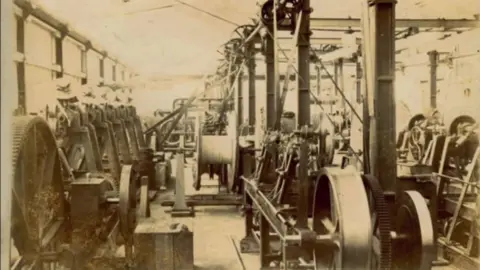
About 5,000 people used to work at the former British Insulated Callender's Cables (BICC) factory in Helsby, which closed in 2000 and is now a series of housing estates, a supermarket and a sports club.
The land where the sample was taken is next to the factory site. It has not been built on and is not due to be redeveloped.
Dr Megson's findings led the landowner Balfour Beatty - the successor company to BICC – to commission a consultant to investigate the area where the sample was taken, as well as the integrity of a nearby "containment cell", which was built to contain PCBs from the factory. A nearby footpath was fenced-off.
The council has for the first time confirmed to the BBC that in 2024 it launched its official investigation under the Environmental Protection Act (EPA) to establish if the land should legally be regarded as contaminated land, which can then lead to a process to decide how it can be remediated and who should pay for it.
 Cheshire Image Bank/Jim and Jennie Lloyd
Balfour Beatty's report has now been sent to the council as part of the EPA investigation, but the council has refused to release it under transparency regulations, arguing it is commercially sensitive and could prejudice its own ongoing investigation.
The regulator, the Information Commissioner, has upheld the council's decision but campaigners say they will take the issue to a tribunal.
Dr Megson said his testing found the site was "leaking PCBs, and a lot of PCBs" but wider testing should reveal "what the scale is" and "where the PCBs have gone".
"If that pollution that we found was widespread then it would pose a really big risk to that community," he said.
 Cheshire Image Bank/Jim and Jennie Lloyd
The council told the BBC there had been "a substantial amount of work to investigate, assess and remediate" other areas of the BICC site that have been redeveloped for housing and other uses.
The planning permission process "required the respective developers to undertake redevelopment in a safe manner and to ensure that the site is suitable for a residential end use," a council spokesperson said.
"As redevelopment is still ongoing, officers continue to assess all land contamination matters to ensure it meets the appropriate standard," a spokesperson added.
Dr Megson explained: "Those houses - if everything's been done correctly - should be safe to live in."
Gwen Olson, who worked at the BICC factory for 10 years until 1986 and now lives on the site, told the BBC: "It doesn't worry me per se, but if you're a family with young children then it would worry you."
She said she "would hope" contamination on the land would have been dealt with as part of the planning permission process.

George Randles, president of Helsby Community Sports Club, which is based on part of the former BICC site, said PCBs were "a difficult subject" but added "to the best of my knowledge I believe they have been cleared".
A Balfour Beatty spokesperson said the firm takes "all environmental matters extremely seriously".
"The health, safety, and wellbeing of the public and our workforce, is always our highest priority and will continue to keep Cheshire West and Chester Council and the Environment Agency informed as sampling and analysis progresses," they said.
Investigation at second site
Cheshire West and Chester Council announced in 2024 that it was also conducting an EPA investigation into a former landfill site 2km (1.2 miles) away in the village of Alvanley, where the authority said PCB waste from the BICC factory was dumped.
This year, the BBC saw liquid trickling down a hill from underneath the field containing the former landfill site into a small pond on the lower adjoining field, where the water is covered with an oily film and there is a gaseous smell.
Testing for the Buried podcast also found elevated levels of PCBs near this site, which closed in the 1970s and has a drainage system discharging water into the nearby Foxhill Brook, which feeds the Mersey estuary.
The land was never owned by BICC or its successor Balfour Beatty and the council said there was currently no registered owner for it.
A successful prosecution was brought in 1991 because PCB waste from the site was flowing into the brook but no remediation took place because the then landowner "did not have the means to pay" and the former National Rivers Authority "was unsuccessful in its attempts to identify funds for remediation," the council report said.
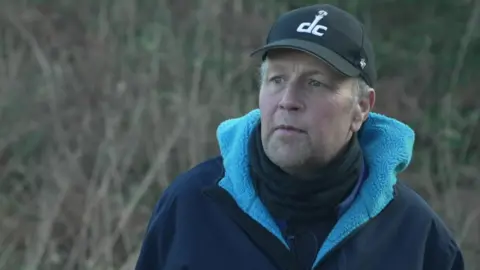
Farmer Paul Jackson owns the adjoining field and believes the council investigation is taking too long.
"I've tried to be positive with the council, I've done it the easy way being polite trying to talk to them, I've done it the hard way, I've run out of ideas," he said.
"We were told they were going to do something to tidy it up and 35 years later we're still in the same situation."
"It makes me angry," he added.
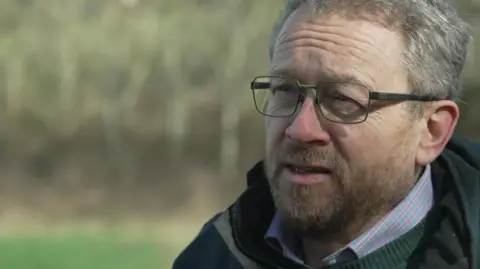
The council said consultants were now analysing new samples from the site, adding that it was pursuing its investigation "as a priority" and is following legal process.
"The process is both methodical and thorough to ensure all relevant factors are identified, considered and addressed accordingly."
Green councillor Chris Copeman, a member of the task force of councillors reviewing the council's investigation, said it would "give us some answers, but I think we need to scrutinise it and make sure a proper job is done".
Read more stories from Cheshire on the BBC, watch BBC North West Tonight on BBC iPlayer and follow BBC North West on X. You can also send story ideas via Whatsapp to 0808 100 2230.
