Historic buildings added to at risk register

 Peter Davison
Three historic Wiltshire buildings have been deemed to be at risk and added to a national list of concern.
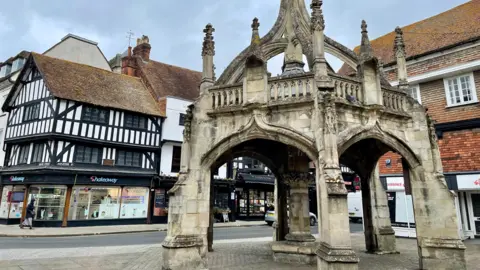
The Poultry Cross in Salisbury is considered at "immediate risk of further rapid deterioration," according to Historic England's At Risk register.
The 13th Century Church of St John the Baptist in Bishopstone and Wardour Castle Chapel in Tisbury are the other additions, with both said to be suffering from "slow decay".
Salisbury City Council, which owns the Poultry Cross, declined to comment when approached by the BBC.
A previously agreed plan to rescue Wardour Castle Chapel has yet to be implemented, while no solution has been reached to save the Church of St John the Baptist.
A number of listed buildings and structures already on the list have also continued to decline since the register was last published in November 2024.
These include the Lansdowne Monument at Calne, the Abbey Church of St Mary and St Aldhelm in Malmesbury and the former hangars at Yatesbury Airfield near Cherhill.
The Assizes Court in Devizes, which is set to become the new home for Wiltshire Museum, is also included in this group.
The new register has indicated some progress on other buildings, with several other sites listed as improving including Tottenham House near Marlborough and Courtfield House in Trowbridge.
Grade I listed Tottenham House near Marlborough is currently undergoing a multi-million pound restoration to restore the main house, stable block and grounds, while Courtfield House in Trowbridge has been converted into apartments.
A number of archaeological landmarks near Amesbury have also been removed from the register.
Follow BBC Wiltshire on Facebook, X and Instagram. Send your story ideas to us on email or via WhatsApp on 0800 313 4630.
