How is new guidance helping protect shipwrecks?

 CISMAS
A new push to crack down on heritage crime at sea has been hailed as a "truly pioneering" by police.
Historic England, working with the University of Plymouth, produced new national guidance that aims to be a legal toolkit for authorities dealing with underwater crime.
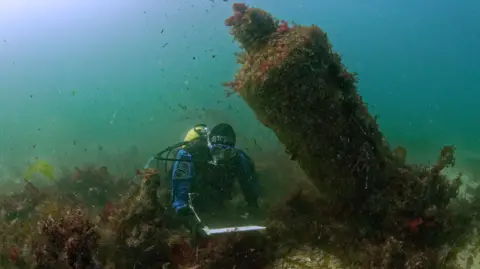
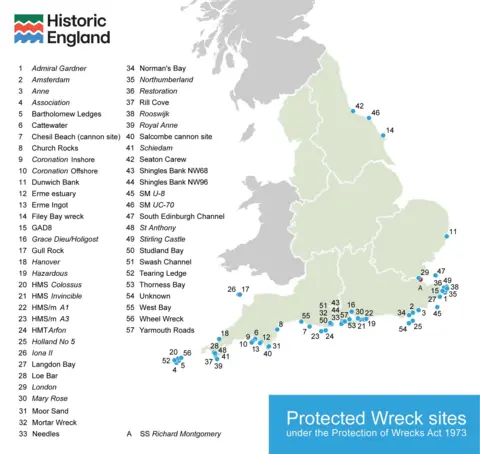
More than half of England's 57 nationally important shipwrecks lie in remote locations - many situated around the coast of Cornwall and Devon - with signs of interference often going unnoticed, the university said.
Sgt Julian Fry, from Devon and Cornwall Police, said the manual had been a "game-changer" in helping crack down on illegal dumping. "This is truly pioneering work," he said.
 University of Plymouth
The Common Enforcement Manual was developed by Prof Jason Lowther and visiting Prof Mike Williams from the university's School of Law, Humanities and Social Sciences, along with Beccy Austin, a senior consultant working for Marine Safety Data Sheet Marine.
Lowther described the guidelines as "a major milestone in the protection of our rich underwater cultural heritage" and an "unprecedented piece of joined-up action" with legal advice, protocols and clearer communication routes between agencies all brought together.
It aims to give the police, government and fishery bodies the "eyes and ears" they need on the water, he said.
Lowther said heritage crimes - such as stealing from a shipwreck - were often only spotted when they were shared on social media or listed for sale.
How underwater crime is spotted
Lowther said people may not know they were damaging something historically significant.
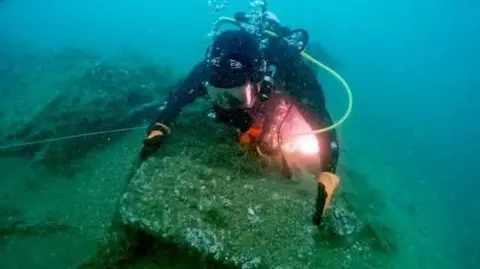
"It might well be the licensed divers that go on to the wrecks and conduct archaeology might notice there's been some sort of interference in it," he said.
"Obviously, that's difficult because it isn't a crime scene like you would expect to find on land - the natural environment beneath the water is going to be a complex and dynamic one and things change all the time.
"Without proper baseline understanding of what's there in the first place, sometimes it can be quite difficult to establish something has been damaged."
 MSDS Marine
Fry said the manual offered clear and easy to use guidance for police.
"This is truly pioneering work which brings together the knowledge, skills and experience of those involved with enforcement in the maritime heritage crime sector into one place for the first time," he said.
Lowther said: "We had a few results in the summer in relation to potting, or pots being illegally dumped on shipwrecks which potentially causes damage to that area."
He said after having "a little word with the people concerned" it meant that did not happen again.
Mark Harrison, Historic England's head of heritage crime, said rapid action was vital.
"Responding to crime at sea requires swift action, clear procedures and the secure preservation of evidence," he said.
"By strengthening awareness and coordination... we are enhancing our collective ability to identify offenders, secure crime scenes, and protect historic wreck sites.
"This sends a clear message that criminal activity will not be tolerated."
The Chartered Institute for Archaeologists' Heritage Crime Special Interest Group described the manual as "leap forward" in safeguarding underwater heritage for future generations.
Is it illegal to take objects from shipwrecks?
Historic England guidance and the enforcement manual make it clear removing material from historic wrecks and causing damage or disturbing sites is a form of heritage crime.
Many wrecks are legally protected under heritage legislation and divers are expected to respect this.
The Protection of Wrecks Act 1973 also states taking artifacts is prohibited unless licensed and grants the highest level of protection to 57 wrecks.
Licensed divers act as custodians and are encouraged to report any changes or damage and only archaeologists should remove objects, according to the guidance.
Unesco also has a code of ethics for diving on archaeological sites.
Where are protected shipwrecks in Devon and Cornwall?
 Historic England
Shipwrecks protected by government legislation in Devon, Cornwall and the Isles of Scilly include:
- Coronation Inshore, Cornwall
- Coronation Offshore, Cornwall
- Hanover, Cornwall
- Loe Bar Wreck, Cornwall
- Rill Cove, Cornwall
- Royal Anne, Cornwall
- Schiedam, Cornwall
- St Anthony, Cornwall
- Cattewater, Devon
- Church Rocks, Devon
- Erme Estuary, Devon
- Erme Ingot, Devon
- Gull Rock, Devon
- Iona II, Devon
- Moor Sand, Devon
- Salcombe Cannon Site, Devon
- Association, Isles of Scilly
- Bartholomew Ledges, Isles of Scilly
- HMS Colossus, Isles of Scilly
- Tearing Ledge, Isles of Scilly
- Wheel Wreck, Isles of Scilly
Wrecks scheduled under the Ancient Monuments and Archaeological Areas Act 1979 include:
- HMS Montagu, Devon
- HMS/m D1, Devon
- Northam Burrows, Devon
- South Australian, Devon
- The Axe Boat, Devon
- Westward Ho!, Devon
- Wreck near Low Bream Ledge, possibly the remains of the Phoenix, Isles of Scilly
