Women affected by pension changes 'not going away'

 BBC
BBCWomen who were denied compensation by the government after being affected by changes to the state pension age say they are "not going away".
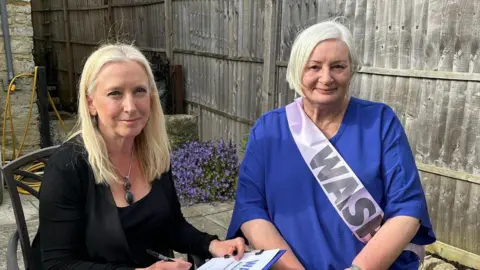
Women Against State Pension Inequality (Waspi) campaigner Hilary Simpson, from Wiltshire, described the government's decision as a blatant injustice and said it felt like a "kick in the teeth".
Waspi believes about 3.6 million women born in the 1950s were not properly informed of the rise in their state pension age, which brought it into line with men.
On Thursday, the government said it had reconsidered the case and had concluded no compensation should be paid.
Simpson, from Cricklade, chairs the Waspi Campaign 2018 and said that despite the decision, the women she campaigned with were "a resilient generation and we're not going away".
Rosa Kell, 72, from Wells in Somerset, said she was determined to carry on fighting.
"We may be dying but we aren't going away," she said.
Elizabeth Stanley, 71, Waspi coordinator for Stroud in Gloucestershire, added: "There is nothing tougher than a tough old lady, so we are not giving up.
"We've always got a plan."
Stanley said they would continue to write to MPs and demonstrate.
Some women are considering taking legal action against the government but Stanley said she would prefer to go through the parliamentary route.
Kell said she could not afford to take legal action, but said the Department for Work and Pensions had to be "held responsible for its mismanagement".
![Getty Images A Women Against State Pension Inequality [Waspi] demonstration. A group of women are stood behind metal fencing which has WASPI banners on it with the words 'Salisbury and Wilts Group' on them. Some of the women are blowing whistles, some are holding banners. Some are also wearing sashes. They are protesting outside of Parliament.](https://ichef.bbci.co.uk/news/480/cpsprodpb/6f61/live/db0164e0-fdf2-11f0-8244-8b38c2f9341b.jpg.webp) Getty Images
Getty ImagesIn 2024, a parliamentary ombudsman recommended compensation of between £1,000 and £2,950 each for those affected. However, it could not enforce the payment and the government rejected it.
Speaking in the House of Commons, Work and Pensions Secretary Pat McFadden said on Thursday that the government accepted that "individual letters about changes to the state pension age could have been sent earlier".
But he said "women did not suffer any direct financial loss from the delay".
Simpson said "the government seems to be looking for every and all excuses not to pay compensation".
"It's a question of justice and the money could be found if there was a will to find it," she added.
Follow BBC Gloucestershire, Somerset and Wiltshire on Facebook, X and Instagram. Send your story ideas to us on email or via WhatsApp on 0800 313 4630.
