Are ties and blazers on the way out? Why some schools are pushing for 'active' uniforms

 BBC
BBC"If I had a pound for every time I said 'tuck your shirt in', I wouldn't need to teach, I'd be a millionaire," laments one Derbyshire secondary school teacher.
The teacher, who asked us not to use their real name, works at a school with a strict uniform policy, where pupils can end up in detention if they repeatedly forget their tie or paint their nails. Pupils wear a blazer, shirt and tie, which "look really uncomfortable".
"We're meant to stand at the door and greet students just to check that they're wearing the uniform correctly and that their shirts are tucked in and they're looking smart and ready to learn," the teacher says. "It just wastes time."
She says the regular uniform checks are disruptive for pupils and give teachers unnecessary work.
Another secondary school in Derbyshire, Alvaston Moor Academy, is now ditching blazers and ties in favour of a black all-weather jacket and polo shirt from September.
The teacher we spoke to called the policy "genius". "It looks so comfortable and it looks smart still," she says.
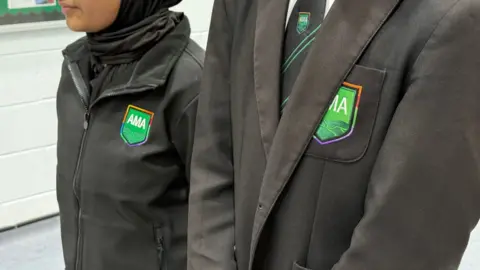
Currently, learning to tie a tie for secondary school is almost a rite of passage in the UK. In fact, a 2020 study of the uniform policies of every state secondary school in Scotland found that 90% required ties and 66% had blazers.
But Alvaston Moor's new uniform appears to be part of a broader movement to introduce more practical school clothing. Proponents say this encourages children to be more active, is more comfortable and makes life easier for children with special educational needs and disabilities (SEND) - but others argue traditional uniforms look smarter and instil discipline.
One concern some parents and staff have about traditional school clothing is that blazers, which some schools demand pupils wear at all times, aren't always weather appropriate.
'It's a bigger issue than people realise'
One Leeds grandmother says her 11-year-old granddaughter is often "freezing" at school wearing her blazer, as opposed to a jumper: "That isn't conducive to children's learning."
A former teacher in Walsall says the secondary school where she used to work had the opposite problem - pupils usually weren't allowed to take their blazers off, leaving them uncomfortable at times. Mum Laura has a similar issue with her son, who has ADHD and often gets hot and claustrophobic in his formal shirt and tie.
Laura's son isn't alone. Traditional school uniforms can often be difficult for SEND pupils.
"It's actually a bigger issue than people realise," says Duncan, from Devon, whose teenage daughter is autistic and has sensory processing disorder, which means she is more sensitive to how clothing feels against her skin.
His daughter switched schools two years ago, and one of the main reasons was her school's inflexible uniform policy, he says.
The teenager found some aspects of her uniform so uncomfortable that they became painful, like the embroidered logo, seams and tag on her polo shirt, her dad says.
"She was refusing school for a long time," Duncan says. He says her previous SEND school turned down his proposal that she wear her own T-shirt in the school's colour and black leggings or jogging bottoms.
Among primary schools, the push for more practical school uniforms is largely to encourage physical activity and play. More than half of children aged five to 16 weren't meeting the chief medical officer's guidelines of 60 minutes of physical activity per day in the 2023-2024 school year, says Sport England.
Link to behaviour
"If you were taking your kids out on a Saturday to play, there is no way that you would choose the kind of clothes that we send children to school in," says Prof Helen Dodd, who researches children's play at the University of Exeter. "The clothes that they're wearing are getting in the way."
A small-scale 2012 study by Australian academics suggested that girls at primary schools were "significantly more active" during breaks and at lunchtime when they wore their sports uniform rather than their winter uniform. A 2021 study was less conclusive but suggested that wearing sports uniforms "may yield small improvements" in activity levels throughout the day.
Academics and parents also push back against some of the main arguments in favour of more traditional uniforms - for example, that they encourage better behaviour and prepare pupils for the world of work.
"The research evidence does not support that smart uniform affects behaviour," says Dodd from the University of Exeter.
And fewer people are wearing blazers and ties to work after the pandemic led to people dressing more informally for the office. What people wear to the office has "just gone so casual" in the past few years, personal stylist Karina Taylor previously told BBC News, attributing this to the rise in remote work.
But many people told BBC News they were still in favour of having some kind of uniform to create a sense of community and to stop pupils who couldn't afford the latest trends feeling left out.
"I think you can have a school uniform without it being cumbersome," says Duncan, who also has a son who wears a blazer and tie to middle school.
'You don't have to wear a uniform to learn'
Some schools have already ditched blazers and ties in favour of a more comfortable uniform.
A survey of teachers in 2024 by the app Teacher Tapp suggested that fewer secondary school pupils were wearing ties than the previous year.
The pandemic affected school uniform policies, as many pupils could wear what they wanted for virtual lessons, says Dr Rachel Shanks of the University of Aberdeen.
"People could see, especially teenagers, you don't have to be wearing a uniform to be learning," she says.
And after lockdown, some primary schools began letting pupils come in in their sports kits on days they had PE, "and a lot of schools have kept to that" after realising pupils were more comfortable, she says.
Dame Dorothy Primary School in Sunderland switched to what it called an "always active" uniform in 2024 with support from Youth Sport Trust. Pupils now wear leggings or jogging bottoms, a t-shirt and a hoodie, with black trainers.
Head teacher Iain Williamson tells BBC News it was "one of the best changes" the school had introduced, with attendance and behaviour improving afterwards.
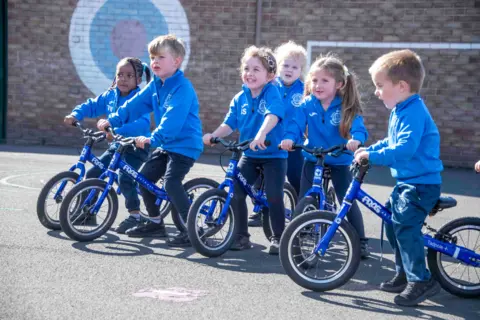
He reels off the benefits: PE lessons are 20 minutes longer now since pupils don't need to get changed, they don't have to worry about bringing their sports kit, the uniform is quick drying and doesn't need ironing, and pupils are more active in the playground.
Many staff members at the school even opt to wear the active uniforms, too, he says.
Some schools say less formal uniforms particularly benefit girls.
Girls at Broadbent Fold Primary School in Cheshire had wanted a change in uniform so they could be more active, head teacher Catherine Parker tells BBC News. Since introducing the new uniform, girls play more during break time, she says.
Rachel's daughter is in year seven at a secondary school in Cheshire where pupils wear polo shirts with a choice of sweatshirt, jumper or fleece.
"It's really practical, it looks really smart," Rachel says.
Duncan's daughter's new SEND school doesn't have a uniform.
"She's allowed to wear what she wants and she's comfortable in because there is an understanding there that it makes a big difference to her ability to engage," she says.
