Lost nuclear bunker rediscovered in castle grounds

 Oli Constable/BBC
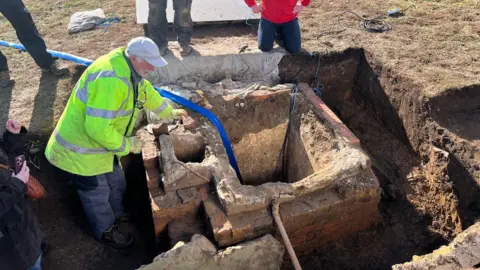
A Cold War nuclear bunker has been rediscovered after lying almost forgotten in the grounds of a castle in North Yorkshire for well over half a century.
The subterranean monitoring post at Scarborough Castle, dating back to the mid-20th Century, would have been staffed by volunteers from the Royal Observer Corps (ROC) if a nuclear war looked like becoming a reality.
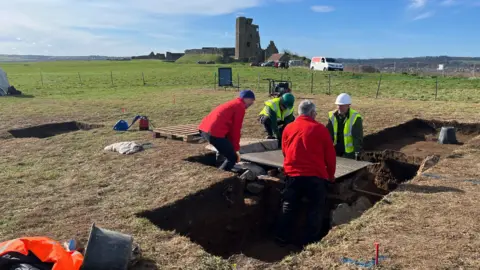
The bunker was closed and sealed in 1968 and was assumed lost until an archaeological dig by English Heritage successfully pinpointed its location in the castle's grounds.
Tim Kitching, a former ROC volunteer in Yorkshire, said: "It's fascinating seeing it being unearthed. It's a part of history."
In total, about 1,500 such underground observation posts were built, dotted around the whole of the country during the height of the Cold War, which saw heightened tensions between Nato countries, including the UK, and the Soviet Union.
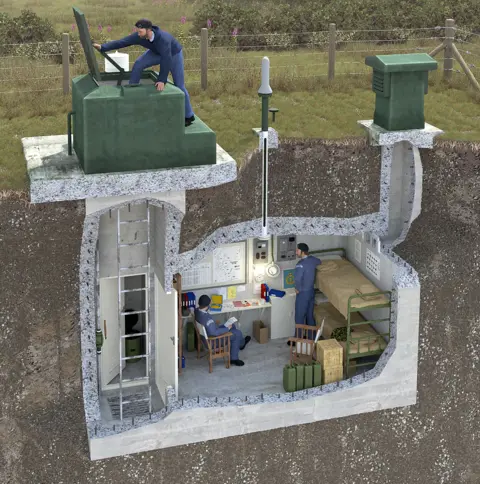
The bunkers would each have protected three ROC volunteers who would have helped map where Soviet nuclear bombs had exploded, with rations for the occupants expected to last about two weeks.
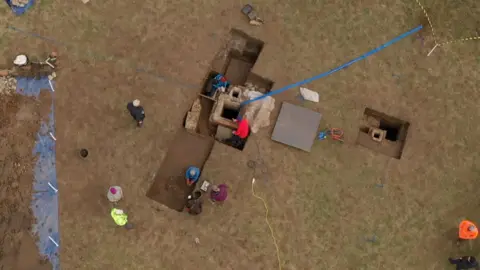
The exact location of the ROC post in Scarborough had been a mystery since its closure, with websites pointing to it being buried somewhere between the castle and the North Sea.
Kevin Booth, head curator of collections at English Heritage, said its rediscovery had proved a scintillating prospect.
"We wanted to pinpoint it and see if we could reopen it and see what was inside," he said.
"Old mapping gives a sense of where it might be, but it really comes down to survey, looking under the ground with radar to find the big black blob that is a concrete structure."
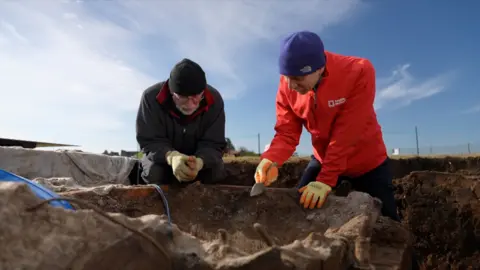
When the archaeologists chipped away at the grass and soil from around the bunker's ventilation shaft and entrance, a sense of just how small it would have been became clear.
Other similar ROC bunkers measured about 15ft 6in (4.7m) in length and 7ft 6in (2.3m) in width, and were just high enough to stand up in.
"Probably 'cosy' would be a diplomatic statement," Kitching said.
As an ROC volunteer, he trained at a post in West Yorkshire, with his exact volunteering role remaining confidential at the time as he had to sign the Official Secrets Act.
"The entrance shaft is a very tight space, you were 15ft down that ladder," he remembered.
"You didn't need the hatch to be closed to feel isolated when you closed the door on the monitoring room."
Inside the bunker would have been a bomb indicator that would measure pressure waves in the event of explosions.
Meanwhile, a pinhole camera would have been fitted on the top of the bunker which would have recorded the blasts.
Using those readings, the volunteers underground in Scarborough would ring in that information to another bunker, at 20 Group Headquarters in York.
That bunker - much larger than those dotted around the countryside - remains to this day and is now a tourist attraction.
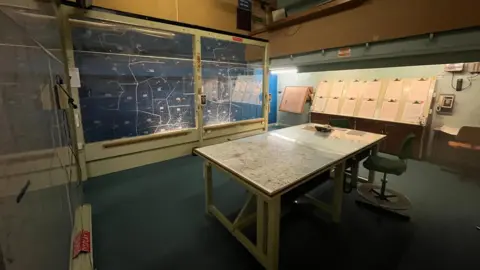
Nestled in the middle of a housing estate, it would have been home to the operations room, to which volunteers in about 70 monitoring posts would send their reports in the event of war.
In the subterranean York HQ, about 60 ROC volunteers would map where the nuclear explosions had taken place, how powerful they were and the impact on towns from after-effects such as fallout.
Kitching said: "When you work out most of the members of a post would be local, they would know how what was happening would be affecting their families.
"The job that we had to do would tell us immediately if our families were still alive or in danger."
The ROC post in Scarborough only operated for a few years, being capped with concrete in 1968 as the nuclear threat at the time slowly reduced.
"A lot of these places are closed without the chairs being removed, without the notice on the wall being removed," Booth said.
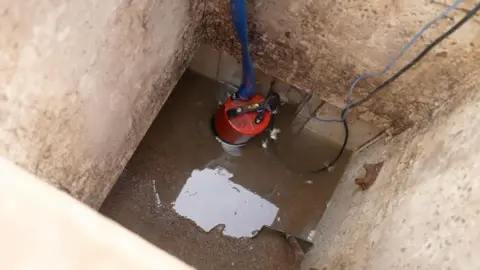
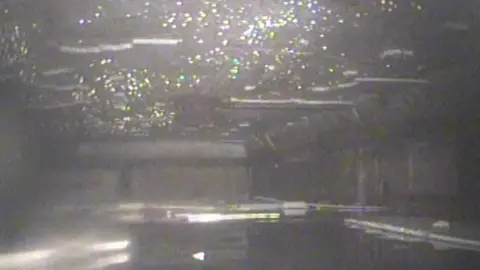
A camera placed inside the bunker has revealed about 6ft (2m) of water in the bunker, perhaps not a huge surprise considering its location high on the headland.
With money from the National Lottery Heritage Fund, a grainy black and white photo taken inside shows floating white tiles, thought to have been used as soundproofing.
 English Heritage/Star Geomatics
 Bob Marshall
Booth said that while the water had clearly filled the bunker site for some time, it was hoped it could eventually be emptied and, when safe, people could take a step into the post for the first time in decades.
"We're getting inklings of some interesting survival down there," he said.
"The wooden door that I'm looking down this shaft at, it's solid, you can tap on it despite it being flooded for 60 years.
"We're finding a physical connection with the memories of the ROC, who tell me about these spaces, who tell me that they're cold, who tell me they used to get fish and chips in instead of eating the rations."
 Oli Constable/BBC
Booth said that despite its waterlogged state, rediscovering the bunker meant historians had been able to connect this point with the group control in York.
"For English Heritage, it's not only completing the story of Scarborough Castle, we're completing the story of the Cold War and the way Britain was trying to deal with that threat," he said.
"There's something about this long history of people being on this headland, looking out, observing, watching - and this is the final part of Scarborough Castle's history of that endeavour."
Listen to highlights from North Yorkshire on BBC Sounds, catch up with the latest episode of Look North.
