Ambulance delays contributed to asthma death

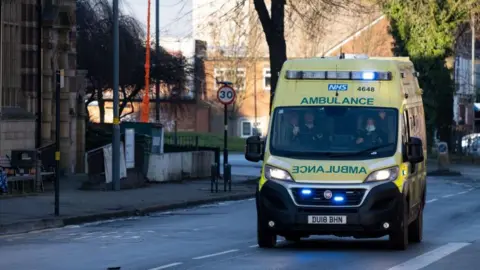 Getty Images/Mike Kemp
A 22-year-old who died following an asthma attack could have survived if he had received medical attention more quickly, an inquest has concluded.
Based on answers given to an ambulance call handler, Roman Barr from Coventry was assessed as a category two emergency and was told he could have to wait several hours for an ambulance.
The inquest heard his family drove him to hospital, but he died shortly after arrival.
Coventry coroner Linda Lee concluded ambulance delays and confusion over questions asked by the call handler contributed to his death.
The inquest heard Barr's father had called West Midlands Ambulance Service.
In her prevention of future deaths report, the coroner said it appeared the questions asked by the call handler were not fully understood by his father.
As a result, she said he was classed as a category two emergency, when clearer wording could have obtained further information which would have led to him being classified as a more urgent category one.
She raised concerns over the scripted questions given to the call handler and said "such scripts may not always use wording that is easily understood by lay callers in distress".
Her report also noted there had been "significant delays in hospital handovers" and "prolonged ambulance handover times at local hospitals were a significant factor".
'Information not obtained'
Barr's family chose to drive him to hospital and on the way they were involved in a serious collision, which resulted in serious injuries to his mother.
The report said families transporting sick relatives to hospital was also a concern that should be looked at.
Finally, the coroner said there was evidence Barr used his inhaler "more frequently than recommended, indicating poor asthma control".
She said it appeared "neither he nor his family were aware of the clinical significance of this increased use".
In this case, she said his GP practice subsequently carried out a review and introduced measures to better identify and monitor patients' inhaler-use.
But in her report, she said: "Evidence showed that excessive or repeated requests for salbutamol inhalers may not be reliably identified within existing systems."
Following the conclusion of the inquest on 3 March, she sent copies of her report to a number of bodies, including NHS England, the Care Quality Commission, the Royal College of GPs and the secretary of state for health and social care.
In her narrative verdict she said: "Information indicating the need for an urgent ambulance response was not obtained, and because no ambulance was available for several hours, he was taken to hospital by his family.
"On the balance of probabilities, earlier intervention by an emergency ambulance would have prevented his death."
Follow BBC Coventry & Warwickshire on BBC Sounds, Facebook, X and Instagram.
